
Trew Landscape Blog
Christmas Light Installation Cost: Per-Foot Guide for 2025–2026
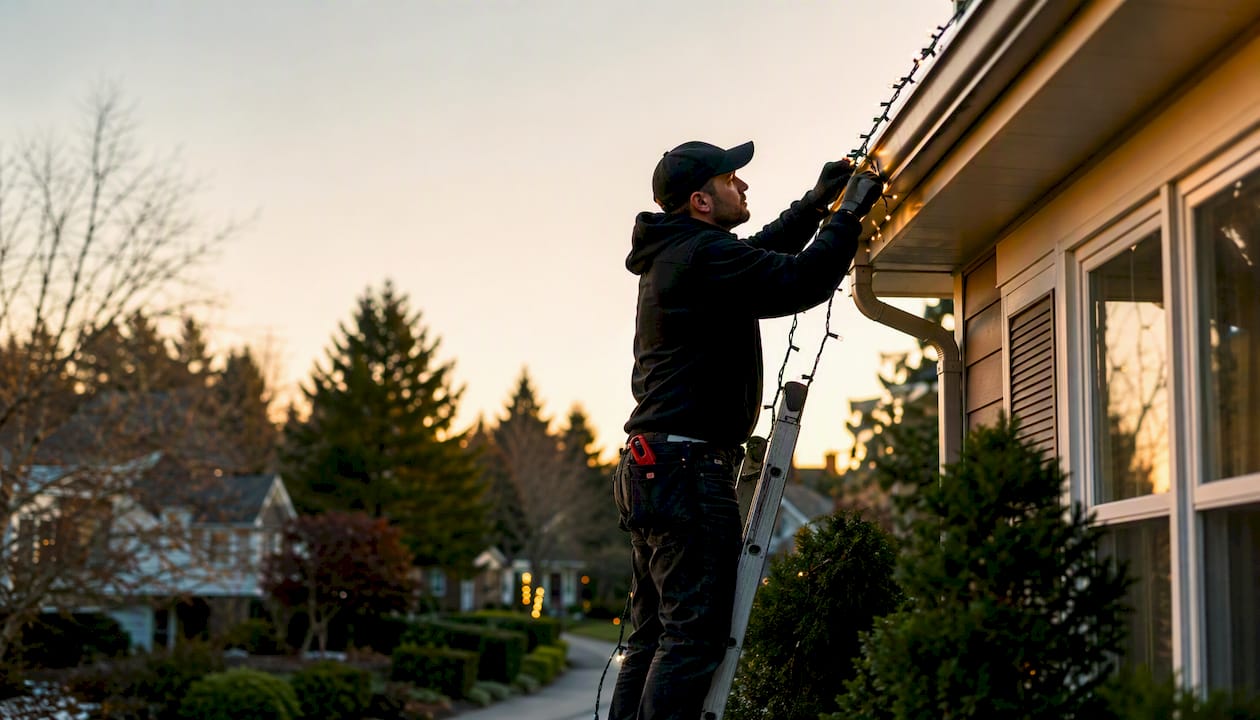
Christmas Light Installation Cost: Per-Foot Guide for 2025–2026 ! Installer hanging Christmas lights on roofline Hiring a pro to install Christmas lights typically costs within a range commonly observed for standard residential displays, with the national average near the midpoint according to Angi's 2025–2026 data.
Christmas Light Installation Cost: Per-Foot Guide for 2025–2026
Hiring a pro to install Christmas lights typically costs within a range commonly observed for standard residential displays, with the national average near the midpoint according to Angi’s 2025–2026 data. Two shortcuts make budgeting fast: use $2–$5 per linear foot for labor-only quotes, or $5–$10 per linear foot when the installer supplies and hangs the lights. HomeAdvisor’s 2025 figures put the per-foot range at $2.50–$7 depending on scope, which lands in the same band.
Quick budget shortcut: multiply your roofline footage by $3.50 (labor-only) or $7 (all-in) to get a rough midpoint estimate.
For a 120-linear-foot roofline:
- Labor-only: 120 ft × $3.50 = $420
- All-in (lights included): 120 ft × $7 = $840
Those numbers assume a single-story home with a straightforward roofline. Add trees, a steep pitch, or a second story and the total climbs. Trew Landscape LLC handles both labor-only and full-service installs in Kansas City, so you can price either way.
Key Takeaways
Professional Christmas light installation costs $220–$684 for most U.S. residential jobs, with a national average of $442; use $2–$5/ft for labor-only or $5–$10/ft for an all-in package to build a fast budget.
| Point | Details |
|---|---|
| National average cost | Most jobs run $220–$684; the national average is $442 for a standard residential install. |
| Per-foot shortcuts | Use $2–$5/ft for labor-only or $5–$10/ft when lights are included to estimate any job quickly. |
| Book in September | Installers fill their fall calendars fast; early booking secures better availability and more transparent pricing. |
| Ask three questions | Request itemized quotes confirming what’s included for takedown, storage, and insurance before signing. |
| Trew Landscape LLC | Offers free estimates and full-service or labor-only Christmas light installation across the Kansas City metro. |
Table of Contents
- How much does Christmas light installation cost by pricing tier?
- What factors raise or lower your installation quote?
- How does your location affect the price?
- What does a quote usually include, and what surprises homeowners?
- How do you get an accurate estimate and compare quotes?
- Are permanent LED roofline systems worth the upfront cost?
- How Trew Landscape LLC prices Christmas light installation in Kansas City
- What does mid-season maintenance or repair cost?
- The real reason most homeowners overpay for Christmas lights
- Trew Landscape LLC’s Christmas light installation services in Kansas City
- Sources
- FAQ
How much does Christmas light installation cost by pricing tier?
Professional installers generally quote one of four pricing models. Knowing which one you’re looking at makes it much easier to compare bids side by side.
ThePricer’s breakdown confirms these tiers and notes that permanent systems commonly run $3,000–$6,000 for a typical home. Full professional packages covering materials, installation, takedown, and storage can push residential jobs into the $1,500–$4,000 range, with large or custom displays exceeding $5,000, per Christmas Lights HQ.
A few things shift first-year cost versus subsequent years:
- Year one with a rental package: you pay the full per-foot rate but avoid buying lights outright.
- Year one buying your own lights: higher upfront spend, but labor-only quotes drop significantly in future seasons since you already own the materials.
- Permanent systems: high capital cost in year one, but annual operating costs drop to near zero once installed.
What factors raise or lower your installation quote?
Two homes with identical roofline footage can produce quotes that differ by hundreds of dollars. These are the specific drivers installers price into every bid.
Property features that affect labor time:
- Linear footage of roofline, gutters, fascia, and any wrapped columns or railings
- Number of stories (two-story homes require ladders or lifts, adding time and risk)
- Roof pitch — steep pitches slow every step and may require safety harnesses
- Roof complexity: dormers, multiple peaks, valleys, and irregular shapes all add time
- Gutter type (K-style gutters clip faster than round gutters or exposed fascia)
- Multi-building properties (detached garages, outbuildings, fences)
Installation complexity drivers:
- Number of trees or hedges to wrap (each mature tree can add 30–60 minutes of labor)
- Ground-level landscaping versus elevated planters or retaining walls
- Need for a bucket truck or lift on very tall or steep structures
- Electrical capacity — if your outdoor outlets can’t handle the load, an electrician visit runs $50–$100 per hour before the installer even starts
- Weather delays or mid-season service calls
Pro Tip: Before requesting quotes, photograph your roofline from the street, count your outdoor outlets, and measure your linear footage with a tape measure or a free app like Google Earth’s ruler tool. Installers who receive this information upfront tend to quote more accurately and with fewer change orders.
Homeowner checklist before requesting quotes:
- Measure total linear footage of roofline, gutters, and any other areas you want lit.
- Count the number of trees or shrubs you want wrapped.
- Note the number of stories and whether any sections require a ladder above 12 feet.
- Photograph the front and sides of the home from the street.
- Locate your outdoor GFCI outlets and note how many circuits are available.
How does your location affect the price?
Geography shifts the per-foot math more than most homeowners expect. Urban markets with higher labor costs and denser seasonal demand routinely run above the national average, while rural Midwest and Southern markets often come in below it.
General regional patterns:
- Northeast and West Coast metros (Boston, New York, Seattle, San Francisco): expect to pay 15–40% above the national average. Labor rates are higher, and seasonal demand concentrates in a short window, which pushes prices up.
- Midwest and South (Kansas City, St. Louis, Nashville, Charlotte): pricing tends to track close to or slightly below the national average of $442. Competition among local installers keeps rates more predictable.
- Rural markets: per-foot rates may dip below $2 for labor-only, but travel fees can offset savings on small jobs.
A job that costs $600 at the national midpoint might realistically run $720–$780 in Boston or Seattle. Angi notes that geographic location and property design are the primary drivers of cost variation, with urban markets requiring more equipment and time on complex rooflines.
What does a quote usually include, and what surprises homeowners?
A standard professional quote covers installation labor, basic mounting clips, and sometimes a single takedown visit at the end of the season. What it often leaves out is where homeowners get caught off guard.
Typical inclusions:
- Installation labor (per linear foot or flat rate)
- Basic clips and mounting hardware
- One takedown visit (confirm this — not all quotes include it)
Common exclusions that become line items:
- Standalone removal: $100–$400 depending on scope, if not bundled
- Storage of lights between seasons: $50–$150 per season
- Electrician fees: $50–$100 per hour if outlets need upgrading or a new circuit is required
- Replacement bulbs or mid-season repairs: usually billed separately at an hourly rate
- Lift or bucket truck rental: added on large or steep properties
Family Handyman flags that many installers maintain minimum fees and that licensing and insurance vary widely — two details worth confirming before you sign anything.
Always ask for an itemized quote that separates labor, materials, takedown, and storage. A single lump-sum number makes it impossible to compare bids fairly or know what you’re actually paying for.
How do you get an accurate estimate and compare quotes?
Getting three comparable bids takes about 20 minutes of prep work. Here’s the workflow that produces the most useful quotes.
- Measure your footage. Walk the perimeter of every area you want lit and record linear feet. Include roofline, gutters, porch railings, columns, and any trees.
- List your trees and shrubs. Note height and approximate canopy diameter for each one you want wrapped.
- Send a photo package. Front-of-home photo, side views, and a close-up of your outlet locations.
- Request an itemized bid. Ask each installer to break out labor, materials (or rental), takedown, and storage separately.
- Confirm insurance. Ask for proof of general liability and workers’ comp before anyone gets on your roof.
Sample calculation for a realistic job:
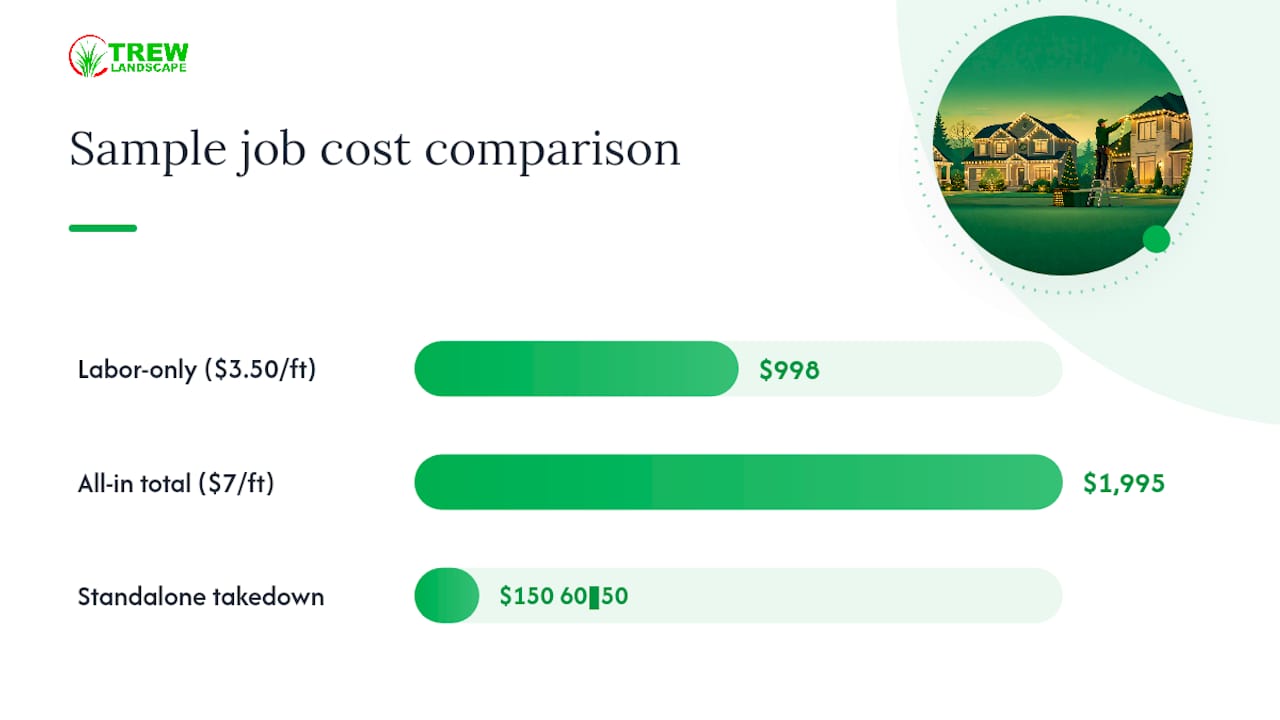
- 150 ft of roofline + 3 medium tree wraps (estimated 45 ft of lights each = 135 ft)
- Total estimated footage: 285 ft
- Labor-only at $3.50/ft: $998
- All-in at $7/ft: $1,995
- Add standalone takedown if not included: $150–$250.
Red flags in quotes:
- Very low per-foot rate with no mention of takedown
- No clarity on who owns the lights after the season
- No proof of insurance when asked
- No written contract or scope of work
Service Autopilot recommends booking in early fall. Installers’ calendars fill fast once October arrives, and last-minute bookings in November often come with premium pricing or limited availability.
Are permanent LED roofline systems worth the upfront cost?
Permanent systems install once and stay in place year-round, controlled by an app and activated each season without a crew returning. The tradeoff is a significant upfront investment.
Typical costs:
- Upfront installed cost: $3,000–$6,000 for most residential rooflines
- Per-foot installed: roughly $20–$35 depending on system and complexity
- Expected lifespan: 10+ years with minimal maintenance
Pros:
- No annual installation or takedown fees
- App-controlled color and scheduling
- Works for holidays beyond Christmas (Fourth of July, Halloween, etc.)
Cons:
- High capital cost concentrated in year one
- Less flexibility to change display style or coverage area
- Requires professional wiring; not a DIY project
Break-even example: A $3,500 permanent system versus annual professional installs at $500–$700 per season breaks even in roughly 5–7 seasons. If you’re spending $600 a year on a full-service install, you recover the permanent system cost in about six years — and every season after that is essentially free. ThePricer notes that permanent systems often break even in 6–10 seasons depending on annual install totals.
How Trew Landscape LLC prices Christmas light installation in Kansas City
Trew Landscape LLC offers both labor-only and full-service Christmas light installation for residential and commercial properties in the Kansas City area. Pricing follows the same per-foot structure described throughout this article, with quotes itemized so you can see exactly what you’re paying for before signing.
What a typical Trew Landscape LLC package includes:
- On-site measurement and design consultation
- Professional installation using quality clips and hardware
- Optional full-service packages with lights supplied
- Takedown at season end (confirm availability when booking)
- Optional storage between seasons
- Coordination with licensed electricians when outlets or circuits need upgrading
Free estimates are available — request yours here before the fall booking window fills. Trew Landscape LLC serves the Kansas City metro area on a seasonal schedule, so availability is limited once October arrives.
Pro Tip: Bundling installation, takedown, and storage into a single package quote almost always costs less than booking each service separately and eliminates the coordination headache of managing multiple visits.
For homeowners also considering year-round landscape lighting upgrades, Trew Landscape LLC can assess whether your existing electrical setup supports both permanent fixtures and seasonal displays in the same visit.
What does mid-season maintenance or repair cost?
Most professional installs run without issues, but bulbs burn out, strands trip circuits, and wind occasionally pulls clips loose. Here’s what to expect if something goes wrong after the crew leaves.
Common mid-season issues and typical costs:
- Bulb replacement: often free or included during the display period if the installer supplies the lights; billed at cost if you own them
- Strand replacement: $20–$80 per strand for materials, plus a service call fee
- Service call / troubleshooting visit: $50–$150 flat fee depending on the company
- Re-securing clips or sections after wind damage: usually $50–$100 for a short visit
If you’re on a full-service rental package, mid-season repairs are frequently included because the installer owns the lights and has an incentive to keep them working. Labor-only customers typically pay for any service call after installation is complete. Ask about this policy before you book — it’s a meaningful difference between packages that look similar on paper.
The real reason most homeowners overpay for Christmas lights
Most homeowners get one quote, accept it, and assume the price is what it is. That’s the single most expensive mistake in this category.
The per-foot pricing model is actually quite transparent once you understand the tiers. A $900 quote for 150 feet of roofline works out to $6 per foot, which sits squarely in the install-plus-lights band. That’s fair. But the same $900 for a labor-only install on a single-story ranch is $6 per foot for a job that should cost $3–$4 per foot — and that gap is real money.
The other thing most articles won’t say plainly: the best time to negotiate is September, not November. Installers booking in September have open calendars and more flexibility on price. By the first week of November, they’re turning away jobs. Booking early isn’t just about availability — it’s the closest thing to a discount this industry offers. Service Autopilot’s guidance makes this point directly: seasonal capacity and pricing transparency change substantially as demand peaks in late autumn.
One more thing worth saying: the cheapest quote is rarely the best value. An uninsured installer who falls off your roof becomes your liability. Confirm insurance every time, even if it feels awkward to ask.
Trew Landscape LLC’s Christmas light installation services in Kansas City
Trew Landscape LLC’s Christmas light installation service gives Kansas City homeowners a straightforward path from quote to lit display, without the guesswork of managing materials, timing, or takedown logistics on their own. Packages range from labor-only (you supply the lights) to full-service installs where Trew Landscape LLC handles everything, including design, installation, takedown, and optional storage.

Scheduling fills quickly once fall arrives, so the best time to lock in your slot is September or early October. Request a free estimate now, and a Trew Landscape LLC team member will walk through your property’s footage, discuss package options, and give you an itemized quote with no obligation. For homeowners planning broader exterior upgrades, Trew Landscape LLC’s full services overview covers everything from hardscaping to permanent landscape lighting.
Sources
The figures in this article reflect a 2025–2026 national snapshot. These sources provide the underlying data and methodology:
- How Much Does Professional Christmas Light Installation Cost? 2026 Data | Angi
- How to Bid Christmas Light Installation | Service Autopilot
- How Much Does Christmas Light Installation Cost?
- How Much Do Professionally Installed Christmas Lights Cost? 2025 Data
- How Much Does Christmas Light Installation Cost? | Family Handyman
- How Much Does Christmas Light Installation Cost? Real Pricing Breakdown | Christmas Lights HQ
FAQ
How much do people usually charge to put up Christmas lights?
Most professional installers charge $220–$684 for a standard residential display, with a national average around $442. Per-foot rates run $2–$5 for labor-only or $5–$10 when the installer supplies the lights.
How much does it cost to install 200 ft of Christmas lights?
At labor-only rates ($3.50/ft midpoint), a length runs roughly the per-foot rate multiplied accordingly. An all-in package at $7/ft brings the total higher, before any add-ons like takedown or storage.
Can you pay someone to put Christmas lights up?
Yes. Professional installers, landscaping companies like Trew Landscape LLC, and gig-platform workers all offer installation services ranging from labor-only to full-service packages that include lights, installation, and takedown.
How much do people get paid to install Christmas lights?
Installers typically earn based on per-foot production rates or hourly wages. Handyperson-style installers often work at rates comparable to general labor, while specialized seasonal crews at professional companies operate on per-foot pricing that reflects their speed and equipment.