
Trew Landscape Blog
Rock vs Mulch Landscaping: Which Is Best for Your Yard?
Rock vs Mulch Landscaping: Which Is Best for Your Yard? !
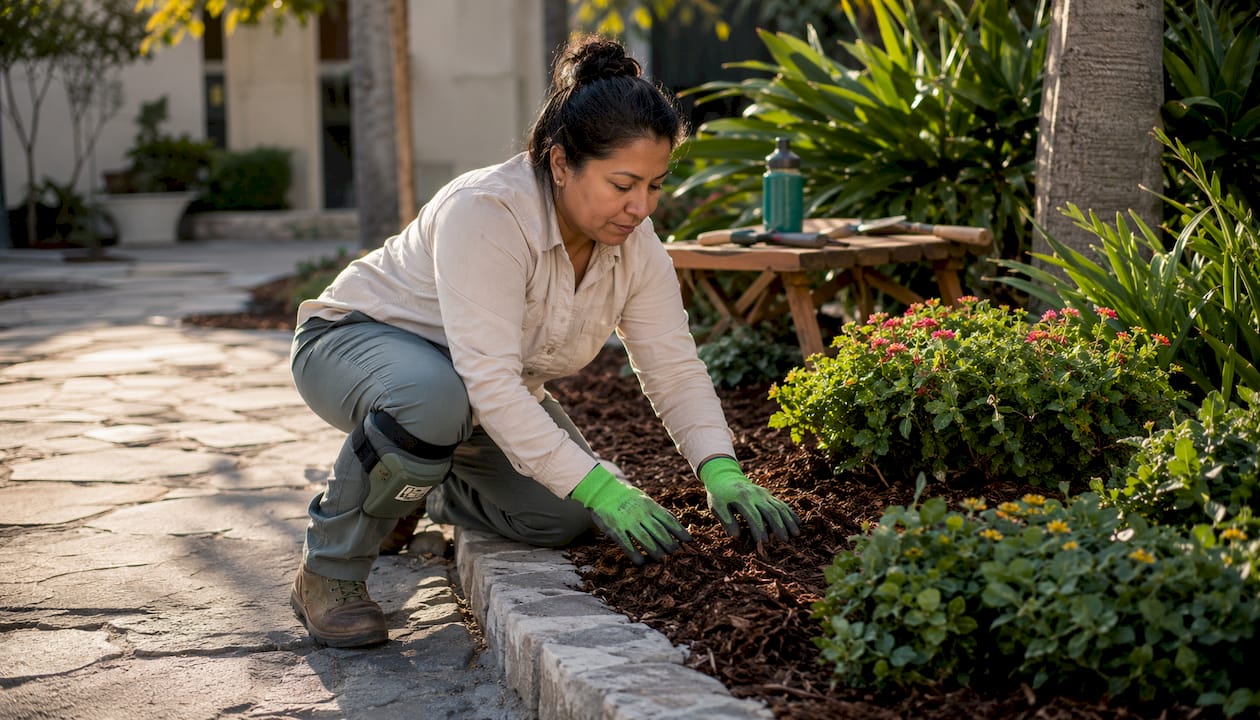
Rock vs Mulch Landscaping: Which Is Best for Your Yard?
TL;DR:
- Organic mulch is ideal for planting beds because it retains moisture and improves soil health, while rock is better for drainage, slopes, and foundation perimeters due to its permanence. Using both materials in different yard zones maximizes benefits, with mulch supporting plant growth and rock managing erosion and water flow. Proper installation, including grading and edging, is essential for long-term success, and professional services can ensure optimal results.
For most North Kansas City homeowners with active garden beds and established plants, organic mulch is the better starting point. Rock earns its place in specific situations: drainage zones, slopes, pathways, and low-water architectural beds. The smartest yards often use both.
Choose organic mulch when:
- You have flower beds, shrubs, or trees that need moisture retention and soil-building
- You want to moderate soil temperature through Kansas City’s hot summers and cold winters
- You plan to change your planting layout within the next few years
Choose rock when:
- You need erosion control on a slope or improved drainage near a downspout
- You want a permanent, low-replacement ground cover for a dry or architectural bed
- You’re working around a foundation where moisture retention could cause problems
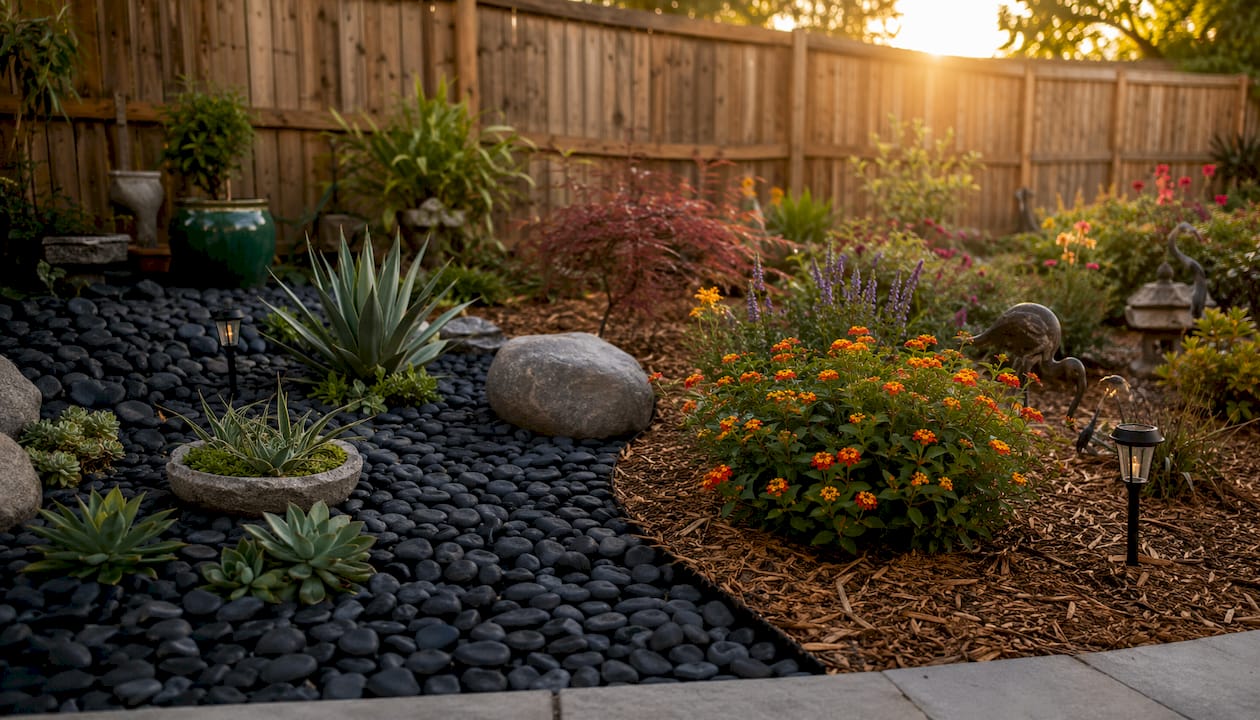
Use both when: planted areas need mulch for plant health while adjacent paths, drainage channels, or accent zones benefit from stone’s permanence.
If you’d rather skip the guesswork, Trew Landscape LLC handles material selection, site prep, and installation for homeowners across the Kansas City area.
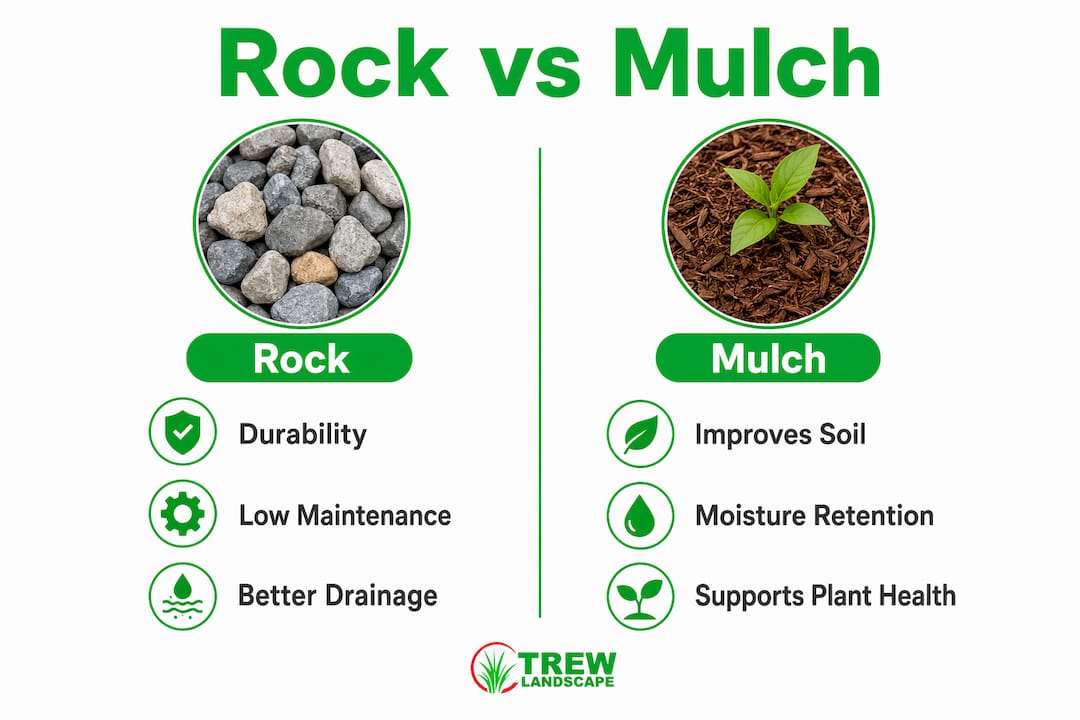
Table of Contents
- What you need to know about mulch: types, benefits, and real trade-offs
- Rock mulch: what it does well and where it falls short
- Head-to-head: which material fits your yard scenario?
- Installation essentials and common mistakes to avoid
- Costs and maintenance: what to budget over time
- How rock and mulch affect your yard’s microclimate
- When should you hire a pro for ground cover installation?
- How Trew Landscape installs mulch or rock: the professional sequence
- Final recommendation and next steps
- Key Takeaways
- A Kansas City landscaper’s perspective
- Trew Landscape LLC can handle the whole project
- FAQ
What you need to know about mulch: types, benefits, and real trade-offs
Organic mulch retains soil moisture, moderates temperature, and feeds your soil as it breaks down. Those three functions together are hard to replicate with any inorganic material.
Common types and their best uses:
- Shredded hardwood bark — the workhorse for most beds; breaks down slowly, stays in place
- Wood chips — excellent around trees and shrubs; coarser texture, longer lifespan
- Pine needles — good for acid-loving plants like azaleas; lightweight and attractive
- Compost-based mulch — fastest to improve soil structure; needs more frequent replenishment
Primary benefits:
- Reduces soil moisture loss, cutting irrigation frequency
- Buffers soil temperature swings, which matters in Kansas City’s climate
- Adds organic matter as it decomposes, improving long-term soil health
- Suppresses weeds when applied at the correct depth of 2–3 inches
Downsides to plan for:
- Breaks down and needs replenishment annually or every two years
- Can harbor pests or fungal issues if piled too deep against plant stems
- Dry mulch near a structure carries a fire risk — keep it 18 inches from wood siding
- Cost recurs: you pay every replenishment cycle
| Factor | Organic Mulch |
|---|---|
| Recommended depth | 2–3 inches |
| Replenishment cycle | Annual to biennial |
| Weed suppression | Good at correct depth |
| Soil health impact | Positive (adds organic matter) |
Mulch covers a typical range of square footage per cubic yard at a 2–3 inch depth — a useful number when estimating how many yards to order for a bed.
Rock mulch: what it does well and where it falls short
Stone is permanent in a way organic mulch never is. That permanence is both its biggest advantage and its most significant liability.
Common rock types:
- River rock — smooth, rounded; 1–3 inch diameter; popular for drainage beds and accent areas
- Pea gravel — small, rounded; excellent for pathways and improving water infiltration
- Crushed stone — angular; locks together well for slopes and edging transitions
- Decomposed granite — fine-textured; compacts into a firm surface; good for dry-style beds
Benefits:
- Lasts indefinitely with no routine replacement
- Controls erosion on slopes when properly installed
- Drains quickly after rain, reducing standing water
- Pairs well with drought-tolerant and native plantings
Downsides:
- Rock raises soil temperature more than organic mulch, which stresses moisture-sensitive plants in summer
- Debris (leaves, seeds) collects between stones and is difficult to remove
- Limestone-based gravels can raise soil pH, harming acid-loving plants like rhododendrons
- Once rock mixes into topsoil, removal requires significant labor — sometimes mechanical excavation
- Higher upfront cost than mulch
| Factor | Rock / Stone Mulch |
|---|---|
| Recommended depth | 2–4 inches |
| Replacement cycle | Rarely (decades) |
| Weed suppression | Moderate (debris accumulates) |
| Soil health impact | Neutral to negative over time |
Research has found that mineral mulches can record higher soil temperatures and lower moisture percentages than organic mulches — a meaningful difference for plants that need consistent soil moisture through summer.
Head-to-head: which material fits your yard scenario?
Horticultural experts agree there is no universal winner. The right call depends on what you’re planting, where water flows, and how much ongoing work you want.
| Scenario | Best Material | Key Reason |
|---|---|---|
| Perennial flower beds | Organic mulch | Moisture retention, soil-building |
| Tree and shrub root zones | Organic mulch | Avoids heat stress, feeds roots |
| Slopes and erosion control | Crushed stone or river rock | Stays in place, drains fast |
| Foundation perimeter | Rock (dry-laid) | Keeps moisture away from structure |
| Pathways | Pea gravel or decomposed granite | Firm surface, good drainage |
| Dry/xeric accent beds | Decomposed granite or river rock | Suits drought-tolerant plants |
| Mixed design (planted + structural) | Both | Mulch in beds, rock in borders |
Scenario notes:
- Next to your house: Rock is generally safer near foundations because it doesn’t hold moisture against the structure. Keep any mulch at least 6 inches from siding.
- Slopes: Crushed angular stone locks together better than smooth river rock, which can roll. Pair with proper edging or a retaining wall for steeper grades.
- Mixed approach: Rock along a drainage swale with mulch in adjacent planted beds is a common and effective combination in Kansas City yards.
Installation essentials and common mistakes to avoid
Getting the material right matters less than getting the installation right. Most ground cover failures trace back to prep errors, not material choice.
Step-by-step bed preparation:
- Clear existing vegetation, weeds, and old mulch down to bare soil.
- Grade the bed so water drains away from structures and plant root zones.
- Install solid edging (steel, aluminum, or concrete) to contain material and define the bed.
- Check and protect root flares — never bury the base of a tree or shrub trunk.
- For rock beds: lay a pre-emergent herbicide treatment rather than landscape fabric when possible.
- Apply material at the correct depth: 2–3 inches for organic mulch and 2–4 inches for rock.
- Keep material pulled back from plant stems and tree trunks by 2–3 inches.
Pro Tip: Skip landscape fabric under rock. It suppresses weeds for a season or two, but organic debris accumulates on top of the fabric over time, creating a weed-growing medium that’s nearly impossible to remove without pulling the entire rock bed.
Pro Tip: For mulch, more is not better. Piling mulch deeply against a trunk creates “mulch volcanoes” that rot bark and invite disease. Keep mulch at 2–3 inches deep, pulled back from the stem, for best results.
Costs and maintenance: what to budget over time
Mulch costs less upfront but costs more over time. Rock costs more upfront but requires infrequent replacement.
| Cost Factor | Organic Mulch | Rock / Stone |
|---|---|---|
| Replenishment frequency | Every 1–2 years | Rarely |
| Weed control effort | Moderate (annual) | Moderate (debris removal) |
| Renovation cost | Low | High (removal is labor-intensive) |
Ongoing maintenance tasks:
- Mulch: Rake and fluff annually; top up to restore 2–3 inch depth; check for pest activity near structures
- Rock: Blow or rake out leaf debris seasonally; spot-treat weeds; check edging integrity after freeze-thaw cycles
Over a five-year window, a mulched bed typically costs more in cumulative material than a rock bed of the same size. The math flips if you ever want to redesign: removing established rock from a bed can cost more than the original installation.
How rock and mulch affect your yard’s microclimate
Ground cover choice changes more than aesthetics. It changes how hot your soil gets, how fast water moves, and how much heat your home absorbs.
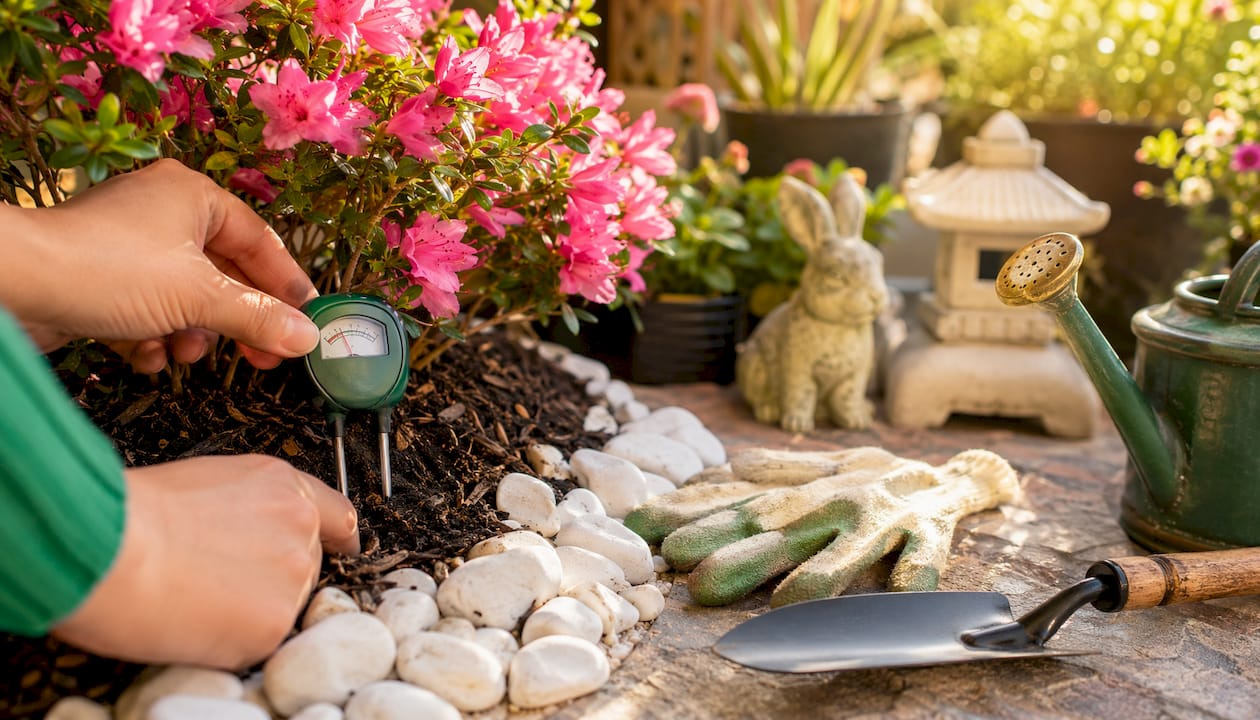
Research on building wall heat loads shows that xeric (rock and gravel) landscapes transfer noticeably more heat to nearby structures than grass or planted landscapes during the hot season. For Kansas City homeowners with south- or west-facing beds, that’s worth factoring in.
Key microclimate effects:
- Organic mulch keeps soil cooler in summer and warmer in winter, buffering plant roots from temperature extremes
- Rock absorbs solar heat during the day and releases it at night, raising soil temperatures and potentially stressing heat-sensitive plants
- Pea gravel improves water infiltration during heavy rain events, reducing runoff
- Limestone-based rock can gradually raise soil pH, making nutrients less available to acid-preferring plants
If you’re planting azaleas, rhododendrons, or blueberries near a rock bed, verify the stone’s composition before installation. Alkaline stone and acid-loving plants are a poor combination.
When should you hire a pro for ground cover installation?
Some jobs are straightforward DIY. Others go sideways fast without the right equipment and experience.
Hire a professional when:
- The bed has drainage problems that need grading before any material goes down
- You’re renovating a bed where old rock has already mixed into the topsoil
- The project involves a slope where erosion control and proper compaction matter
- The bed runs along a foundation where drainage must be engineered correctly
- The area is large enough that material sourcing, delivery, and labor coordination saves real time
What a pro like Trew Landscape LLC handles:
- Site assessment and grading to ensure proper drainage
- Edging installation with the right material for the application
- Accurate depth control across the entire bed
- Material sourcing from reputable local suppliers
- Cleanup and final inspection
Trust signals to look for in any contractor:
- Licensed and insured in Missouri
- Provides a written scope of work before any deposit
- Offers references from local projects
- Gives a free estimate with no pressure to sign immediately
How Trew Landscape installs mulch or rock: the professional sequence
Here’s what a professional installation looks like from start to finish, so you know what to expect and what to ask about when comparing quotes.
- Site assessment — evaluate drainage patterns, existing plant health, soil condition, and proximity to structures
- Grading and drainage prep — correct any low spots or drainage issues before material goes down; proper grading protects the installation long-term
- Edging installation — set steel or aluminum edging to defined bed boundaries and contain material
- Root flare check — confirm no existing plants will be buried by the new material depth
- Material application — apply organic mulch at 2–3 inches deep and rock at 2–4 inches deep across the entire bed
- Compaction (rock only) — lightly compact crushed stone or decomposed granite for stability on paths and slopes
- Final cleanup and inspection — remove excess material from lawn and hardscape; walk the site with the homeowner
Trew Landscape LLC serves residential and commercial properties across the Kansas City area, including North Kansas City, with landscape design, drainage, hardscaping, and ground cover installation.
Final recommendation and next steps
Mulch is the right default for most planted beds. Rock earns its place in drainage zones, slopes, pathways, and foundation perimeters. The best yards use both deliberately.
Your next steps:
- Walk your yard and identify each area by use: planted bed, drainage zone, path, or foundation perimeter
- Match the material to the function using the scenario table above
- Check your soil drainage before ordering anything — a bed that holds water needs grading first
- For mulch beds: measure square footage, then divide according to coverage guidelines to estimate cubic yards needed
- For rock beds: get a material composition confirmation from your supplier before installing near pH-sensitive plants
- Contact Trew Landscape LLC for a free estimate if the project involves grading, drainage, or a full bed renovation
Key Takeaways
Mulch supports plant health and soil quality; rock offers durability and drainage. Choosing by use-case, not preference, is what separates a yard that thrives from one that just looks good on installation day.
| Point | Details |
|---|---|
| Mulch depth matters | Apply organic mulch at 2–3 inches; deeper can cause root suffocation and bark rot. |
| Rock is a long-term commitment | Once rock mixes into topsoil, removal is labor-intensive and often requires mechanical excavation. |
| Heat effects are real | Rock mulch records higher soil temperatures and lower moisture than organic mulch, stressing heat-sensitive plants. |
| Lifecycle cost differs | Mulch costs less upfront but requires annual replenishment; rock costs more initially but rarely needs replacement. |
| Trew Landscape LLC | Provides free estimates and handles full installation, from grading and drainage to material application, across Kansas City. |
A Kansas City landscaper’s perspective
The question we hear most often in North Kansas City is some version of “can I just put rock down and forget about it?” The honest answer is: sometimes, but not usually. Rock is genuinely low-maintenance in the right application — a dry creek bed, a gravel path, a foundation perimeter. Put it under a Japanese maple in full sun, though, and you’ve created a heat trap that stresses the tree every August. Kansas City summers are brutal enough without adding radiant heat from stone at the root zone.
The other myth worth addressing is that mulch attracts pests. Mulch doesn’t attract termites or rodents on its own — improper installation does. Mulch piled against wood siding or buried against a foundation creates the moisture and harborage conditions pests need. Pull it back 6 inches from any structure, keep it at the right depth, and that concern largely disappears. The material isn’t the problem; the installation is.
Trew Landscape LLC can handle the whole project
Choosing between mulch and rock is the easy part. Getting the grading right, installing edging that actually holds, and sourcing material that suits your specific plants — that’s where most DIY projects run into trouble.
Trew Landscape LLC works with North Kansas City homeowners on everything from single-bed mulch installations to full hardscape and drainage projects that integrate rock, edging, and drainage tile into a cohesive design. The team provides free estimates, a clear written scope before any work begins, and the local experience to know what Kansas City soil and weather actually demand. Request your free estimate at trewlandscape.com/services and get a plan that fits your yard, your plants, and your budget.
FAQ
Is it better to use mulch or rock for landscaping?
Mulch is better for most planted beds because it retains moisture, moderates soil temperature, and improves soil health as it decomposes. Rock is better for drainage zones, slopes, pathways, and foundation perimeters where moisture retention would cause problems.
How much does landscape rock cost compared to mulch?
Organic mulch typically costs a moderate range per volume unit; landscape rock costs more per unit weight. Rock costs more upfront but rarely needs replacement, while mulch requires annual or biennial replenishment.
Is it better to put rocks or mulch next to your house?
Rock tends to be a safer choice next to a foundation since it generally holds less moisture against the structure. If you use mulch near the house, keep it at least 6 inches from any wood siding and maintain the correct 2–3 inch depth.
Do rocks last longer than mulch?
Yes. Rock lasts a very long time with minimal replacement needs, while organic mulch breaks down and requires periodic replenishment. The trade-off is that rock is difficult and costly to remove if you want to redesign the bed later.