
Trew Landscape Blog
Drain Tile Cost for Homeowners: What to Budget
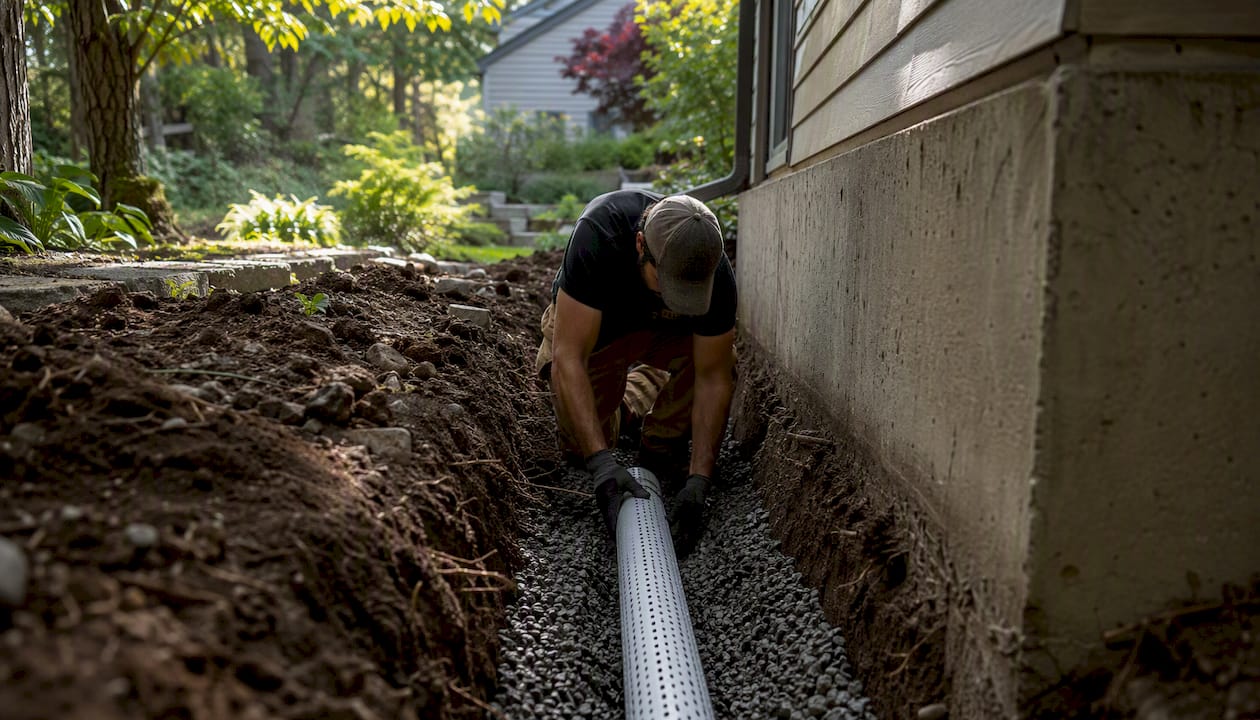
Drain Tile Cost for Homeowners: What to Budget ! Exterior basement drain tile pipe in trench A full-perimeter interior drain tile system typically runs $4,000–$12,000, or roughly $40–$85 per linear foot according to HomeGuide.
Drain Tile Cost for Homeowners: What to Budget
A full-perimeter interior drain tile system typically runs $4,000–$12,000, or roughly $40–$85 per linear foot according to HomeGuide. Exterior systems cost considerably more, typically around $120 per linear foot, with full-system totals often $8,000–$30,000 depending on the perimeter length and restoration needs. Exterior systems cost considerably more because they require deep excavation and landscape restoration. Before you call a contractor, measure your basement perimeter — that single number drives every estimate you’ll receive.
Quick cost snapshot: Interior drain tile averages $40–$85/lf (with calculator-based midpoints near $75/lf); exterior averages around $120/lf. A sump pump adds $500–$1,500 on top of either system.
- Interior perimeter system costs thousands when installed
- Exterior (weeping/footing) system costs significantly more installed
- Per-linear-foot range varies depending on system type
- Sump pump costs extra and are usually required
- Landscape restoration costs vary depending on scope
Table of Contents
- How contractors price drain tile: per-job vs. per-linear-foot
- Sample job estimates by basement perimeter
- Interior vs. exterior drain tile: which one fits your situation?
- How to tell if you actually need drain tile
- What installation looks like and how much disruption to expect
- How to evaluate bids and what to ask every contractor
- Lower-cost options to consider before a full system
- Key Takeaways
- What Trew Landscape LLC actually recommends
- Trew Landscape LLC handles drain tile and full yard restoration in Kansas City
- Useful sources
- FAQ
How contractors price drain tile: per-job vs. per-linear-foot
Most contractors price drain tile by the linear foot, then add fixed line items on top. That structure makes it easy to compare bids once you know what each one includes.
Per-linear-foot pricing covers the trench, perforated pipe, filter fabric, and gravel bed. The PNNL Building America Solution Center describes the correct construction method: perforated pipe wrapped in filter fabric, laid in washed stone on a slightly sloped bed, and discharged to daylight, a drywell, storm sewer, or sump pump. That’s the baseline. Everything else is an add-on.
Common line items and typical price bands:
- Perforated pipe, gravel, and filter fabric: included in the per-lf rate
- Concrete slab demo and patching (interior installs): $500–$3,000
- Sump pump installation: $500–$1,500
- Battery backup for sump pump: $200–$500
- Waterproofing membrane (exterior installs): $2,000–$8,000
- Landscape/driveway/patio restoration: $500–$10,000+
- Soil disposal: $200–$800
A 120-lf interior basement at a per-foot rate comes to several thousand dollars for pipe and labor alone. Adding a sump pump and concrete patching significantly increases the cost before any landscaping work. That math is why bids for “the same job” can look wildly different — one contractor includes concrete patching; another doesn’t.
Sample job estimates by basement perimeter
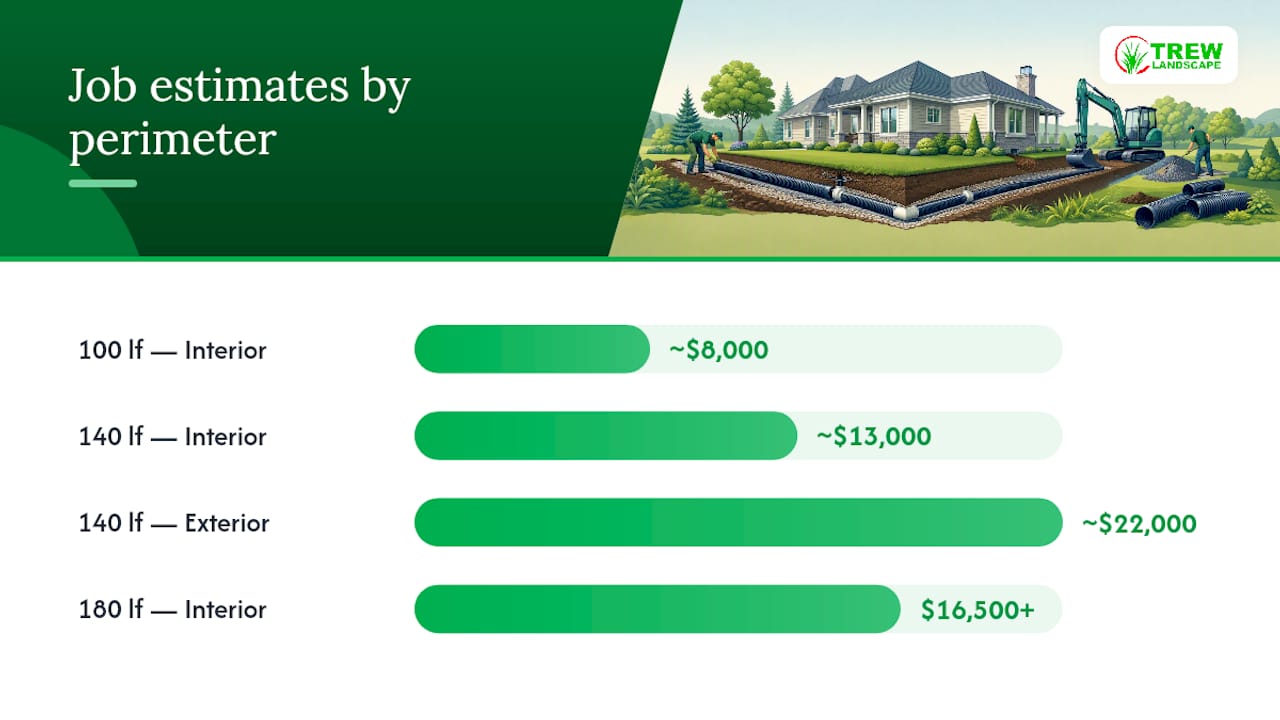
These scenarios use real per-linear-foot ranges to show how total costs build. Assumptions are listed below the table.
| Basement Perimeter | System Type | Rate Used | Est. Total (pipe + labor) | With Sump + Concrete | Full System Est. |
|---|---|---|---|---|---|
| 100 lf (small) | Interior | $55/lf | $5,000–$9,000 | +$2,500 | ~$8,000 |
| 140 lf (medium) | Interior | $75/lf | $10,500 | +$2,500 | ~$13,000 |
| 140 lf (medium) | Exterior | $120/lf | $16,800 | +$5,000 | ~$22,000 |
| 180 lf (large) | Interior | $75/lf | $13,500 | +$3,000 | $16,500+ |
Assumptions:
- Interior totals include one sump pump ($1,000) and basic concrete demo/patch ($1,500)
- Exterior totals include one sump pump ($1,000), waterproofing membrane ($2,500), and basic landscape restoration ($1,500)
- Landscape restoration for patios, decks, or driveways is NOT included and can add $2,000–$10,000+
- Rates reflect mid-range national figures; local labor variation applies
These numbers are benchmarks, not bids. A contractor who has walked your basement will price it differently based on soil, access, and finish expectations.
- Perimeter under 100 lf: budget $5,000–$9,000 for a basic interior system
- Perimeter 120–160 lf: budget $10,500–$16,800 interior, $16,800–$22,000 exterior
- Perimeter over 180 lf: budget $13,500+ interior, $22,000+ exterior with restoration
Interior vs. exterior drain tile: which one fits your situation?
The core difference comes down to where the water is intercepted. According to US Waterproofing, exterior drain tile intercepts water at the footing before it enters the wall; interior systems manage water that has already breached the foundation and route it to a sump. Both work — they just solve slightly different problems.
Interior perimeter drain tile:
- Lower cost ($40–$85/lf)
- Minimal yard disruption
- Requires concrete demo inside the basement
- Does not stop water from entering walls — manages it once it arrives
- Practical choice for most existing homes
Exterior (weeping/footing) drain tile:
- Higher cost (often $120/lf or more, totaling 2–3× an interior system per Basement Moisture Lab)
- Keeps foundation walls genuinely dry when paired with a waterproofing membrane
- Requires deep perimeter excavation and full landscape restoration
- Best for new construction, major foundation repairs, or situations where wall moisture is causing structural damage
When exterior makes sense: active foundation wall damage, new construction where the footing is already exposed, or cases where interior management has failed repeatedly.
When interior is the pragmatic call: most retrofit situations in existing homes where the goal is a dry basement floor and the walls are structurally sound.
Pro Tip: If a contractor recommends exterior drain tile for a finished basement with no wall damage, ask specifically why interior won’t solve the problem. The answer should be technical, not vague.
How to tell if you actually need drain tile
Wet basements have many causes, and drain tile is not always the right fix. Family Handyman recommends exhausting simpler, lower-cost checks before committing to excavation.
Clear signs drain tile is likely necessary:
- Recurring seepage along the base of foundation walls after rain
- Standing water at the footing or floor-wall joint
- Visible efflorescence (white mineral deposits) on walls indicating chronic moisture
- Mold or persistent musty odor despite dehumidification
- High water table confirmed by a contractor or soil test
- Hydrostatic pressure causing floor cracks or wall bowing
Homeowner checklist to try first:
- Clean gutters and downspouts — clogged gutters dump water directly at the foundation
- Extend downspouts at least 10 feet from the foundation
- Regrade soil so it slopes away from the house (6 inches of drop over 10 feet is the standard)
- Check window well drains for blockage
- Install a curtain drain uphill of the house if surface water is the primary issue
Cost comparison: Gutter cleaning runs $100–$300. Downspout extensions cost $20–$50 each. Regrading a small area runs $500–$2,000. A curtain drain typically costs $1,000–$5,000. A full interior drain tile system starts at $4,000 and goes up from there, with exterior systems typically ranging from $8,000 to $30,000 — so the checklist above is worth an afternoon before you call anyone.
These fixes resolve a surprising number of moisture complaints. If water returns after correcting all of them, that’s when a drain tile system becomes the right conversation.
What installation looks like and how much disruption to expect
Interior installs typically take 1–3 days for an average basement. Exterior installs run longer — often several days to two weeks depending on perimeter length, soil conditions, and how much landscaping must be removed and restored.
Disruption by system type:
- Interior: Jackhammering the concrete floor along the perimeter, trenching, pipe installation, gravel backfill, and concrete patching. Expect significant dust and noise. The basement is unusable during work.
- Exterior: Heavy equipment (mini-excavators) working around the foundation perimeter. Landscaping, patios, decks, or driveways in the excavation path must come out. Soil stockpiles on the yard. Restoration work follows after the pipe is installed.
Homeowner prep checklist:
- Clear the basement of stored items along all walls (interior installs)
- Move vehicles and outdoor furniture away from the foundation perimeter (exterior installs)
- Protect HVAC equipment, water heaters, and electrical panels from dust
- Arrange for pets to be out of the work area
- Confirm utility lines are marked before excavation begins (call 811)
- Plan for limited basement access for 1–5 days minimum
Stormwater management during the job matters too — if heavy rain hits mid-excavation on an exterior job, a good contractor has a plan for it. Ask before work starts.
How to evaluate bids and what to ask every contractor
Getting three bids is the baseline. Getting three detailed bids is what actually protects you.
Questions to ask every contractor:
- Did you measure the perimeter yourself, or is this estimate based on what I told you?
- What pipe diameter and material are you using, and is it wrapped in filter fabric?
- Who installs the sump pump — your crew or a subcontractor?
- What does landscape/concrete restoration include, and what’s excluded?
- How do you handle soil disposal?
- Is a permit required for this job, and who pulls it?
- What is the project timeline, and what’s the payment schedule?
- What warranty do you offer on labor and materials?
Plumbers, waterproofing contractors, and landscaping contractors all install drain tile depending on the job scope. Verify that whoever you hire has done this specific type of work — not just general drainage or plumbing.
Red flags on bids:
- A lump-sum price with no line items
- No mention of permits
- Unusually low price with vague scope (“full drainage system — $3,500”)
- No proof of insurance or references from similar jobs
- Pressure to sign before you’ve compared bids
Pro Tip: Ask for photos or addresses of two or three completed drain tile jobs. A contractor who can’t provide references for this specific work type is a risk, regardless of price.
Warranties typically cover labor for 1–5 years and pipe materials longer. Get the warranty terms in writing before signing. Document the existing condition of your basement and yard with photos before work begins — you’ll want that record if a dispute arises.
Lower-cost options to consider before a full system
A full-perimeter drain tile system is the right answer for chronic, whole-basement moisture. For targeted or mild problems, these alternatives cost less and are worth trying first.
- Curtain drain (French drain): A trench filled with gravel and perforated pipe installed uphill of the foundation to intercept surface water before it reaches the house. Typically $1,000–$5,000 depending on length. Works well when surface runoff is the main culprit. See yard drainage solutions for how curtain drains fit into a whole-yard strategy.
- Improved gutters and downspout extensions: The cheapest fix on the list. Extending downspouts 10 feet from the foundation costs almost nothing and eliminates a major water source for many homes.
- Yard regrading: Correcting negative slope (soil that pitches toward the foundation) costs $500–$2,000 for a small area and solves surface drainage without any excavation. Yard grading guidance explains how slope correction works alongside drain tile.
- Spot exterior excavation: Instead of a full-perimeter dig, some contractors excavate only the wet corner or wall section. This costs less than a full exterior system but doesn’t address water entering from other directions.
- Interior localized trenching: Trenching and piping only the wet wall rather than the full perimeter. Less expensive than a full system, though it may need to be extended later.
The staged approach — try the cheap fixes, wait one wet season, then reassess — makes sense when moisture is mild and intermittent. When seepage is consistent, recurring, or causing mold or structural damage, skipping straight to a full system saves money in the long run.
Surface drainage and subsurface drain tile often work together; parking lot flood prevention strategies illustrate how surface-to-subsurface drainage interactions apply even in paved environments, reinforcing why surface fixes should come before subsurface ones.
Key Takeaways
A full interior drain tile system typically costs several thousand dollars installed, while exterior systems cost significantly more — with per-linear-foot rates varying by system type driving the estimates.
| Point | Details |
|---|---|
| Interior vs. exterior cost | Interior typically costs $40–$85 per linear foot and $4,000–$12,000 total; exterior runs about $120 per linear foot, with full-perimeter jobs often $8,000–$30,000 or more when restoration is included. |
| Sump pump is not optional | Budget $500–$1,500 for a sump pump; large basements may need two. |
| Try cheap fixes first | Gutter cleaning, downspout extensions, and regrading cost $100–$2,000 and resolve many moisture problems. |
| Use the formula | Multiply perimeter × rate, add fixed costs, then add a 10–25% contingency for unknowns. |
| Trew Landscape LLC | Offers drain tile installation, yard grading, and concrete repair in Kansas City with free on-site estimates. |
What Trew Landscape LLC actually recommends
The most common mistake homeowners make isn’t choosing the wrong system — it’s skipping the restoration budget entirely. A contractor quotes $12,000 for interior drain tile, the homeowner approves it, and then discovers that the concrete patching looks rough, the sump discharge trench needs grading, and the basement floor needs sealing. Suddenly the “done” project needs another $2,000–$4,000 of work. Build restoration into the budget from day one, not as an afterthought.
On the interior vs. exterior question: for most existing Kansas City homes, interior drain tile is the right starting point. The clay-heavy soils here create real hydrostatic pressure, but interior systems handle that load well when paired with a properly sized sump pump and a battery backup. Exterior systems are worth the premium when there’s active wall damage, a failed waterproofing membrane, or a new construction project where the footing is already exposed. Recommending exterior for a structurally sound basement is usually an oversell.
The other thing worth saying plainly: two sump pumps with battery backups are not an upsell in this region. Kansas City storms can knock out power for hours, and a flooded basement during a power outage is exactly the scenario a drain tile system is supposed to prevent. The backup pump is cheap insurance relative to the cost of the system.
*— Trew Landscape LLC
Trew Landscape LLC handles drain tile and full yard restoration in Kansas City
If your basement has a moisture problem and you’ve already worked through the gutter and grading checklist, a professional site evaluation is the right next step. Trew Landscape LLC installs drain tile systems for Kansas City homeowners and handles the full scope: drain tile installation, yard grading, concrete removal and patching, and landscape restoration after excavation — so you’re not coordinating three separate contractors for one project.

Every project starts with a free on-site estimate. A Trew Landscape team member walks the property, measures the perimeter, assesses soil and drainage conditions, and provides a written, line-item bid. Phased options are available for homeowners who want to address the most critical section first. To get started, visit the Trew Landscape services page or request a free estimate — have your basement dimensions and a description of where moisture appears ready when you reach out.
Useful sources
- Footing drain pipe resource guide — PNNL Building America Solution Center
- Drainage system installation cost — HomeGuide
- What is drain tile? — Family Handyman
- Interior vs Exterior Drain Tile: The Honest Verdict
- Drain Tile Installation Cost Calculator 2026 — MyHomeCostCalc.com
- What is Drain Tile 101 — US Waterproofing
- Do plumbers install drain tile? - ZipRecruiter
FAQ
How much does drain tile cost per linear foot?
Interior drain tile typically costs $40–$85 per linear foot installed; exterior systems generally run about $120 per linear foot, with full-perimeter jobs commonly totaling $8,000–$30,000. A sump pump adds $500–$1,500 on top of either system.
Is drain tile worth the investment?
For homes with recurring basement seepage, hydrostatic pressure, or mold caused by chronic moisture, drain tile is generally worth the cost. Try gutter cleaning, downspout extensions, and regrading first — if moisture persists after those fixes, a drain tile system is the appropriate solution.
How much does drain tile cost per acre?
Agricultural drain tile is priced differently from residential systems and varies widely by soil type, tile spacing, and outlet distance. Residential basement drain tile is priced by linear foot of perimeter, not by acreage.
Do plumbers install drain tile?
Yes — plumbers commonly install drain tile, but waterproofing contractors and landscaping contractors also handle this work depending on the job scope. Verify that any contractor you hire has specific experience with the system type (interior or exterior) your project requires.