
Trew Landscape Blog
Playground Turf Installation: Safety-First Guide for Homeowners
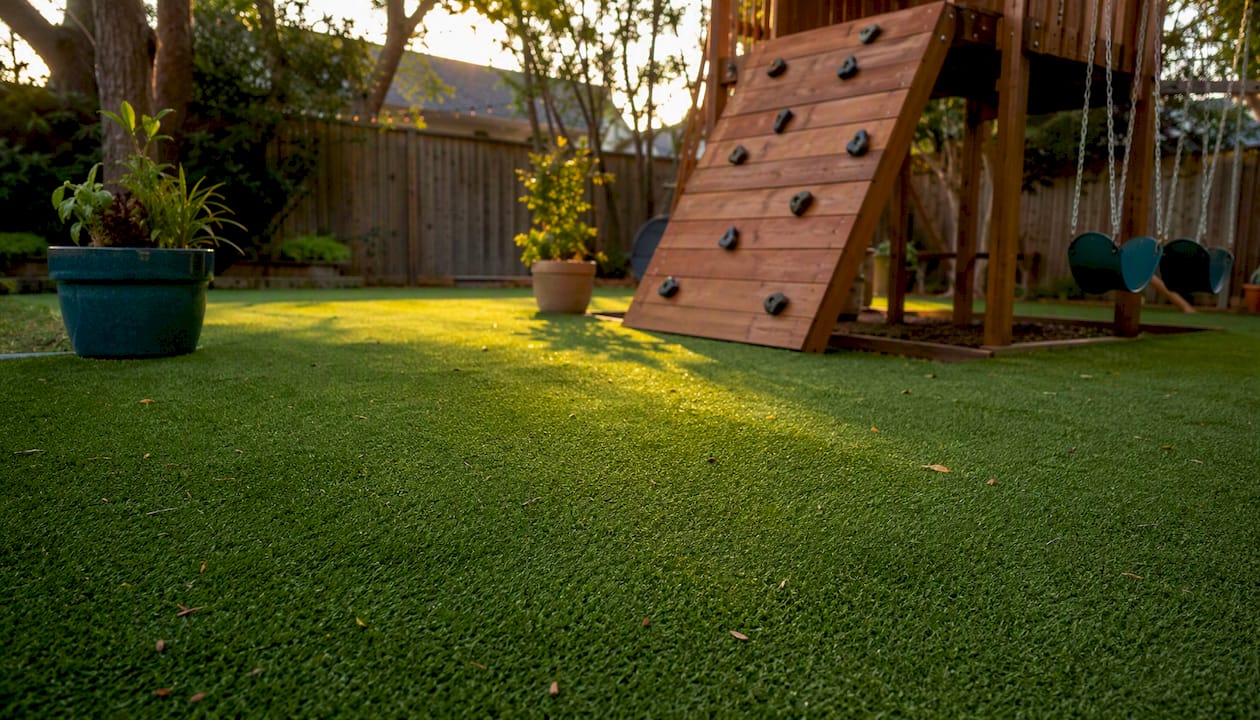
Playground Turf Installation: Safety-First Guide for Homeowners ! Close-up of playground synthetic turf installation Playground turf is a strong choice for most residential and small commercial play areas — provided the installed system (pad + turf + compacted base) carries documented critical fall height under ASTM F1292, and the product holds IPEMA certification.
Playground Turf Installation: Safety-First Guide for Homeowners
Playground turf is a strong choice for most residential and small commercial play areas — provided the installed system (pad + turf + compacted base) carries documented critical fall height under ASTM F1292, and the product holds IPEMA certification. Before anything else, confirm five things: the system’s critical fall height (CFH) equals or exceeds the tallest equipment drop on your site; you have an IPEMA certificate or lab test report from the manufacturer; drainage is engineered into the base, not an afterthought; the pad or loose-fill depth meets the CFH requirement; and the installer provides QA documentation at project close.
- CFH documentation: The installed assembly (turf + pad + base) must be tested to ASTM F1292 and the CFH must match or exceed your equipment’s highest fall point.
- IPEMA certification: Request the certificate and the underlying lab test report, not just a marketing claim.
- Drainage: A perforated sub-base or drain tile system prevents standing water that degrades both the pad and the turf backing.
- Pad or loose-fill depth: Depth directly controls impact attenuation. Shortcuts here are the most common cause of CFH failure.
- Installer QA records: Compaction reports, field impact test results, and seam inspection sign-offs belong in your project file.
DIY is possible for small residential areas with low equipment heights, but any commercial or public playground should be professionally installed and field-tested.
Key Takeaways
A safe playground turf installation depends on the full installed assembly meeting ASTM F1292 critical fall height requirements, with IPEMA certification, proper drainage, and documented QA at project close.
| Point | Details |
|---|---|
| CFH documentation is non-negotiable | The installed assembly (turf + pad + base) must be tested to ASTM F1292 and the CFH must match your equipment’s highest fall point. |
| Pad and drainage drive cost | Installed costs for standard turf are moderate; engineered pads and drain tile work add meaningfully to the overall cost. |
| Maintenance protects performance | Quarterly brushing, annual infill checks, and periodic field impact testing keep the system within its rated CFH over its 10–15 year lifespan. |
| DIY has real limits | Small residential projects with low equipment are manageable DIY; commercial or public playgrounds require professional installation and documented field testing. |
| Trew Landscape LLC covers the full system | Trew Landscape LLC installs artificial turf with sub-base construction, drainage, and concrete or paver edging for residential and commercial properties in Kansas City. |
Table of Contents
- Why do people choose playground turf and when does it make sense?
- What U.S. safety standards do you need to verify before buying?
- What does a playground turf system actually contain?
- What should you put under playground turf?
- How is playground turf installed? A step-by-step checklist
- How much does playground turf installation cost?
- Is playground turf right for your site?
- How do professionals guarantee safety and long-term performance?
- The part of playground turf most owners get wrong
- Playground turf installation services from Trew Landscape LLC
- Useful sources and further reading
- FAQ
Why do people choose playground turf and when does it make sense?
Synthetic grass for playgrounds earns its keep on three fronts: consistent impact performance, low ongoing maintenance, and year-round usability regardless of weather. Unlike engineered wood fiber, it does not scatter, compact unevenly, or wash out of the use zone after a hard rain. Unlike poured-in-place rubber, it can be installed in sections, repaired in patches, and replaced without demolishing the entire surface.
The accessibility argument is real, too. When the installed system is tested to ASTM F1951, it qualifies as an accessible route under ADA guidance, which matters for daycare centers, municipal parks, and any commercial property subject to accessibility requirements. Loose-fill materials rarely pass that test without additional work.
Where turf fits well:
- Residential backyards with play structures up to 6 feet in fall height
- Daycare centers and preschool yards where debris-free surfaces reduce choking hazards
- Small commercial playgrounds where consistent appearance and low maintenance justify the higher upfront cost
- Areas where natural grass struggles: heavy foot traffic zones, shaded spots where grass thins out, or sites with irrigation restrictions
Where you should think twice:
Chronic standing water is the biggest disqualifier. If your site floods regularly, no turf system performs reliably until the drainage problem is solved first. Steep slopes above roughly 8% complicate both installation and drainage routing. Tree root zones create an uneven sub-base that shifts over time, which degrades CFH performance. And in full-sun climates, synthetic turf surfaces can reach temperatures significantly higher than air temperature on hot days, which is a real concern for toddler-only areas where children sit or crawl directly on the surface.
What U.S. safety standards do you need to verify before buying?
The CPSC Public Playground Safety Handbook is clear on one point that often gets glossed over in sales conversations: surfacing reduces the risk of life-threatening head injuries, but it does not eliminate injuries. The goal is to meet the CFH requirement for your specific equipment, then maintain the system so it keeps meeting it.
ASTM F1292 and critical fall height
ASTM F1292 defines how surfacing materials are tested in a laboratory to determine their critical fall height. CFH is the maximum fall height from which a child can fall onto the surface without exceeding the head injury threshold (HIC of 1,000 and peak deceleration of 200g). The number that matters is the CFH of the installed assembly, not the turf roll alone. The pad, the compaction of the base, and the turf backing all contribute to the final CFH. A turf product rated for an 8-foot CFH in the lab may perform differently once it sits on your specific sub-base.
ASTM is actively revising F1292 through work item WK88682 to consolidate field-test procedures into the standard. That means the version your installer references today may not be the current one in 12 months. Always ask for the test report date and the standard version it was tested against.
Field testing vs. lab testing
Lab testing establishes the product’s CFH under controlled conditions. Field testing, conducted under ASTM F3313, verifies that the installed surface on your specific site still meets the CFH requirement after the base was compacted, the pad was laid, and the turf was seamed and anchored. These are two different things. For any commercial or public playground, require field testing after installation. For residential projects, at minimum ask the installer to confirm the installed assembly matches the lab-tested configuration.
IPEMA certification
IPEMA is an independent third-party program that verifies a manufacturer’s claim that their product meets ASTM F1292 (and F1951 for accessibility). Request the IPEMA certificate and the underlying lab test report. A certificate number alone does not tell you what CFH was achieved or under what conditions.
- Ask for the ASTM F1292 test letter showing the CFH of the full assembly (turf + pad + base configuration)
Pro Tip: Before final payment, ask the installer for copies of all lab reports, field test results, and compaction records. A reputable installer has these ready. If they hesitate, that is a red flag worth taking seriously.
What does a playground turf system actually contain?
A playground turf installation is not a single product. It is a layered assembly, and every layer affects safety, drainage, and how long the system lasts.
Turf face and pile specifications
Pile height for playground applications typically runs 1.5 to 2.25 inches. Shorter pile is more durable under heavy foot traffic; taller pile feels softer underfoot but can mat down faster in high-use zones like swing exits and slide landings. Face weight (the weight of the fiber per square yard) and density together determine how well the turf resists matting. Higher face weight generally means better wear resistance, but the relationship is not linear. Tuft bind strength, the force required to pull a fiber tuft from the backing, is the spec that tells you whether the turf will hold up to the kind of lateral stress kids generate.
Backing and seam quality
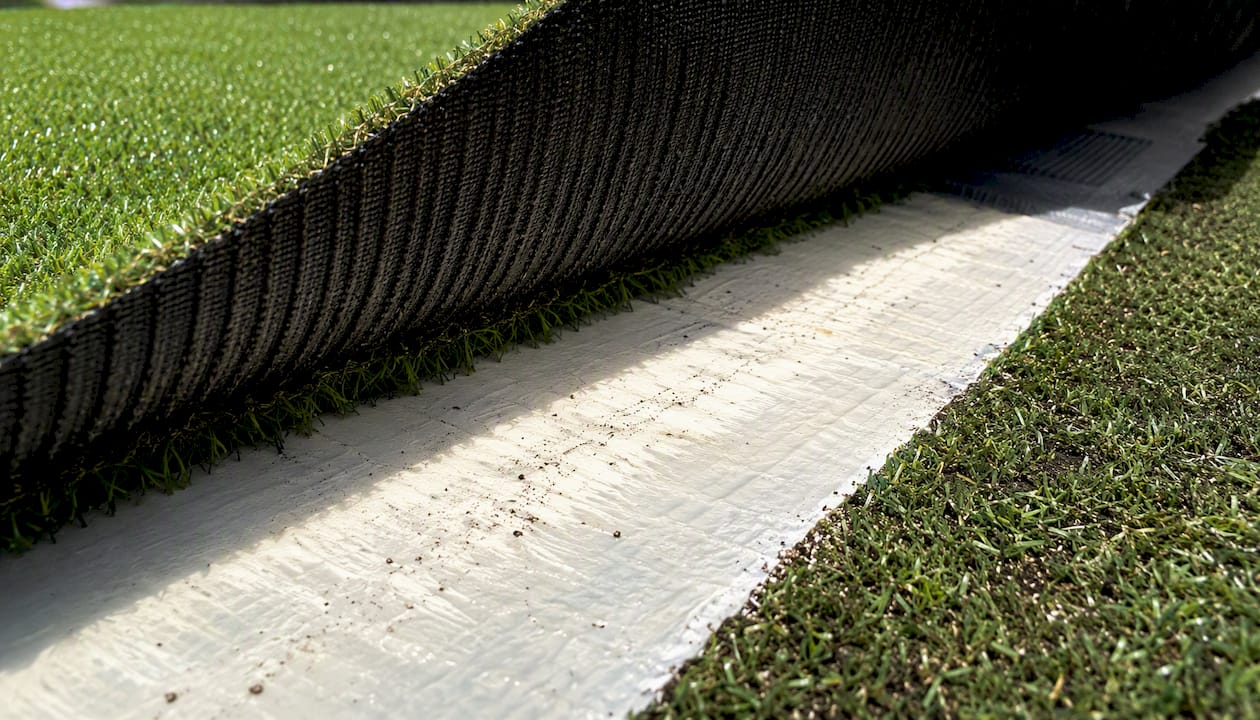
The backing is what holds the fibers and gives the turf its structural integrity. A polyurethane-coated backing resists moisture penetration and holds tuft bind strength over time better than a basic latex coating. Seams are the most common failure point in any turf installation. Seams should be joined with a seam tape and two-part polyurethane adhesive, with fibers hand-trimmed to minimize the visible line. On playground installations, seams in high-traffic zones (under swings, at slide exits) deserve extra adhesive coverage and should be inspected annually.
Drainage layer and geotextile
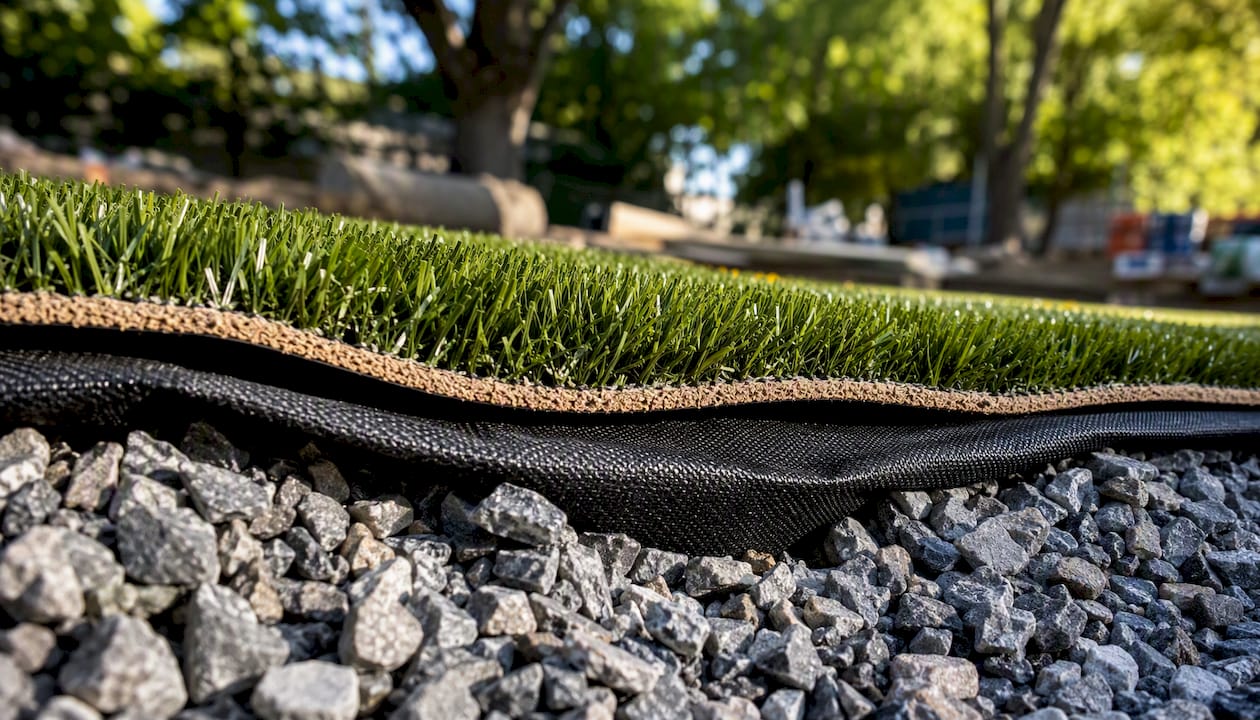
A geotextile fabric between the sub-base and the turf backing prevents fine particles from migrating up into the turf and clogging the drainage layer. Below the geotextile, a crushed angular stone base provides the drainage pathway. Permeability matters: a well-designed system drains fast enough that standing water does not pool on the surface after rain. Ask for permeability test data from the manufacturer, and confirm the installed base achieves the same drainage rate.
Edging and perimeter restraint
Turf edges that are not properly anchored lift, curl, and create trip hazards. Common perimeter options include pressure-treated nailer boards staked into the sub-base, concrete curbing, or aluminum edging. For playground applications, any edge detail that creates a raised lip or exposed fastener within the use zone needs to be addressed. Concrete perimeter work, like what Trew Landscape LLC provides through its concrete contractor services, creates a clean, durable edge that holds the turf flat and transitions smoothly to adjacent paved surfaces.
What should you put under playground turf?
The underlayer is where most of the impact attenuation work happens. The turf face contributes some cushioning, but the pad or base system beneath it determines whether the installed assembly actually meets the CFH requirement for your equipment.
Foam and closed-cell panel systems
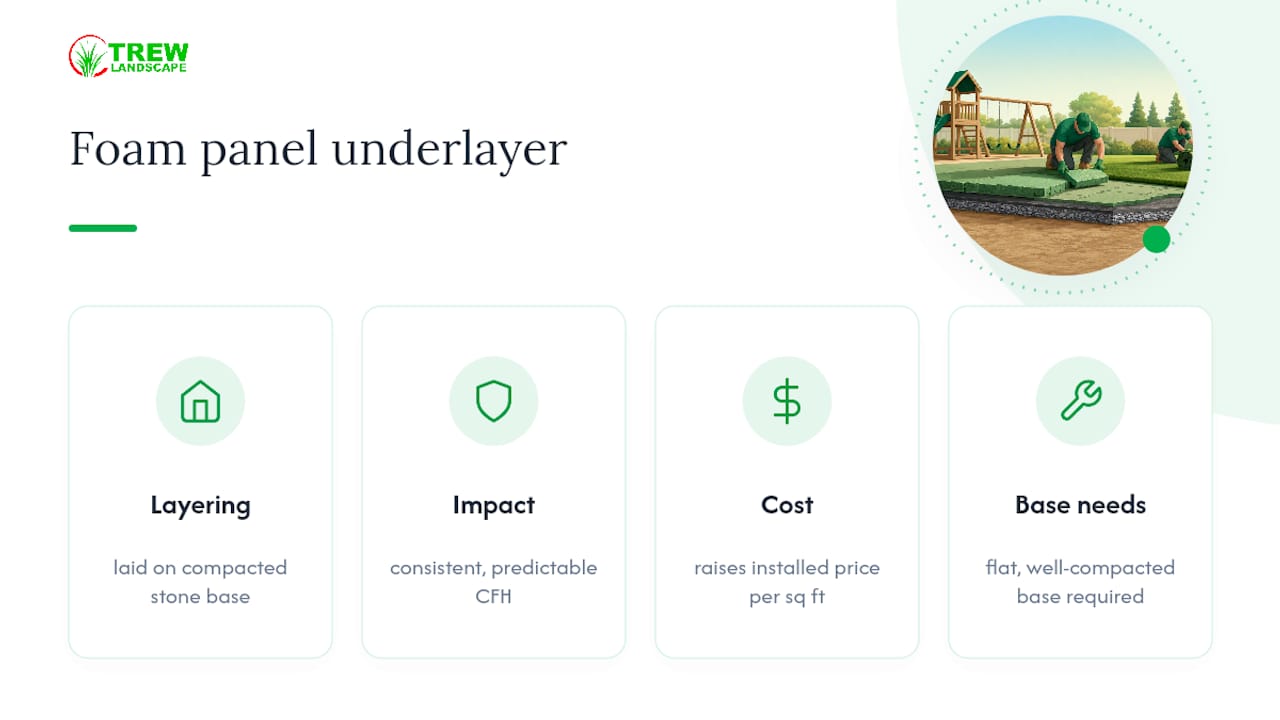
Engineered foam panels (sometimes called safety foam or closed-cell polyethylene panels) are cut to fit the use zone and laid directly on the compacted stone base before the turf goes down. They deliver consistent, predictable CFH performance because their thickness and density are controlled at the factory. The tradeoff is cost: foam panels add meaningfully to the installed price per square foot. They also require a flat, well-compacted base, because any high spot in the stone will telegraph through the panel and create an uneven surface.
Poured-in-place rubber and rubber tiles
Poured-in-place (PIP) rubber is a two-layer system: a base layer of recycled rubber granules bonded with polyurethane, topped with a wear layer of EPDM rubber. It is durable, seamless, and delivers excellent CFH performance. As a standalone surface it is widely used in commercial playgrounds. As an underlayer beneath turf, it is less common but possible. Rubber tiles offer similar performance in a modular format that is easier to repair in sections.
Aggregate sub-base as the foundation
Regardless of which pad system you choose, the sub-base beneath it must be right. Professional specifications typically call for a minimum 4-inch layer of angular crushed stone, compacted to 90–95% per standard compaction targets. A finish layer of compacted decomposed granite or fine crushed stone goes on top to create a smooth, level surface for the pad or turf. Deviations in compaction directly reduce CFH. A base that tests at 85% compaction instead of 95% is not a minor shortfall.
Loose-fill alternatives
Engineered wood fiber (EWF) and rubber mulch are loose-fill options that can be used in combination with turf borders or in adjacent areas. Loose-fill requires minimum depths that vary by equipment fall height, and those depths must be maintained through regular top-up. EWF compacts over time, reducing its effective CFH. It also does not meet ASTM F1951 accessibility standards without a solid sub-base beneath it. For a turf installation, loose-fill is generally not placed under the turf, but it is worth understanding as a comparison point when evaluating your full playground surfacing plan.
How is playground turf installed? A step-by-step checklist
A well-executed installation follows a defined sequence. Use this as a reference when reviewing contractor proposals or supervising a project.
- Install sub-surface drainage. Lay perforated drain pipe at the low point of the excavation, connected to a daylight outlet or a drain tile system. Cover with drainage aggregate.
Pro Tip: Video the seam areas and pad placement before the turf goes down. If a seam fails or a soft spot develops later, that footage is the fastest way to determine whether the issue is workmanship or a material defect.
How much does playground turf installation cost?
Cost is where quotes diverge most, and the reason is almost always scope. Residential artificial turf projects typically cost a moderate amount per square foot installed, varying by project specifics, but that range covers general landscaping turf, not playground-specific systems with engineered pads and drainage. Add an impact pad, a drain tile system, and field testing, and the per-square-foot cost rises. Material-only playground turf typically costs a few dollars per square foot, depending on product choice for certain products, but that figure excludes installation labor, pad, drainage, and edging.
| Project size | Approximate installed cost | Typical timeline |
|---|---|---|
| Small backyard (200 sq ft) | — | 2–4 days |
| Mid-size residential/daycare (1,000 sq ft) | — | 5–10 days |
| Large commercial playground (5,000 sq ft) | — | 2–4 weeks |
Ranges reflect turf + pad + base + drainage + edging. Costs vary by region, site complexity, and pad type. Always confirm what is included.
What drives cost up
Pad type is the single biggest variable. Foam panel systems add a measurable additional cost over compacted-stone-only base systems. Drainage work, especially if the site has chronic water issues, can add thousands in pipe, aggregate, and grading labor. Site complexity, including curves, tree root removal, and steep slopes, increases both material waste and labor hours. Infill selection matters too: synthetic alternatives to crumb rubber cost more per pound but may be the right call for a children’s play area.
DIY vs. professional installation
DIY is feasible for a small residential backyard with low play equipment, provided you can achieve proper compaction and source a turf product with documented CFH for your equipment height. The hidden costs of DIY mistakes are real: a seam that fails in year one, a base that settles unevenly, or a pad that shifts under the turf all require professional remediation that often costs more than hiring correctly the first time. For any commercial or public playground, professional installation with documented QA is not optional.
Common repairs
Seam repairs are the most frequent intervention. A seam that lifts or gaps can usually be re-adhered with fresh seam tape and adhesive if caught early. Localized infill loss in swing zones is normal and requires periodic top-up. If a section of pad has compressed or shifted, the turf in that area needs to be pulled back, the pad replaced or shimmed, and the turf re-seamed.
When to replace vs. repair
Replace the system when the fiber pile has worn below the infill level across significant areas, when the backing shows cracking or delamination, or when a field impact test shows CFH performance has dropped below the required level for your equipment. That last point is the one most owners miss: a surface that looks fine can fail a CFH test if the pad has compressed over years of use. Scheduling a field test every 3–5 years on a commercial installation is money well spent.
Is playground turf right for your site?
Run through these checkpoints before committing to a turf system.
Go ahead if:
- Your equipment’s highest fall point is within the documented CFH of the turf assembly you are specifying.
- The site drains adequately or can be made to drain with sub-surface work.
- The slope is 8% or less across the use zone.
- You have budget for the full system (turf + pad + base + drainage + edging + QA testing), not just the turf material.
- ADA accessibility is required and you can specify a system tested to ASTM F1951.
Pause and get professional input if:
- The site has chronic flooding or a high water table.
- Slopes exceed 8% in the use zone.
- Large tree roots run through the excavation area.
- The soil is contaminated or unstable.
- Your equipment exceeds 8 feet in fall height and you have not yet confirmed a pad system with a matching CFH.
For sites with drainage problems, solving that first is not optional. Trew Landscape LLC’s drain tile installation services address sub-surface water issues before turf goes in, which protects both the pad and the long-term CFH performance of the system.
How do professionals guarantee safety and long-term performance?
The difference between a playground turf installation that holds up for 12 years and one that fails a CFH test in year three usually comes down to documentation. Professional installers working to specification-grade standards are required to supply impact attenuation test results, permeability data, installer references, and warranty provisions before and after the project.
What to require in the contract
- Scope of base work: excavation depth, stone type, compaction target (90–95%), finish layer depth and material.
- Pad specification: product name, thickness, and the CFH of the full assembly (pad + turf + base configuration).
- Seam warranty: minimum term and what constitutes a covered failure.
- Remedy clause: what happens if compaction or CFH tolerances are not met on the field test.
- Documentation deliverables: compaction test report, ASTM F3313 field impact test results, permeability check, IPEMA certificate, and manufacturer’s lab test letter.
Installer qualifications to ask about
Ask for a list of previous playground installations with contact references. Ask whether the installer is a manufacturer-authorized installer for the specific turf and pad products being used, which matters for warranty coverage. Confirm they carry liability insurance and, for commercial projects, that they can provide a performance bond.
Pro Tip: Schedule an acceptance walkthrough before the crew demobilizes. Walk every seam, check every perimeter anchor, and confirm you have received all documentation in writing. A signed acceptance form with a punch list protects both parties.
The part of playground turf most owners get wrong
Most of the conversations about playground turf focus on the turf itself: the pile height, the color, the infill, the brand. That is understandable. The turf is what you see. But the surface you see is almost never what fails.
What fails is the base. A compaction target of 90–95% sounds like a technical detail, but it is the number that determines whether your pad stays flat in year five or develops soft spots that quietly erode the system’s CFH. Owners who skip the compaction report at project close have no way of knowing whether that target was actually hit. By the time a soft spot is visible, the pad has already been compromised.
The second thing owners underestimate is the difference between a lab-tested CFH and an installed CFH. A manufacturer’s data sheet showing an 8-foot CFH was measured in a controlled lab on a specific base configuration. Your installer’s base may be close to that configuration, or it may not be. Field testing under ASTM F3313 is the only way to know. On a commercial playground, that test is a requirement. On a residential project, it is still worth the cost, because the alternative is assuming the system performs as specified with no verification.
Transparency about these details is what separates a professional installation from a turf-laying job. Ask for the compaction report. Ask for the field test results. If the installer cannot produce them, find one who can.
Playground turf installation services from Trew Landscape LLC
Getting the sub-base right, the drainage engineered correctly, and the CFH documentation in hand before final payment is exactly the kind of project where professional help pays for itself. Trew Landscape LLC handles the full scope of artificial turf installation for residential and commercial properties in Kansas City, including sub-base construction, compaction, drain tile installation, and concrete or paver perimeter work.

Before requesting a quote, pull together a few details that will speed up an accurate estimate: the dimensions of the use zone, the height of the tallest play equipment, whether the site has existing drainage issues, and any ADA accessibility requirements. With that information, Trew Landscape LLC can scope the base work, recommend the right pad system for your equipment height, and give you a quote that covers the full installed system, not just the turf material. You can also explore the broader range of outdoor services, from hardscape designs to landscape design, at trewlandscape.com/services. To get started with a site visit and estimate, reach out directly through the website.
Useful sources and further reading
The primary references for playground surfacing safety in the United States are:
- Public Playground Safety Handbook
- ASTM F1292-17 - Standard Specification for Impact Attenuation of Surfacing Materials Within the Use Zone of Playground Equipment
- Installation and Maintenance Guide for ADA Compliance in Playground Surfacing
- Playground Grass Academy CSI
- PLAYGROUND RESILIENT SURFACING PROPLAY PLUS SYNTHETIC TURF
- The average cost to install artificial grass (LawnStarter)
- What Is The Cost Of Installing Playground Turf? - Greatmats
When requesting documentation from a manufacturer or installer, ask specifically for: the ASTM F1292 test letter for the full assembly (turf + pad + base configuration), the ASTM F1951 certificate if accessibility is required, permeability test data, and the installer’s compaction report.
FAQ
What should you put under playground turf?
The underlayer depends on your equipment’s fall height. For most residential applications, a compacted crushed stone base (minimum 4 inches, compacted to 90–95%) topped with an engineered foam or closed-cell panel provides consistent CFH performance. The full assembly must be tested to ASTM F1292 and the documented CFH must equal or exceed the tallest fall point on your equipment.
How much does playground turf installation cost per square foot?
Installed costs for residential artificial turf average $15–$19 per square foot for standard projects; playground-specific systems with engineered impact pads, drain tile, and edging typically run higher. Material-only playground turf can start around $3–$8 per square foot for certain products, but that figure excludes installation, pad, and drainage work. Always confirm what is included in any quote.
What is IPEMA certification and why does it matter?
IPEMA is an independent third-party program that verifies a manufacturer’s claim that their surfacing product meets ASTM F1292 (impact attenuation) and ASTM F1951 (accessibility). Requesting the IPEMA certificate and the underlying lab test report confirms the product was independently tested, not just self-certified.
Can you install playground turf yourself?
DIY installation is feasible for small residential areas with low play equipment, provided you achieve proper sub-base compaction and use a turf product with documented CFH for your equipment height. Commercial or public playgrounds should always be professionally installed and field-tested under ASTM F3313 to verify the installed system meets the required CFH.
How long does playground turf last?
A well-installed playground turf system typically lasts 10–15 years before the turf face requires replacement. Lifespan depends on UV exposure, drainage quality, maintenance frequency, and whether infill levels are kept consistent. Scheduling a field impact test every 3–5 years on a commercial installation confirms the system still meets its rated CFH as the pad ages.