
Trew Landscape Blog
Artificial Turf Maintenance: A Homeowner's Complete Guide
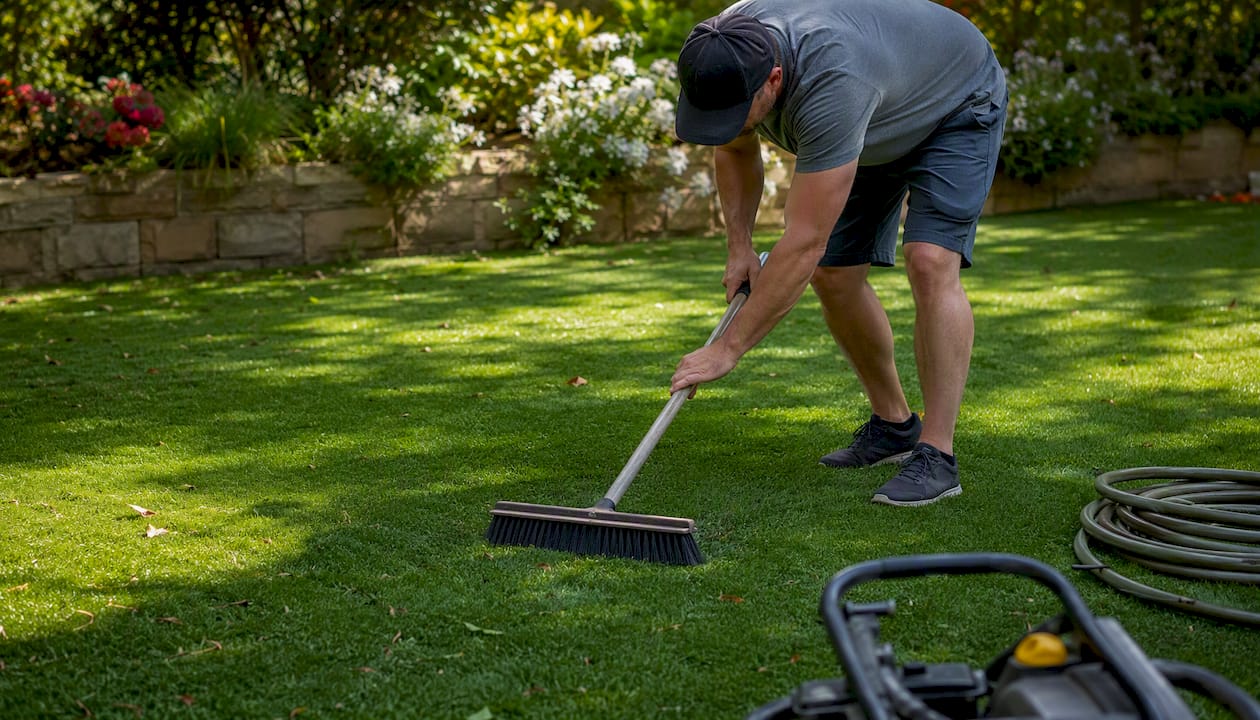
Artificial Turf Maintenance: A Homeowner's Complete Guide ! Homeowner brushing artificial turf fibers Weekly debris removal, monthly brushing, and an annual deep clean keep synthetic turf looking sharp and protect your warranty.
Artificial Turf Maintenance: A Homeowner’s Complete Guide
Weekly debris removal, monthly brushing, and an annual deep clean keep synthetic turf looking sharp and protect your warranty. Here is the short version you can pin to your phone:
- Daily/weekly: Scoop pet waste, blow or rake loose debris, rinse pet zones
- Monthly: Full cross-brush groom, rinse the whole surface, inspect infill depth
- Seasonally: Check edges and seams, top up infill if low, treat for weeds at perimeter
- Annually: Deep clean or hire a professional service, inspect drainage and backing
Pet zones, high-traffic paths, and shaded corners need the most attention. Shade slows drying and traps odor; heavy foot traffic compacts infill fastest. Properly maintained turf can reach a long service life of many years, while neglected installations often fail well before that.
Key Takeaways
Properly maintained synthetic turf lasts 15–20 years; neglected turf fails significantly earlier, and documented maintenance is what keeps warranty claims valid.
| Point | Details |
|---|---|
| Weekly debris removal | Blow or rake loose debris 2–3 times per week to prevent drainage blockage and odor buildup. |
| Monthly cross-brushing | Brush against fiber grain monthly to lift pile and redistribute infill, especially in high-traffic zones. |
| Annual deep clean | Schedule professional deep cleaning once a year to remove compacted infill, biofilm, and embedded contaminants. |
| Infill depth checks | Measure infill monthly in pet and traffic zones; top up when the gap from fiber tips exceeds 3/4 inch. |
| Trew Landscape LLC | Provides installation, power brooming, infill replenishment, and drainage repair for Kansas City properties. |
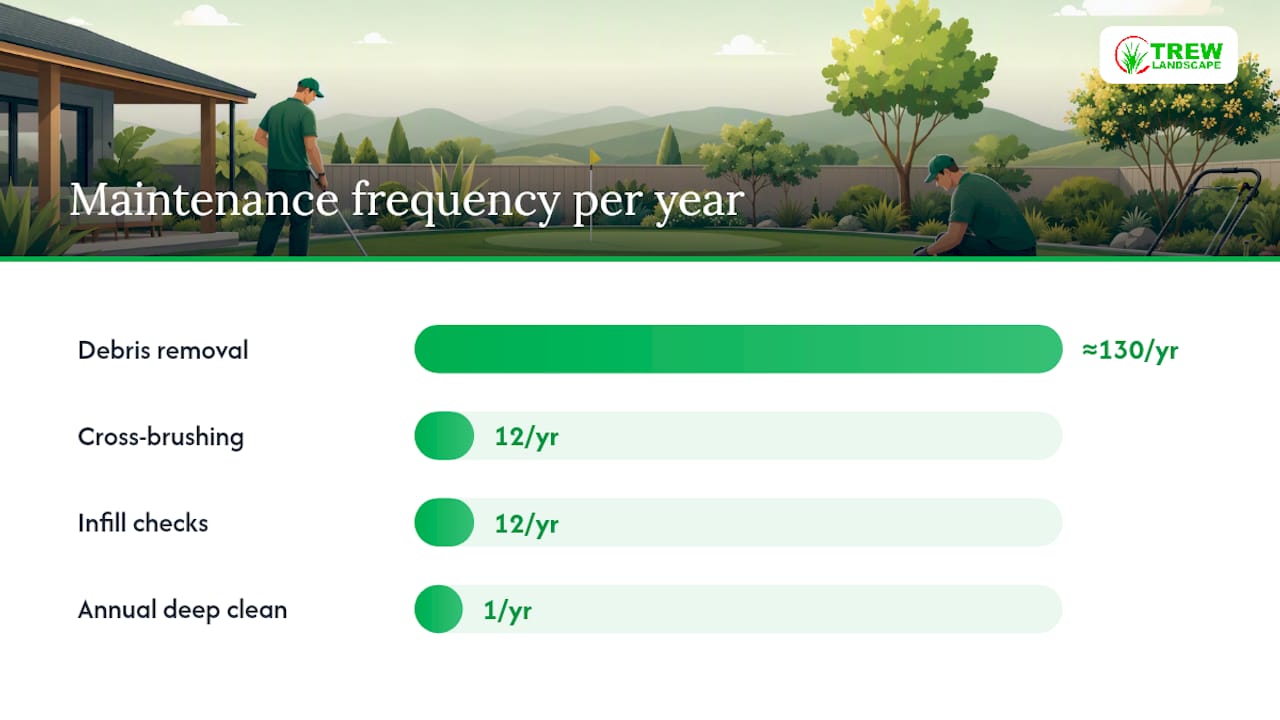
Table of Contents
- What does artificial turf maintenance actually involve?
- How to handle pet waste and odor on synthetic grass
- How to remove common stains from artificial turf
- Brushing technique, infill depth, and when to top up
- When and how to deep clean your synthetic lawn
- Weed control and edge maintenance
- How to fix seams, small rips, and sinking spots
- Season-by-season care for your artificial lawn
- What tools and products should you keep on hand?
- How maintenance affects your warranty and what safety precautions matter
- A practical maintenance schedule and what it costs
- Diagnosing common problems fast
- When should you hire a professional for turf maintenance?
- What Trew Landscape LLC sees homeowners get wrong
- Trew Landscape LLC can handle your turf maintenance and installation
- Sources
- FAQ
What does artificial turf maintenance actually involve?
Routine debris removal, brushing to lift fibers, and periodic rinsing prevent the three biggest problems: matting, drainage blockage, and odor buildup. Think of it as three layers of care stacked on each other. The first layer is daily tidying, the second is monthly grooming, and the third is periodic deep work.
Loose debris is the root cause of most synthetic grass problems. Leaves, twigs, and dirt settle into the pile, hold moisture, and feed organic growth. A quick pass with a leaf blower or a plastic-tined rake two or three times a week takes less than ten minutes and stops that cycle before it starts.
Rinsing matters more than most homeowners expect. Dust, pollen, and light residues accumulate on fiber surfaces and, left long enough, bond to the pile. A garden hose with a spray nozzle, run across the whole surface once a week in dry weather, flushes those particles through the drainage layer. In rainy climates, nature handles most of this, but you still need to rinse pet zones separately.
- Use a leaf blower on low setting or a plastic-tined rake for debris
- Rinse the full surface weekly in dry weather; rinse pet zones after every use
- Cross-brush monthly with a stiff synthetic-bristle push broom, working against the grain of the fibers to lift pile and redistribute infill
Pro Tip: Brush against the direction the fibers naturally lean. You will feel the resistance — that is the pile standing back up. Two passes in opposing directions takes about 15 minutes for a 500-square-foot lawn.
How to handle pet waste and odor on synthetic grass
Pet areas are the highest-maintenance zones on any artificial lawn. Solids must come off daily. Liquids concentrate in the same spots, and without consistent rinsing, urine salts bond to infill particles and create the persistent ammonia smell that no amount of air freshener fixes.
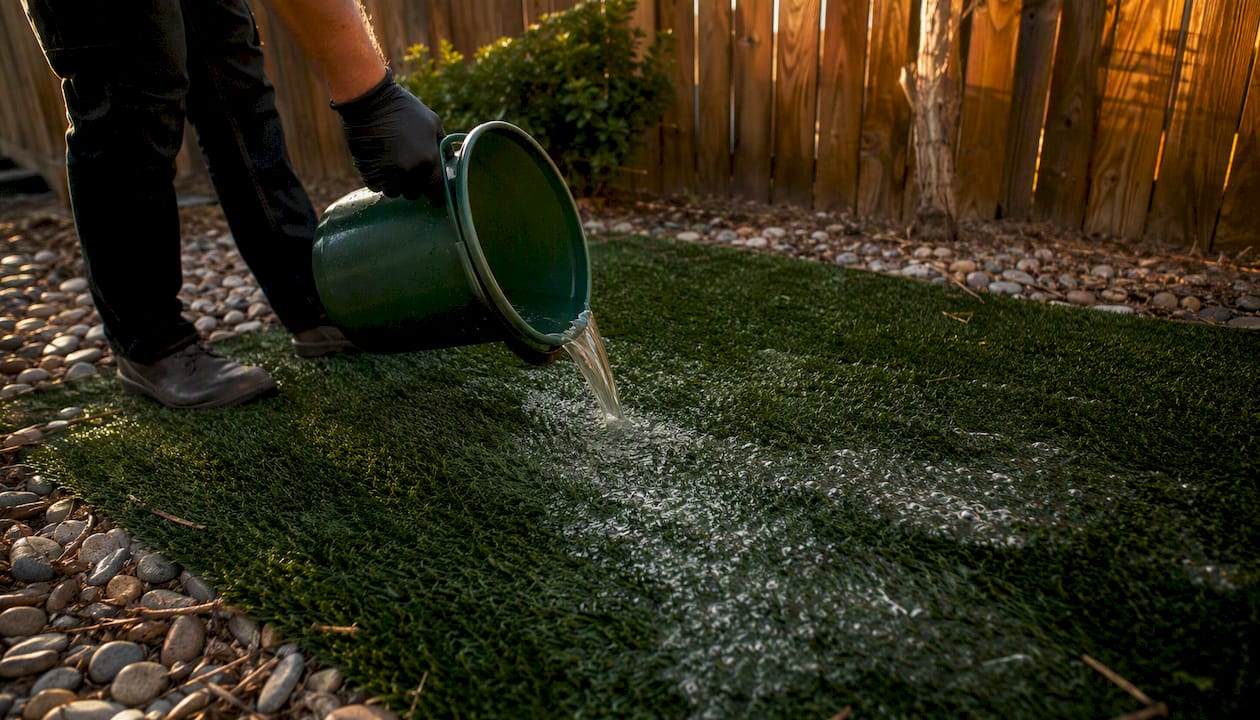
For detailed guidance on pet-friendly turf care, including infill choices that resist odor, the steps below cover the daily and weekly routine.
Daily and weekly pet-zone routine:
- Remove solid waste daily using a plastic bag or scooper. Never use a metal shovel — it snags and pulls fibers.
- Rinse the area immediately with a garden hose. A strong stream, not a pressure washer, is enough.
- Once a week, apply a diluted enzyme cleaner to urine-prone zones. Let it sit for 5–10 minutes, then rinse thoroughly.
- Monthly, cross-brush the pet area to redistribute infill that rinsing has shifted.
What to use and what to avoid:
- Enzyme cleaners (look for products labeled “pet-safe” and “turf-safe”) break down urine compounds at the molecular level. Plain water alone won’t eliminate the odor source.
- Mild dish soap diluted in water works for general cleaning between enzyme treatments.
- Never use undiluted bleach, ammonia-based cleaners, or any solvent. These degrade the turf backing and can void your warranty.
- Avoid steam cleaning — the heat softens adhesive at seams.
Pet odor control works best when mechanical cleaning and rinsing come first. Enzyme treatments won’t fully work if hair and debris block access to the infill where odor compounds live.
How to remove common stains from artificial turf
Most household stains come off with cold water and a mild soap solution if you catch them quickly. The decision is simple: identify the stain type, pick the right cleaner, test a small hidden patch, then rinse completely.
Stain-by-stain approach:
- Food and beverages: Blot up solids first with a clean cloth. Apply a diluted mild soap solution, work it in gently with a soft brush, and rinse with cold water. Hot water can set protein-based stains.
- Grease and oil: Sprinkle a small amount of mineral spirits or a citrus-based degreaser on the spot. Let it sit two minutes, blot (never rub), then rinse with soapy water followed by a clean water rinse.
- Chewing gum: Freeze the gum with an ice pack until it hardens, then break it off in pieces with a plastic scraper. Never use a metal tool.
- Paint (wet): Rinse immediately with cold water. Dried latex paint responds to a diluted isopropyl alcohol solution; oil-based paint requires a small amount of mineral spirits.
Do not use: metal scrapers, wire brushes, acetone, undiluted bleach, or any solvent not labeled safe for synthetic fibers. These strip the UV coating on fibers and can dissolve the adhesive holding seams together.
Always rinse the treated area completely after any cleaner. Residue left in the pile attracts dirt and creates a sticky patch that mats faster than the surrounding turf.
Brushing technique, infill depth, and when to top up
Infill is the layer of sand, rubber, or organic granules that holds fibers upright and cushions the surface. Without it, fibers flatten, the surface hardens, and drainage suffers. Industry guidance recommends brushing for infill redistribution, raking or vacuuming for decompaction, and sweeping for debris removal as the three core maintenance steps.
How to brush correctly:
- Clear all debris from the surface first.
- Use a stiff synthetic-bristle push broom or a purpose-built turf rake. Never use a metal rake.
- Work in rows, brushing against the fiber lean direction.
- Follow with a second pass at 90 degrees to the first.
Checking and topping up infill:
- Push a ruler or a thin dowel straight down through the pile until it hits the backing. The infill depth should sit within roughly 3/4 inch of the fiber tips. If the gap is larger, infill has migrated or compacted.
- High-traffic areas and pet zones lose infill fastest. Check those spots monthly.
- Top up with the same infill type originally installed. Mixing sand into a rubber-infill system changes drainage behavior.
Equipment options:
- Manual push broom: fine for residential lawns up to about 1,000 square feet
- Power broom (rotary brush): faster for larger areas, but set it to the lowest speed setting to avoid pulling fibers. Keep the brush head moving — never let it spin in one spot.
When and how to deep clean your synthetic lawn
Routine care handles surface debris, but embedded contaminants, compacted infill, and biofilm require a deeper approach. Industry guides recommend annual or biennial professional deep cleaning alongside regular DIY care to restore what brushing and rinsing can’t reach.
What deep cleaning removes that routine care misses:
- Compacted infill that has fused into a hard layer
- Organic biofilm (algae, mold) in shaded or damp areas
- Fine particulates embedded in fiber surfaces
- Accumulated pet dander and allergens
Safe DIY deep-clean steps:
- Apply a turf-safe disinfectant or enzyme solution across the full surface. Follow the product’s dwell time instructions.
- Rinse with a garden hose using a wide fan nozzle. Keep the nozzle at least 12 inches from the surface.
- If using a pressure washer, stay below 1,500 PSI and use a 40-degree fan tip. Never use a zero-degree (pinpoint) nozzle — it cuts fibers and blasts infill out of position.
- After rinsing, cross-brush to restore pile and redistribute infill.
Before deep cleaning, check your installation documentation. Many manufacturers specify approved cleaning products and pressure limits. Using an unapproved chemical or exceeding the recommended PSI can void your warranty. When in doubt, contact your installer before you start.
Weed control and edge maintenance
Weeds don’t grow through quality turf backing, but they do grow at the edges where soil meets the perimeter. Organic debris that collects at the border creates a seedbed, and roots can eventually work under the backing if left unchecked.
- Keep a 2-inch clear zone at all perimeter edges. Blow or rake debris away from the border weekly.
- Inspect seams and edges monthly for soil encroachment. Push any migrated soil back and re-secure the edge with landscape staples or bender board if it has shifted.
- For weeds that appear at the perimeter, a water-based herbicide applied carefully to the soil (not the turf surface) is the safest option. Avoid oil-based herbicides near turf backing.
- Never use a flame weeder or torch near synthetic turf. The fibers melt.
- If weeds appear on the turf surface itself, they are almost always growing from debris sitting on top. Remove the debris and the weed source disappears.
How to fix seams, small rips, and sinking spots
Small repairs are within reach for most homeowners. The key is catching problems early, before a 2-inch tear becomes a 12-inch one.
Quick fix for small tears and loose seams:
- Clean and dry the area completely.
- Apply seam tape (self-adhesive or heat-activated, depending on your turf type) under the edges of the tear.
- Press the edges firmly together and weight them with a flat board for 24 hours.
- For larger seam separations, use a two-part polyurethane turf adhesive applied to the tape before pressing the edges down.
Diagnosing sinking or soft spots:
- A soft spot that springs back is usually just compacted or displaced infill. Top up and brush.
- A spot that stays depressed after infill top-up points to a sub-base problem: settled aggregate, poor compaction, or a drainage failure below the surface.
When to call a professional:
- Seam separation wider than 1 inch that won’t hold with tape and adhesive
- Persistent pooling water after 30 minutes of dry weather
- Backing delamination (the fiber layer separating from the backing sheet)
- Any depression deeper than 1/2 inch that returns after infill top-up
For drainage issues below the surface, a professional assessment of the sub-base is the right call. Surface repairs won’t fix a structural drainage failure.
Season-by-season care for your artificial lawn
Turf behavior changes with the seasons, and so should your maintenance routine.
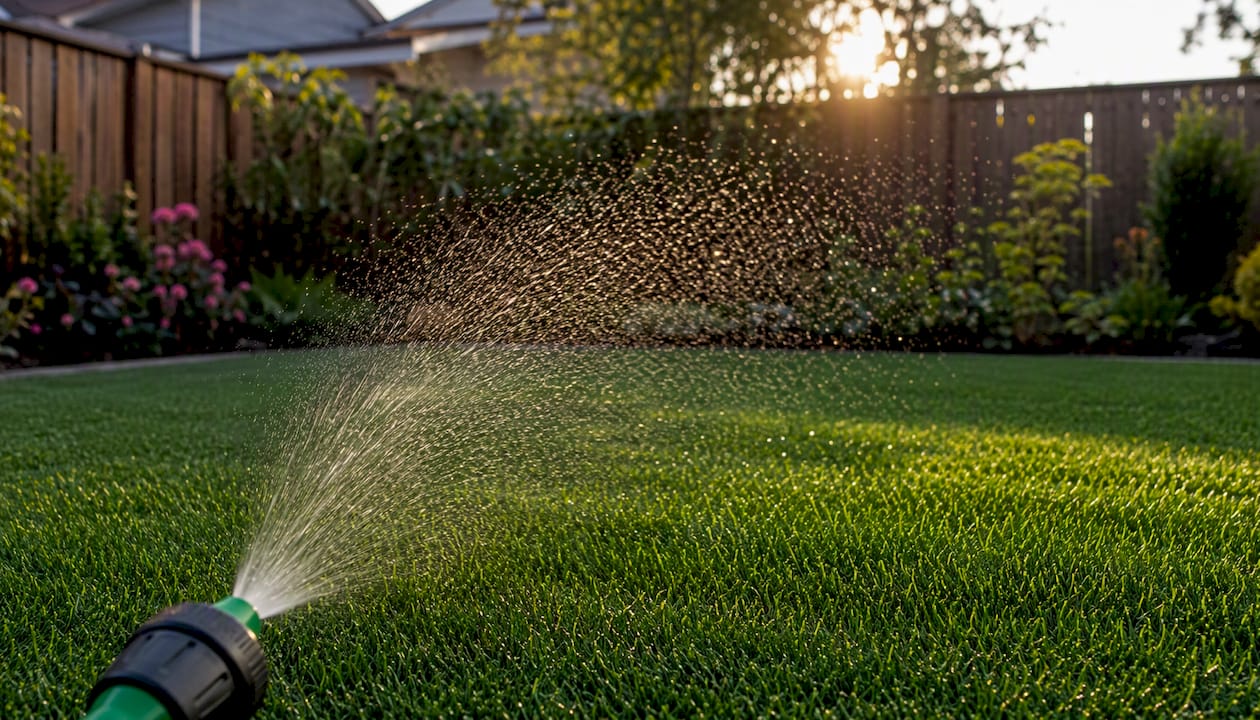
Summer: Synthetic turf surfaces get hot in direct sun, sometimes significantly hotter than the air temperature. A quick rinse with a garden hose cools the surface within minutes and makes it comfortable for kids and pets. In Kansas City’s July heat, rinsing before outdoor use is a practical habit worth building. Keep grills and fire pits off the turf surface entirely.
Fall: Leaf removal becomes the priority. Wet leaves mat down, block drainage, and accelerate organic buildup. Blow or rake at least twice a week during peak leaf fall. Check edges for soil migration before the ground freezes.
Winter: Snow is fine to leave on turf unless you need the space. If you must remove it, use a plastic snow shovel and leave a thin layer rather than scraping to the surface. Never use rock salt or calcium chloride directly on turf — they degrade fibers and backing over time. Sand-based ice melt is safer, but rinse it off as soon as temperatures allow.
Spring: Run a full inspection after winter. Check infill depth, look for any seam movement from freeze-thaw cycles, and do a thorough cross-brush to lift fibers that have been compressed under snow or foot traffic. Spring is also the right time for a full deep clean before heavy-use season begins.
What tools and products should you keep on hand?
You don’t need much.
Essential tools:
- Leaf blower (electric or battery-powered, low setting)
- Plastic-tined rake or turf rake
- Stiff synthetic-bristle push broom (not natural bristle, which holds moisture)
- Garden hose with an adjustable spray nozzle
- Ruler or dowel for measuring infill depth
- Plastic scraper for gum and debris
Recommended cleaners:
- Enzyme-based pet odor cleaner (turf-safe labeled)
- Mild dish soap diluted in water for general stains
- Citrus-based degreaser for oil and grease
- Turf-safe disinfectant for periodic deep cleaning
What not to use: metal rakes, wire brushes, undiluted bleach, acetone, ammonia-based cleaners, harsh solvents, or any open flame near the surface. Avoiding metal tools and concentrated high-pressure washing is a consistent recommendation across installer and manufacturer guidance — it protects fibers, infill, and backing from damage that isn’t always visible until it’s too late.
How maintenance affects your warranty and what safety precautions matter
Most artificial turf warranties run 8–15 years and include conditions. Failing to meet those conditions is the most common reason warranty claims get denied.
Common warranty conditions:
- Regular debris removal and rinsing (documented if possible)
- Infill depth maintained within manufacturer specifications
- No prohibited chemicals (bleach, solvents, oil-based herbicides)
- No heat exposure from grills, fire pits, or reflected glass
- No metal tools used on the surface
Drainage checks: Test drainage by pouring a bucket of water in the center of the turf and timing how long it takes to absorb. Most quality installations drain within 30–60 seconds. Slow drainage signals compacted infill or a blocked sub-base. Document your drainage tests with a date and a note — this record supports warranty claims if backing or drainage issues develop later.
Safety precautions:
- Wear gloves when handling enzyme cleaners or disinfectants, and follow label dilution instructions. The CPSC’s general chemical safety guidance applies to any cleaning product used outdoors.
- When operating a power broom, keep bystanders and pets clear. The rotating brush can throw infill particles at speed.
- Never pressure wash above 1,500 PSI, and always use a wide fan tip.
Read your warranty documentation before you buy any cleaning product. The specific chemicals a manufacturer prohibits vary by brand. A $12 bottle of the wrong cleaner can void a warranty worth thousands of dollars in repair coverage.
The EPA’s research protocol for tire crumb rubber sampling provides useful background on testing standards for rubber infill materials, relevant if you have questions about the environmental profile of your specific infill type.
A practical maintenance schedule and what it costs
Here is a schedule you can follow without overthinking it.
Weekly:
- Blow or rake loose debris
- Rinse pet zones and high-traffic areas
- Scoop and dispose of pet waste
Monthly:
- Full cross-brush groom
- Rinse entire surface
- Check infill depth in high-traffic spots
- Inspect edges and seams
Seasonally (spring and fall):
- Full edge inspection and re-securing if needed
- Infill top-up where depth is low
- Perimeter weed treatment if needed
- Deep clean or schedule professional service
Annually:
- Professional deep clean, power brooming, and infill replenishment
- Full drainage test and documentation
- Seam and backing inspection
Cost ranges: DIY tools and cleaners run roughly $50–$150 to set up initially, with minimal ongoing cost. Professional deep cleaning typically runs $200–$600 for a residential lawn depending on size and condition, with infill replenishment adding $100–$300 depending on square footage and infill type. Seam repairs by a professional generally run $150–$400 per repair. These are industry-typical ranges; get a local quote for your specific situation.
A simple weekly-to-annual schedule prevents matting and organic buildup and is genuinely easy to sustain once the habit is set.
Diagnosing common problems fast
Most turf problems have a clear cause and a straightforward fix.
- Pooling water that won’t drain: Likely compacted infill or blocked sub-base perforations. Remove surface debris, test drainage with a bucket, and brush to decompact infill. If pooling persists after 30 minutes, the sub-base needs professional attention.
- Persistent odor after rinsing: Trapped urine salts in infill. Apply enzyme cleaner, let it dwell, rinse thoroughly. Repeat weekly for 3–4 weeks. If odor continues, infill replacement in that zone may be necessary.
- Flat, matted fibers that won’t lift: Infill has compacted or migrated. Top up infill and cross-brush. High-traffic areas may need this monthly.
- Visible seam lines: Seam adhesive has dried out or the edges have shifted. Small separations are a DIY tape-and-adhesive fix; separations wider than 1 inch need a professional.
- Widespread matting across the whole surface: Usually a sign of chronic under-maintenance or infill loss. A professional power broom and infill replenishment session typically restores the surface.
- Backing delamination (fiber layer peeling from backing): This is a structural failure. Stop using the area and call a professional. DIY repairs won’t hold long-term.
When should you hire a professional for turf maintenance?
Some tasks genuinely need professional equipment or expertise. Knowing the line saves money and prevents accidental damage.
Professional services include:
- Power brooming with commercial-grade rotary equipment
- Infill replenishment (measured, calibrated, and matched to original spec)
- Antimicrobial treatment for pet-heavy or high-use areas
- Seam and edge repair with professional adhesive systems
- Sub-base correction for drainage failures or depressions
- Full system inspection and written documentation
Hire a pro when:
- DIY enzyme treatment hasn’t resolved odor after 4 weeks
- A seam has separated more than 1 inch
- Drainage fails the bucket test after surface decompaction
- A depression deeper than 1/2 inch returns after infill top-up
- You need documented service records for a warranty claim
What to expect from a professional visit: A thorough inspection covers drainage, infill depth, seam integrity, fiber condition, and backing. The technician should provide a written summary. Keep that document with your original installation paperwork.
Pro Tip: Before scheduling a professional visit, measure your turf area in square feet and note the installation date and infill type if you know it. That information lets the technician quote accurately and arrive with the right materials.
What Trew Landscape LLC sees homeowners get wrong
The most common mistake is treating synthetic turf as maintenance-free. It isn’t. It’s low-maintenance, which is a real advantage, but “low” is not “zero.” The homeowners who call us with failing turf almost always share the same history: no regular brushing, no infill checks, and metal tools used for debris removal that slowly shredded the fiber tips over months.
The second most common error is skipping the infill check. Infill is invisible from a distance, so it’s easy to assume it’s fine. But once infill compacts or migrates below the critical depth, fibers flatten and the surface hardens. Restoring it costs more than the quarterly 10-minute check would have.
The habits that produce the biggest long-term value are the simplest ones: a leaf blower pass twice a week, a monthly cross-brush, and one professional deep clean per year. Those three habits, consistently applied, are what keep a turf installation looking sharp at year 12 the way it did at year 2.
Trew Landscape LLC can handle your turf maintenance and installation
Trew Landscape LLC works with Kansas City homeowners and property managers on artificial turf installation and ongoing care. Whether you need a new installation done right from the sub-base up, a professional deep clean to reset a neglected lawn, or a seam repair before the problem spreads, the team brings the equipment and experience to do it correctly.

Professional maintenance from Trew Landscape LLC includes power brooming, infill replenishment matched to your original spec, drainage testing, and a written service record that supports your warranty. For property managers handling multiple sites, scheduled service visits take the tracking burden off your team entirely.
To get a quote, have your turf’s square footage, installation date, and a brief description of any issues ready. Reach out through the Trew Landscape services page to schedule a consultation or maintenance visit. Documented professional service is one of the most straightforward ways to protect a turf investment that, properly cared for, should last well over a decade.
Sources
- Safesportsfields
- Epa
- Maintenance: Synthetic Turf - Safe Healthy Playing Fields
- Ultimate Guide to Synthetic Turf Care - Pacific Pavers
- Maintaining Artificial Grass: The Texas Homeowners’ Guide to Lawn Care (2026)
FAQ
What maintenance is needed for artificial turf?
Artificial turf maintenance requires weekly debris removal and rinsing, monthly cross-brushing to lift fibers and redistribute infill, and an annual deep clean. Pet zones and high-traffic areas need more frequent attention, including enzyme treatments for odor control.
Do you need to put sand on artificial grass every year?
Not necessarily every year, but infill depth should be checked monthly in high-use areas. Top up with the original infill type when the gap between fiber tips and infill surface exceeds roughly 3/4 inch, which may be annually or less often depending on traffic.
How long does artificial turf last with proper maintenance?
Properly maintained synthetic turf can reach 15–20 years of service life. Neglected installations often fail well before that threshold, and documented maintenance is typically required to support warranty claims.
Can you pressure wash artificial turf?
Yes, with limits. Stay below 1,500 PSI and use a 40-degree wide fan nozzle held at least 12 inches from the surface. A zero-degree pinpoint nozzle cuts fibers and blasts infill out of position, so avoid it entirely.
What cleaners are safe for synthetic grass?
Enzyme-based pet cleaners labeled turf-safe, diluted mild dish soap, and citrus-based degreasers are all appropriate. Avoid undiluted bleach, ammonia-based cleaners, acetone, and oil-based solvents, which degrade turf backing and can void manufacturer warranties.