
Trew Landscape Blog
Know the 4 ft and 6 ft Fence Height Limits in North Kansas City
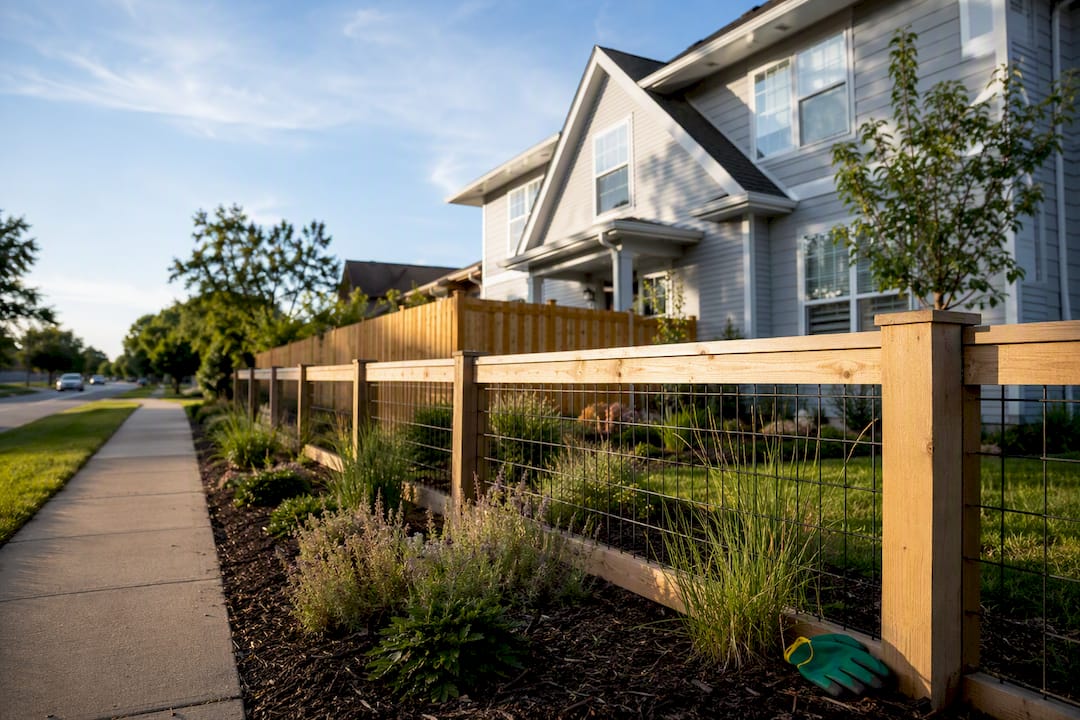
Know the 4 ft and 6 ft Fence Height Limits in North Kansas City ! Street-side fence on a corner lot Front yards and street-side corner lots cap fences at 4 feet.
Know the 4 ft and 6 ft Fence Height Limits in North Kansas City
Front yards and street-side corner lots cap fences at 4 feet. Interior side and rear yards allow up to 6 feet. Standard residential fences in Kansas City don’t need a building permit, but they still have to follow the height and placement rules in Chapter 27 of the zoning code. If your project doesn’t fit those numbers, your next call is Neighborhoods and Housing at 816-513-3200, or 311.
TL;DR:
- Fences higher than 4 feet on front yards or street-side corners require special consideration, as these areas are capped at 4 feet unless a variance is approved.
- Building a 6-foot fence on a sloped lot or on top of a retaining wall can result in a measurement exceeding the height limit because the height is measured from the higher ground.
- No permit is needed for standard residential fences under 6 feet, but thresholds in historic districts, floodplains, or planned developments may trigger additional review or permits.
- Verifying property lines through a boundary survey is crucial before construction to avoid disputes, as the city enforces setbacks based on accurate boundary data.
- Requests for fences taller than 6 feet must go through a formal variance process that requires documentation and possibly professional support, with no guarantee of approval.
Table of Contents
- Fence Height Kansas City: The Quick Reference
- How Fence Height Is Actually Measured
- Do You Need a Permit to Build a Fence in North Kansas City?
- Property Lines and Surveys: Get This Right First
- Getting a Variance for a Taller Fence
- HOA Rules and Material Choices That Keep You Compliant
- What Trew Landscape LLC Checks Before Building Your Fence
- A Straight Answer on What Actually Trips People Up
- Get Fence Installation Done Right the First Time
- Where to Verify These Rules Yourself
- Sources
- FAQ
Fence Height Kansas City: The Quick Reference
The two numbers that matter are 4 and 6. Everything else in this article is detail around those figures.
- Front yard or street-side corner lot: 4 feet maximum
- Interior side yard: 6 feet maximum
- Rear yard: 6 feet maximum
- Fences over 6 feet anywhere on a residential lot: not allowed without a variance
KCMO Chapter 27 sets the citywide baseline, but if your property sits inside North Kansas City’s own municipal boundary rather than Kansas City proper, check the local code directly. North Kansas City carries its own ornamental and transparency requirements near the street right-of-way, meaning some front sections may need to allow visibility through the fence even within that 4-foot limit.
Corner lots trip people up more than any other detail. If your side yard faces a street, it’s treated as a front yard for height purposes, not a side yard. That 6-foot privacy fence you were planning for the side facing the street is actually capped at 4 feet.
How Fence Height Is Actually Measured
The city measures from the grade on the high side of the fence, not the low side. That distinction matters the moment your yard isn’t flat.
Picture a backyard that slopes down toward a rear property line. If you build a 6-foot fence starting from the low end, the fence can end up towering well past 6 feet when measured from the higher ground next door. Chapter 27 measures from whichever side sits higher, so the fence has to be built shorter on the low side to stay compliant overall. Retaining walls compound this. A fence sitting on top of a retaining wall gets measured from the ground at the base of that wall, not from the wall’s top edge, which means a 4-foot retaining wall plus a 6-foot fence on top of it reads as a 10-foot structure to code enforcement.
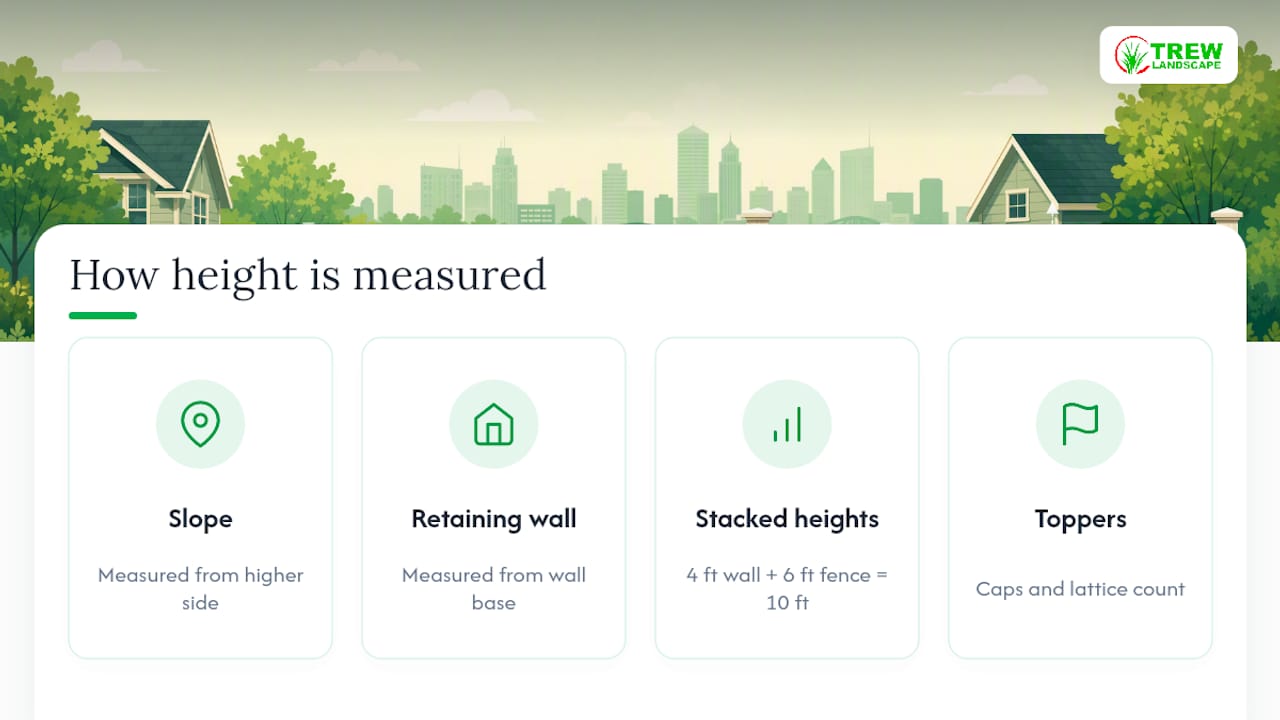
Decorative caps, post finials, and lattice toppers count toward total height too. A “6-foot” panel with an 8-inch lattice cap is really a 6-foot-8-inch fence in the eyes of the code.
Pro Tip: If you need privacy on a front or street-side yard where you’re stuck at 4 feet, skip the fence entirely for that stretch. Staggered evergreen plantings or raised planter boxes along the property line often deliver more visual screening than a fence panel can, without touching the height limit.
Do You Need a Permit to Build a Fence in North Kansas City?
Standard residential fences don’t require a building permit in Kansas City. City guidance confirms fences fall under zoning regulation through Chapter 27, not the building permit process, and enforcement runs through Neighborhoods and Housing rather than a plan review counter.
That exemption has limits. A few situations pull your project back into permit or review territory:
- Historic districts. Properties inside a designated historic overlay often face design review on materials, style, and placement, regardless of height.
- Floodplain areas. Fences in a mapped floodplain can affect drainage and may require additional review before installation.
- Planned unit developments (PUDs). PUDs frequently carry their own site-specific rules that override the general zoning baseline.
- Retaining walls above a certain height. A fence built on or near a tall retaining wall may trigger a separate permit for the wall itself, even though the fence stays exempt.
Before you dig a single post hole, check your property’s overlay status on CompassKC, the city’s zoning and planning portal. It’s the fastest way to confirm whether your lot carries any special designation that changes the baseline rules.
Property Lines and Surveys: Get This Right First
Verifying your property line is entirely your responsibility as the homeowner. The city won’t step in to settle a boundary disagreement between neighbors; Neighborhoods and Housing enforces height and placement rules, not private property disputes.
Before you build, take these steps:
- Pull your deed and plat to see what’s officially recorded for your lot lines.
- Order a boundary survey if the plat is unclear, old, or the property has changed hands or been subdivided since it was last surveyed.
- Physically mark the line with stakes or flags before any digging starts, so your installer builds to the real boundary rather than an assumed one.
- Call Missouri 811 before digging post holes. It’s free, and it keeps you from hitting a gas or utility line mid-project.
A boundary survey costs far less than tearing out a fence you built six inches onto a neighbor’s lot.
Pro Tip: Keep your survey, plat, and dated photos of the property line and staking process in one folder. If a neighbor ever disputes where your fence sits, that paper trail settles the argument faster than any conversation will.
Getting a Variance for a Taller Fence
Some homeowners genuinely need more than 6 feet, usually for noise, privacy from a busy street, or a pool enclosure. That requires a variance through the Board of Zoning Adjustment, and it’s worth knowing the process isn’t quick or guaranteed.
- Call first. Start with Neighborhoods and Housing at 816-513-3200 or 311 to confirm a variance is actually the right path for your situation.
- Document the impact. Successful variance requests typically include a site plan showing how the taller fence affects sightlines and neighboring properties, sometimes with landscaping or tiered design meant to soften the visual impact.
- Bring professional backup. A letter from a landscape architect or engineer supporting the request carries more weight with the board than a homeowner’s written explanation alone.
If a variance looks unlikely for your lot, staggered fence sections, sound-dampening landscaping, or raised garden beds along the property line often solve the underlying privacy or noise problem without ever going before the board.
HOA Rules and Material Choices That Keep You Compliant
City code is the floor, not the ceiling. Homeowners associations frequently impose stricter height limits, material restrictions, or color requirements than Chapter 27 does, so check your CCRs before you order materials.
- Wood looks classic but needs regular sealing to handle Kansas City’s freeze-thaw winters and humid summers.
- Vinyl holds up well against that same weather swing with far less upkeep; see our vinyl fence maintenance guide for seasonal care.
- Ornamental metal meets visibility requirements on street-facing sections almost automatically, since the open pickets satisfy transparency rules while still marking the boundary.
For street-facing sections where transparency matters, wider picket spacing gets you a defined boundary without reading as a solid wall.
What Trew Landscape LLC Checks Before Building Your Fence
A fence that looks right on paper can still land you in a dispute or a compliance letter if nobody checked the fundamentals first. Before we install a fence for a North Kansas City homeowner, our crews walk the site for a handful of specifics that rarely show up in a DIY plan.
- Slope and grade across the fence line, since that determines the high-side measurement point.
- Recorded plat and property corners, confirming the fence goes where the paperwork says it should.
- Overlay zones, checked against CompassKC for historic, floodplain, or PUD status.
- Visible utilities and access points, flagged before any post holes go in.
Coordinating a survey, running the CompassKC check, and keeping a documentation packet on file is standard practice for a licensed local installer. It’s the difference between a fence that stays up without argument and one that becomes a letter from Neighborhoods and Housing six months later.
A Straight Answer on What Actually Trips People Up
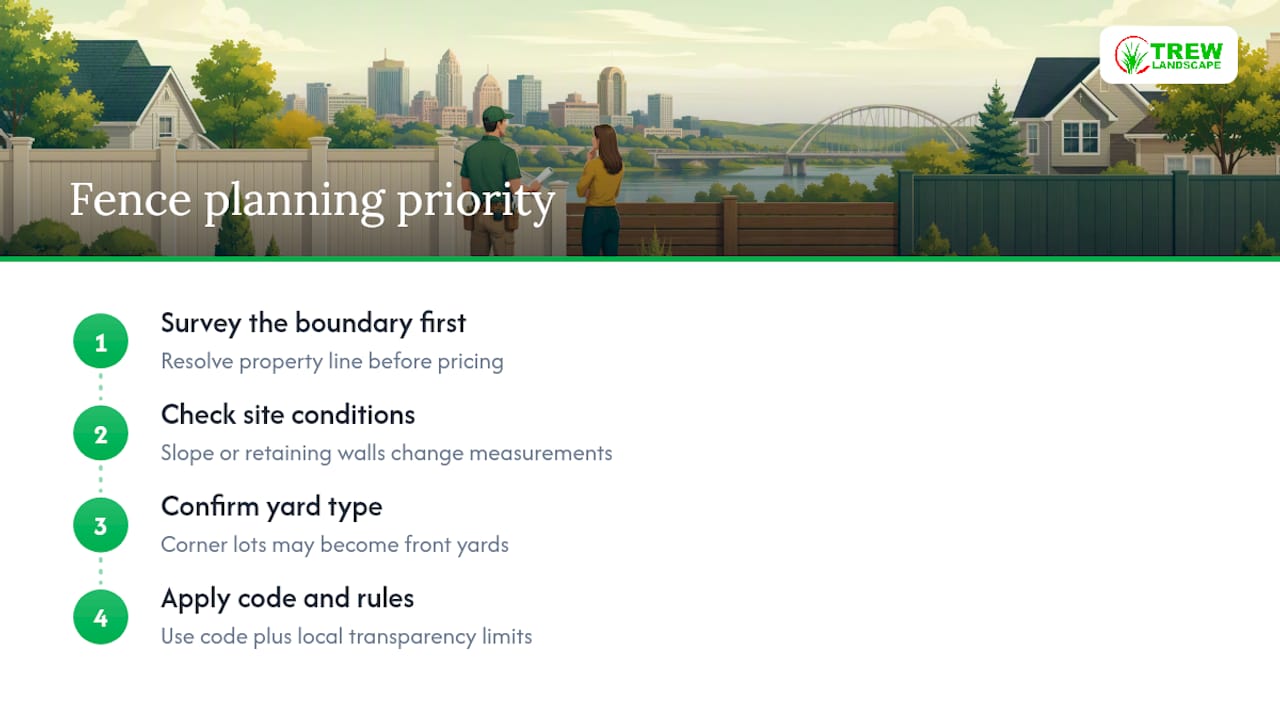
Most homeowners don’t run into trouble with the 4-foot or 6-foot numbers themselves. Those are easy to find and easy to follow. Where projects actually go sideways is the stuff nobody mentions until it’s already a problem: the slope that makes a “6-foot” fence measure taller on the neighbor’s side, the corner lot that quietly reclassifies a side yard as a front yard, or the property line that was never actually surveyed.
Conventional advice on this topic stops at “check the code,” which is true but incomplete. The code tells you the ceiling. It doesn’t tell you that a retaining wall changes your measurement point, or that North Kansas City’s transparency rules can apply even within the 4-foot limit on certain frontages.
If you’re planning a fence this year, prioritize the boundary survey before you price out materials. A wrong property line turns a straightforward install into a legal headache, while a correct one makes every other decision, height, material, design, straightforward. Get the line right first. Everything else follows from that.
— Trew Landscape LLC
Get Fence Installation Done Right the First Time
Trew Landscape LLC handles the parts of a fence project that homeowners usually don’t see coming, the grade check, the overlay lookup, the plat comparison, before a single post goes in the ground. That’s the real advantage over guessing your way through Chapter 27 on your own: fewer surprises, no re-dos, and no compliance letters six months after installation.

We coordinate site visits, boundary confirmation, and design choices that satisfy both city code and your own privacy goals, whether that’s a straightforward 6-foot rear yard fence or a more involved project that ties into a retaining wall or hardscape design. If you’re weighing materials, our fence company guide covers what holds up best in this climate, and our pet-safe fence guide is worth a look if dogs are part of the equation.
Ready to get your fence project started the right way? Request a free on-site consultation through our landscape design services page and we’ll walk your property before you spend a dollar on materials.
Where to Verify These Rules Yourself
- KCMO Chapter 27, Fences and Walls, the full text of the height and placement code
- City of Kansas City code questions page, for permit and enforcement contacts
- North Kansas City Code of Ordinances, for property-specific fence provisions
For anything specific to your lot, call Neighborhoods and Housing at 816-513-3200 or dial 311.
This article is general information, not a substitute for advice from a qualified lawyer. Consult a qualified legal professional about your own circumstances before acting on anything here.
Sources
- Chapter 27 - FENCES AND WALLS | Code of Ordinances | Kansas City, MO | Municode Library
- Code Questions | CITY OF KANSAS CITY
- Building a Fence in Missouri? When You Need a Permit (2026)
FAQ
What are the fence laws in Kansas City?
Fences are regulated under Chapter 27 of the zoning code, which caps front and street-side yards at 4 feet and interior side and rear yards at 6 feet, with no building permit required for standard installations.
Can you have a fence higher than 6ft?
Only with an approved variance from the Board of Zoning Adjustment; standard residential lots cap out at 6 feet in side and rear yards without one.
What is the maximum height of a backyard fence?
A rear yard fence tops out at 6 feet, measured from the grade on the higher side of the fence line.
How close to the property line can I put a fence?
Fences generally go right up to the property line, but the exact line is the homeowner’s responsibility to confirm; order a boundary survey if your deed or plat isn’t clear before building.