
Trew Landscape Blog
Gabion Retaining Wall: Design Rules, Costs, and Build Steps
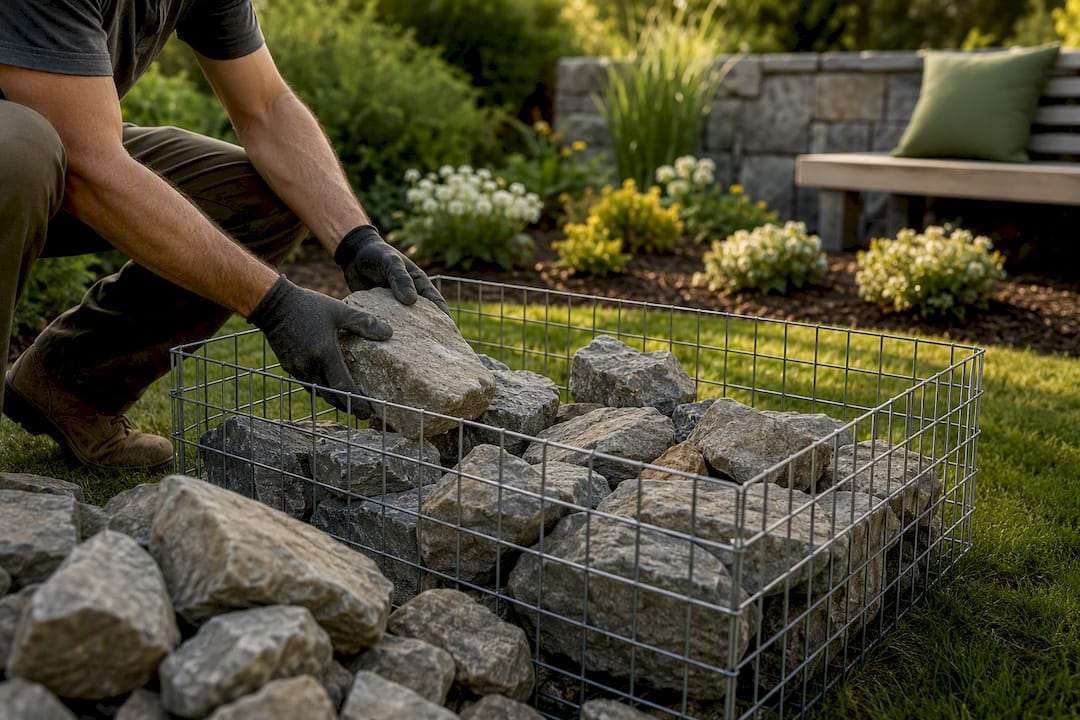
Gabion Retaining Wall: Design Rules, Costs, and Build Steps ! Hands filling gabion wall basket with stones Gabion retaining walls make sense when you need a permeable, settlement-tolerant wall for erosion control or terracing, and you have the space and labor to build one.
Gabion Retaining Wall: Design Rules, Costs, and Build Steps
Gabion retaining walls make sense when you need a permeable, settlement-tolerant wall for erosion control or terracing, and you have the space and labor to build one. They cost less than concrete in many cases if you source fill locally, but they demand real physical work and a wider footprint than a poured wall.
- Drainage: water passes through the stone fill instead of pushing against it, cutting hydrostatic pressure that cracks solid walls
- Flexibility: the structure shifts slightly with the ground instead of fracturing, which helps on uneven or settling soil
- Trade-offs: bulky footprint, heavy manual labor, and an industrial look that some homeowners love and others don’t
The Family Handyman frames gabions as porous, budget-friendly, and labor-intensive. That’s the honest version most guides skip past.
Key Takeaways
Gabion retaining walls succeed when drainage detailing, base preparation, and wire coating are matched to the site’s soil and water conditions, not chosen by price alone.
| Point | Details |
|---|---|
| Drainage is the core advantage | Porous stone fill eliminates the hydrostatic pressure that cracks solid walls. |
| Base width scales with height | Design guidance sets base width at roughly 0.6 to 0.75 times wall height. |
| Coating choice affects lifespan | Zinc-aluminum or PVC-coated wire outlasts standard galvanized wire near salted roads or coastlines. |
| Engineering is required past a threshold | Tall walls, surcharges, poor soil, or seismic zones need a licensed engineer, not a rule-of-thumb. |
| Trew Landscape LLC fits drainage-heavy sites | Trew Landscape LLC recommends gabions for eroding slopes and ponding sites, pairing them with broader retaining wall construction work. |
Table of Contents
- What Is a Gabion Retaining Wall?
- Are Gabion Walls Worth the Labor and Cost?
- How Do You Design a Stable Gabion Wall?
- What Wire and Fill Materials Should You Use?
- How Do You Build a Gabion Wall Step by Step?
- What Are the Numeric Rules for Sizing a Gabion Wall?
- How Long Do Gabion Walls Last With Proper Maintenance?
- What Does a Kansas City Contractor Look for Before Recommending Gabions?
- Why We Think Gabion Walls Are Underrated for the Wrong Reasons
- Ready to Build a Wall That Fits Your Site?
- Sources
- FAQ
What Is a Gabion Retaining Wall?
A gabion retaining wall is a stack of wire-mesh baskets filled with rock, rubble, or recycled concrete, built to hold back soil or slow erosion. Unlike a solid concrete or block wall, it works as a mass gravity structure. Its own weight and internal friction resist the soil pushing against it, not tension steel or mortar bonds.
You’ll run into a few common configurations:
- Single-course walls: one row of baskets, used for low retaining edges or garden terracing
- Stacked multi-course walls: baskets set in tiers with a setback per row, used for taller cuts
- Gabion mattresses: flatter, wider units used on streambeds and slopes for erosion control rather than vertical retention
- Tie-back systems: baskets anchored into the slope behind them for extra resistance on taller or loaded walls
Typical uses span riverbank stabilization, highway cut slopes, backyard terracing, and decorative landscape features where the stone face itself becomes part of the design.
Are Gabion Walls Worth the Labor and Cost?
Gabion baskets earn their keep on drainage. Because water moves freely through the stone fill, hydrostatic pressure never builds up behind the wall the way it does behind a solid concrete or block structure. That single trait is why gabions show up so often on floodplain edges, riverbanks, and waterlogged sites where a sealed wall would eventually fail or need weep holes engineered in from the start, according to Family Handyman.
The flexibility helps too. A gabion wall tolerates minor ground settlement without cracking, and if you have rock on-site or nearby, fill cost drops fast.
- Advantage: permeable, self-draining structure with no weep holes to engineer
- Advantage: tolerates settlement better than rigid concrete or block
- Drawback: labor-intensive to fill by hand, especially for facing stone
- Drawback: wide footprint compared to a poured wall of the same height
- Drawback: wire mesh corrodes faster in coastal or heavily salted environments
Gardenista notes the industrial look reads as a feature in modern landscapes and a flaw in traditional ones. Costs vary widely by region and fill source. A short DIY garden wall is realistic for an ambitious homeowner with a weekend and a truck. Anything over a few feet tall, or requiring machine-placed fill and compaction, calls for a crew and equipment.
Pro Tip: Price your fill stone before you commit to the design. If a quarry near you sells rubble or crushed rock cheap, gabions can beat concrete on cost. If you’re trucking stone in from three counties over, that advantage disappears fast.
How Do You Design a Stable Gabion Wall?
Gabions drain because the stone fill itself is porous, but that only protects the wall if fine soil particles don’t wash into the gaps and clog them. That’s where geotextile filter fabric comes in, laid between the backfill soil and the basket to keep silt and clay out while still letting water pass.
Foundation prep matters as much as the baskets themselves:
- Excavate to a level, compacted base, ideally crushed rock, before setting the first course
- Embed the bottom course partially below grade rather than sitting it directly on grass or loose fill
- Reserve a poured concrete footing for tall walls, poor bearing soil, or where a building code requires it
Base width and batter aren’t guesswork. Design references put base width at roughly 0.6 to 0.75 times the wall’s total height for common ranges, with each stacked course set back slightly from the one below it. That batter angle shifts the wall’s center of gravity back into the slope instead of letting it lean forward under load.
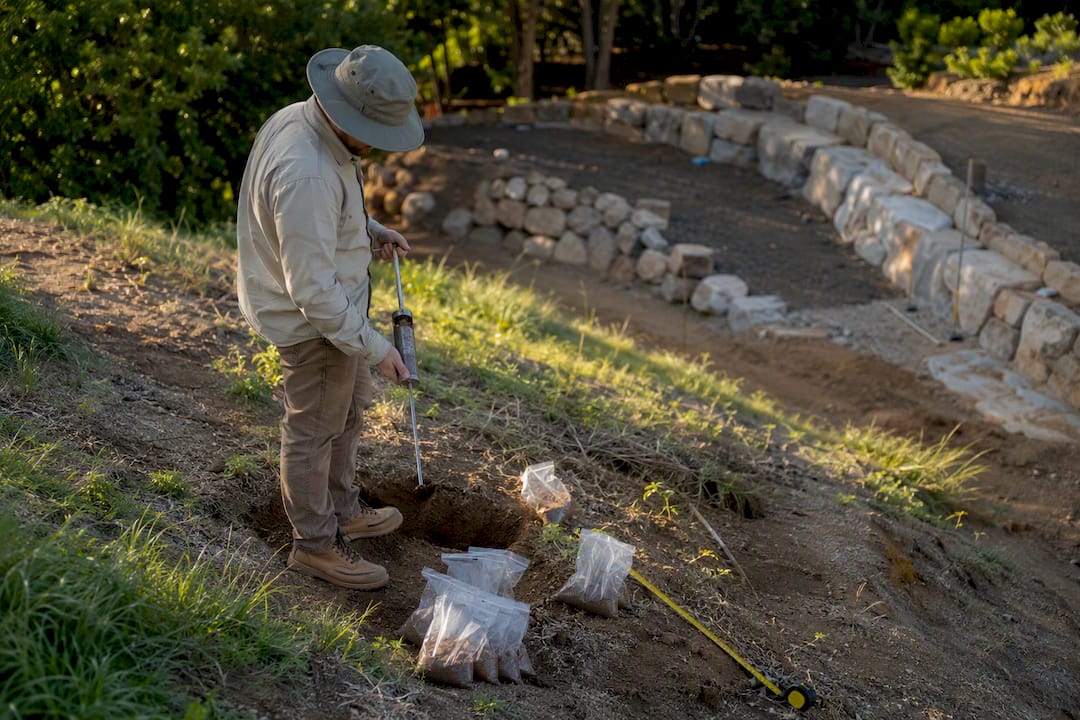
Call in a geotechnical engineer once you’re dealing with walls over a few feet tall, retaining a driveway or structure surcharge, working in poor or expansive soil, or building in a seismically active region. Skipping that step on a marginal site is where DIY gabion projects fail.
What Wire and Fill Materials Should You Use?
Wire coating decides how long your wall lasts, more than almost any other spec. Standard galvanized wire holds up fine in ordinary inland yards. Zinc-aluminum alloy coatings or PVC-coated wire perform far better near roads salted in winter, on coastlines, or anywhere the basket sits in standing or moving water, a point Darda’s technical guidance makes clear for aggressive exposures. Stainless mesh costs more but makes sense on high-visibility or hard-to-access walls where replacement later is a headache.
Mesh opening size drives your stone selection: fill stone has to be visibly larger than the mesh openings, or it works its way out over time.
- Face stones: choose for color and shape since they’re what visitors actually see
- Core fill: recycled concrete rubble works structurally and costs less than quarried stone, though quarried rock packs tighter and interlocks better
- Filter fabric: pick a fabric rated for your soil’s fines content, since a fabric that clogs defeats the whole point of a permeable wall
How Do You Build a Gabion Wall Step by Step?
Site prep decides whether your wall performs for decades or shifts within a year. Get the base compacted and level before anything else touches the ground.
- Excavate and compact the foundation trench, checking it stays level across the wall’s full run
- Assemble basket panels with the manufacturer’s spiral connectors or C-rings, checking every corner for square
- Set the first course, then start filling: hand-place face stones for a clean look, machine-fill the core for speed
- Install cross-bracing wires partway through filling to stop the wire mesh from bulging outward under stone weight
- Lay geotextile fabric against the backfill side and add a base drain or perforated pipe if the site holds groundwater
- Lace each new course to the one below with connecting wire before filling the next tier
Contractors typically hand-place the visible facing stones while a machine drops fill into the core, running cross-bracing wire in as they go rather than after the basket’s already full. That sequencing prevents the classic bulging failure you see in rushed DIY jobs.
Pro Tip: Never fill a basket completely before wiring in the cross-braces. Once the stone’s packed tight, you can’t get bracing wire through it without pulling fill back out.
What Are the Numeric Rules for Sizing a Gabion Wall?
Base width to height ratio is the number most homeowners get wrong. Design references generally put it at 0.6 to 0.75 times wall height for typical residential and light commercial heights, narrower for short walls and wider once you’re stacking multiple courses.
- Embedment: bury the bottom course partially into compacted subgrade, never set baskets directly on unprepared ground
- Batter: step each course back slightly from the one below to shift weight into the slope
- Porosity: expect roughly 35 to 40 percent void space in the fill, which affects both drainage capacity and the wall’s actual weight
That porosity number matters more than it looks. A wall with too much void space and poorly graded stone loses internal friction and interlock, which is exactly what stability calculations depend on.
Four failure modes get checked in any proper gabion design: sliding along the base, overturning about the toe, bearing capacity of the foundation soil, and internal bulging of individual baskets. If your project involves a tall wall, a surcharge load like a driveway or patio above it, or soil with known bearing problems, that’s your signal to bring in an engineer rather than eyeball it. Our retaining wall for slope guide covers more on when slope conditions push a project past DIY territory.
How Long Do Gabion Walls Last With Proper Maintenance?
Inspect a gabion wall at least once a year, and after any major storm. Look for bulging panels, loose or broken connecting wire, drainage outlets clogged with silt, and vegetation roots working into the joints.
- Check corner connections and cross-bracing wire for signs of stretching or breakage
- Clear any base drain or weep points before winter, when clogged drainage causes the most damage
- Watch for rust streaking on standard galvanized wire in wet or salted areas, an early corrosion signal
Standard galvanized wire typically holds up for decades in ordinary conditions, while zinc-aluminum or PVC-coated wire extends service life further in harsh exposures, per design guideline recommendations on coating selection.
Pro Tip: Budget for a coating upgrade if your wall sits within splash distance of a salted road or a pool. The wire is the cheapest part of the project to spec correctly and the most expensive part to replace later.
What Does a Kansas City Contractor Look for Before Recommending Gabions?
Trew Landscape LLC reaches for gabions on sites with real drainage problems: slopes that pond water, creek banks that erode every spring, or terraced yards where a rigid wall would crack within a few seasons. They pair well with broader retaining wall construction work when a property needs both structural retention and a look that fits the surrounding landscape.
- Access matters most for timeline: a wall a backhoe can reach moves faster than one requiring hand-carried fill
- Crew size scales with wall length and course count, not just height
- Fill sourcing is the biggest cost swing we see, more than labor or basket cost itself
- Grading and finish detailing at the wall’s ends and drainage tie-ins take longer than the stacking itself
Sites with standing water or seasonal erosion are where gabions consistently outperform a solid wall. The material choice isn’t aesthetic first. It’s about what the ground is actually doing.
We tell clients to have the maintenance conversation before signing, not after. A gabion wall built with the right coating and drainage detail needs little attention for years, but skipping that conversation is how surprise repair costs happen.
Why We Think Gabion Walls Are Underrated for the Wrong Reasons
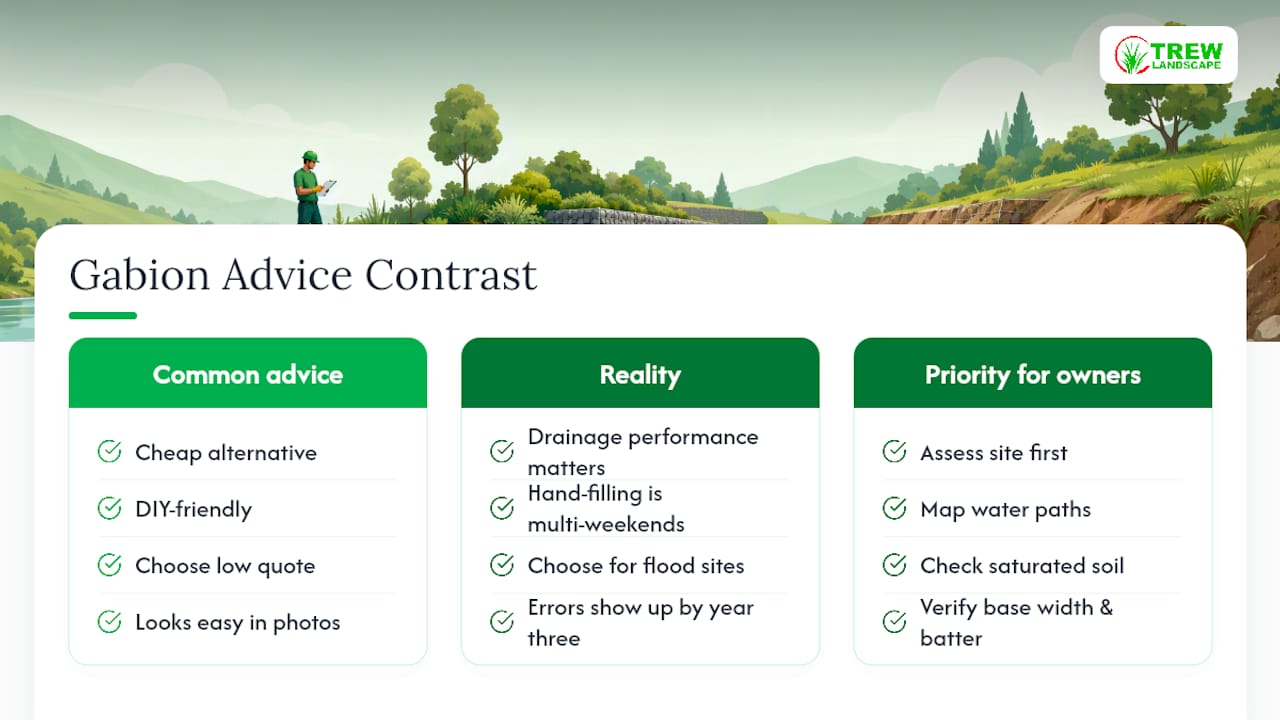
Most advice on gabion walls treats them as a cheap alternative to concrete, and that framing misses the point. The real case for gabions is drainage performance on a site where water is the actual enemy, not the price tag. We’d rather see a homeowner pick a gabion wall because their yard floods every spring than because a quote came in lower.
The conventional advice also undersells the labor math. Guides love to call gabions “DIY-friendly,” but hand-filling baskets for a wall over a couple of feet tall is a multi-weekend job, and getting the base width and batter wrong doesn’t show up as a problem until year three when the wall starts leaning. That’s the gap between what looks easy in a photo and what it takes on your actual slope.
If you’re weighing gabions, prioritize the site assessment first: where does water actually go on your property, and what’s the soil doing when it’s saturated? Everything else, coating grade, fill source, stacking pattern, follows from that answer.
Ready to Build a Wall That Fits Your Site?
If gabions aren’t the right call for your slope, and sometimes a poured or block wall genuinely fits the soil and load better, Trew Landscape LLC still builds the right solution instead of forcing one system on every yard. That’s the real advantage of working with a full hardscaping crew rather than piecing a DIY project together from guides: someone actually walks your site, checks how water moves across it, and specifies the wall accordingly.

Trew Landscape LLC handles everything from initial grading through final drainage tie-ins, and our hardscape design team coordinates retaining wall work with the rest of your landscape plan so the finished project looks intentional, not bolted on. We serve residential and commercial properties across the Kansas City area, and we’ve built enough retaining walls to know which sites need gabions, which need concrete, and which need an engineer before either. If your slope has been eroding, ponding, or slowly leaning for a season or two, request a quote through our retaining wall services page and we’ll walk the site with you.
Sources
- What To Know About Gabion Walls | The Family Handyman
- Gabion Wall | Retaining Wall Design & Drainage — Darda
- GUIDELINES FOR DESIGN AND INSTALLATION OF GABION STRUCTURES
- Hardscaping 101: Gabion Walls - Gardenista
FAQ
What Are the Disadvantages of Gabion Walls?
The main drawbacks are labor-intensive filling, a wider footprint than a poured wall of the same height, an industrial appearance some homeowners dislike, and wire corrosion risk in coastal or heavily salted environments.
Are Gabions Cheaper Than a Standard Retaining Wall?
Gabions can cost less than concrete when local or recycled fill stone is available, but costs rise fast once you need trucked-in stone or heavy equipment for larger walls.
Are Gabions Good for Retaining Walls?
Yes, especially on sites with drainage problems: their permeability prevents the hydrostatic pressure buildup that cracks solid walls, making them a strong fit for slopes, riverbanks, and waterlogged yards.
What Is a Disadvantage of Gabions?
Beyond labor and footprint, wire mesh corrosion is the biggest long-term risk, particularly with standard galvanized wire near salted roads, coastlines, or standing water, which is why coating selection matters as much as the stone itself.
When Should I Hire an Engineer Instead of Building a Gabion Wall Myself?
Bring in a licensed engineer for tall walls, any wall supporting a surcharge like a driveway or patio, poor or expansive soils, or seismically active regions, since these conditions push the design past standard rules-of-thumb.