
Trew Landscape Blog
Code Backed Outdoor Christmas Light Safety for Kansas City Homes
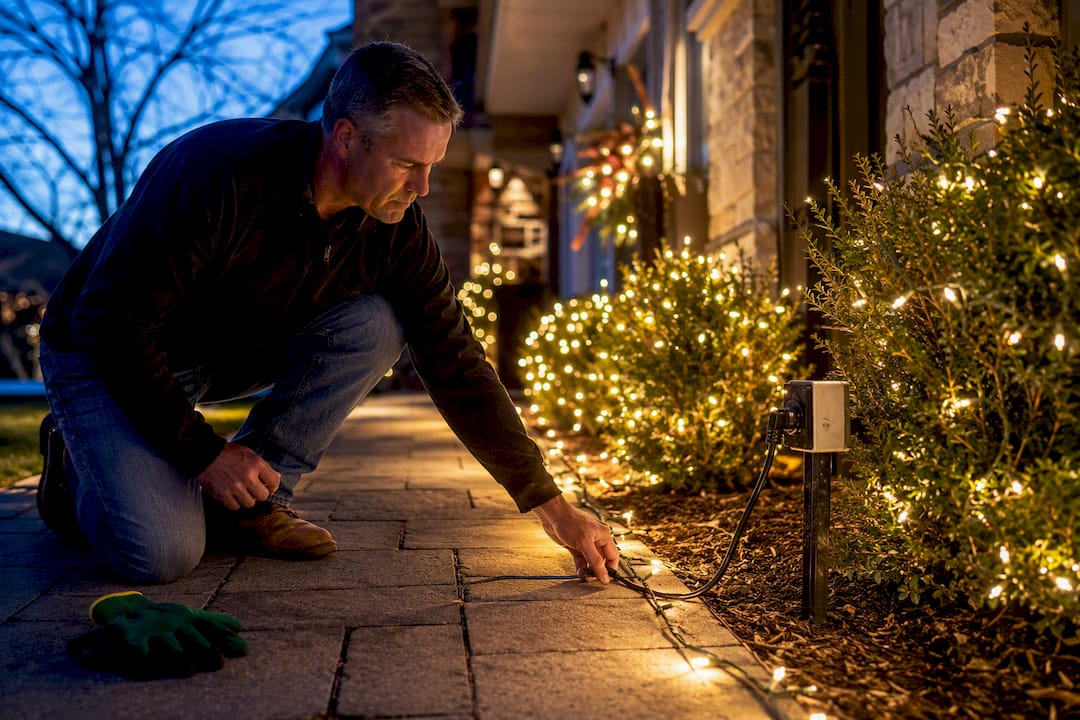
Code Backed Outdoor Christmas Light Safety for Kansas City Homes ! Homeowner inspecting safe outdoor Christmas lights Outdoor Christmas light safety comes down to five things: use lights rated for outdoor use, plug into a GFCI-protected outlet, throw out anything with a frayed or cracked cord, mount lights with insulated clips instead of nails or staples, and put the whole display on a timer.
Code Backed Outdoor Christmas Light Safety for Kansas City Homes
Outdoor Christmas light safety comes down to five things: use lights rated for outdoor use, plug into a GFCI-protected outlet, throw out anything with a frayed or cracked cord, mount lights with insulated clips instead of nails or staples, and put the whole display on a timer. Check the tag for the manufacturer’s end-to-end connection limit before you link multiple strings together. If your setup involves multiple circuits, roofline work, or wiring near a service drop, a licensed installer like Trew Landscape LLC is the safer route.
TL;DR:
- Using LED strings reduces power consumption and heat, making them safer for long rooflines and multi-story homes compared to incandescent lights.
- Always check light string tags for outdoor rating, UL wet or damp certification, and connection limits to prevent overloads and fire hazards.
- Mount lights with insulated clips and secure cords above ground while keeping extension cords and outlets weatherproofed and elevated to avoid moisture entry.
- For complex or multi-circuit displays, hire a licensed professional to ensure safe load distribution, proper hardware, and code compliance.
- Test all light strings before installation and after dark to identify failures early, and promptly dispose of any damaged sets to prevent fire risks.
Table of Contents
- Quick Outdoor Christmas Light Safety Checklist Before You Hang Anything
- What Do UL Ratings and Warning Labels on Light Strings Actually Mean?
- How Much Power Can Your Outdoor Outlet Safely Handle?
- How Do You Hang Christmas Lights Securely Without Damaging Them?
- Keeping Plugs and Cords Dry Through a Kansas City Winter
- When Should You Test, Store, and Replace Your Light Strings?
- When Does Outdoor Christmas Light Installation Call for a Licensed Pro?
- How Do You Prevent Fires From Christmas Light Transformers and Timers?
- How Do You Keep Kids and Pets Safe Around Outdoor Light Displays?
- How Should You Handle and Dispose of Damaged Christmas Lights?
- An Editorial Take: Why “It Worked Last Year” Isn’t a Safety Standard
- Get a Safety-First Christmas Light Installation in Kansas City
- Sources
- FAQ
Quick Outdoor Christmas Light Safety Checklist Before You Hang Anything
Almost one-third of home Christmas tree fires trace back to electrical problems, according to USFA/FEMA data. Most of those failures start with something a five-minute check would have caught.
Work through this order before a single clip touches your roofline:
- Unroll every string and inspect it for frayed wire, cracked sockets, or bent prongs. Throw out anything questionable.
- Confirm the tag says “for outdoor use” and check whether it’s UL wet rated or UL damp rated.
- Find the manufacturer’s end-to-end connection limit printed on the tag, and don’t exceed it.
- Map your outlets, confirm GFCI protection, and plan for a timer rather than manual on/off switching.
- Use outdoor-rated extension cords sized for the run length and total wattage, with connections kept off the ground.
- Fasten with insulated clips, not staples or nails, and keep everything at least 10 feet from power lines.
Pro Tip: Test the whole display on the ground before you climb anything. It’s far easier to spot a dead bulb or bad plug at eye level than 12 feet up a ladder.
Once everything’s mounted, walk the display at dusk. Look for cords crossing walkways, plugs sitting in puddles, or anything a kid or dog could snag.
What Do UL Ratings and Warning Labels on Light Strings Actually Mean?
The tag on a light string tells you almost everything you need to know, if you read it. Look for “for outdoor use,” a UL wet or UL damp rating, and the maximum number of strings you can connect end to end. CPSC guidance on seasonal lighting points to UL 588 as the reference standard, which requires minimum wire gauge, strain relief at connection points, and overcurrent protection built into the set.
LED strings run cooler and pull far less power than incandescent sets, which is why they’re generally the safer pick for long rooflines or multi-story homes. A 100-bulb LED string uses roughly 5 watts compared to about 40 watts for an equivalent incandescent set, according to The Christmas Light Emporium. Lower draw means less heat at the socket and more room under your circuit’s capacity.
Toss a string immediately if you find any of these:
- A pinched or crushed plug
- Exposed copper or bare conductor anywhere along the run
- A cracked or melted socket
- Insulation that’s brittle, split, or peeling
There’s no repairing your way past these. A $15 replacement set beats a house fire every time.
How Much Power Can Your Outdoor Outlet Safely Handle?
Outdoor outlets should have GFCI protection because a ground fault circuit interrupter cuts power the instant it detects current leaking somewhere it shouldn’t., which is exactly the scenario a wet plug or nicked cord creates. If your exterior outlets predate 2008 or so, they may not have GFCI built in. A portable in-line GFCI adapter is a cheap fix if that’s the case, per ESFI’s outdoor decoration guidance.
Circuit math matters more than most homeowners realize. To figure out where you stand, add up the wattage on every string sharing that circuit, then divide by 120 volts to get amps.
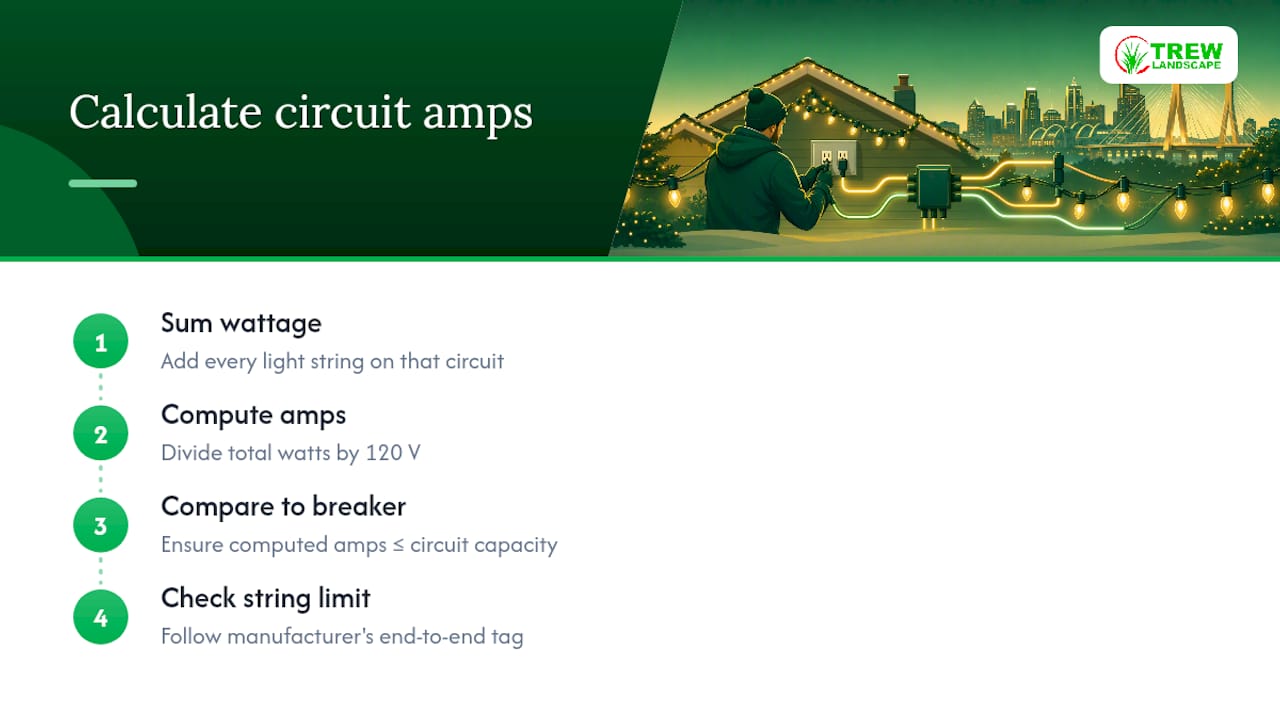
In practice, you’ll hit the manufacturer’s end-to-end connection limit long before you hit circuit capacity, especially with incandescent sets. Check the tag rather than assuming wattage math alone protects you, since connection limits vary by product.
Pro Tip: Put every display on a timer or photocell instead of a manual switch. Lights left running unattended overnight are exactly the continuous-load scenario NEC guidance is trying to prevent.
How Do You Hang Christmas Lights Securely Without Damaging Them?
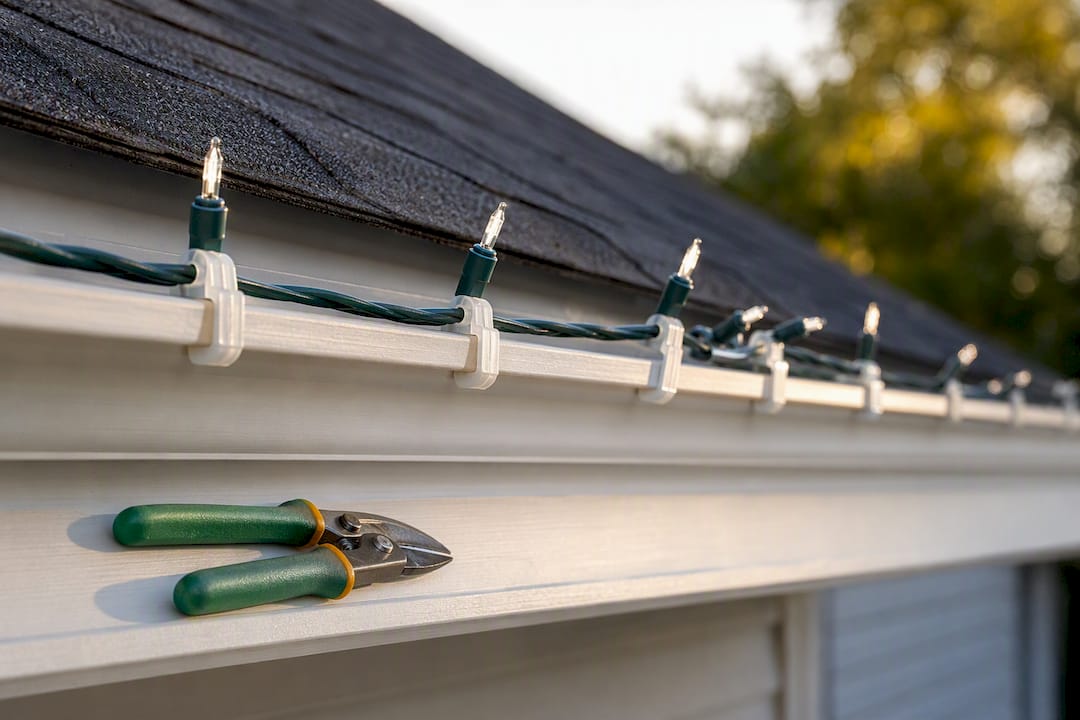
The hardware you use to mount lights matters almost as much as the lights themselves. Insulated plastic clips, gutter-specific hooks, and outdoor-rated zip ties all attach a string without piercing its insulation. Staples and nails do the opposite. ESFI specifically warns against them because a staple through a cord’s jacket creates a path for moisture to reach live wire, which is how shorts and shocks happen.
Trees and shrubs make tempting anchor points, but living vegetation moves in wind and grows, which stresses connections over a season. If you use branches, add slack and separate strain relief rather than letting the cord itself bear the load.
Ladder work deserves its own rules:
- Use a wood or fiberglass ladder for anything near electrical lines, never aluminum.
- Keep three points of contact at all times.
- Have someone spot you from the ground.
- Extend the ladder at least 3 feet above the roofline you’re working on.
- Stay a minimum of 10 feet from any overhead power line, and call your utility company if work requires getting closer to a service drop.
None of this is overkill. It’s the same standard a professional crew works to on every job.
Keeping Plugs and Cords Dry Through a Kansas City Winter
Every connection point along your display is a potential entry for moisture, and moisture plus electricity is the combination that causes ground faults. A drip loop, a simple downward dip in the cord before it reaches the plug, lets water run off the cord instead of following it straight into the connection.
Beyond the loop itself:
- Use outdoor-rated connection covers on every splice or plug junction exposed to weather.
- Keep plugs elevated off the ground on a brick, hook, or dedicated stand rather than sitting in grass or mulch.
- Match extension cord gauge to your run: 14 AWG generally covers shorter runs, while 12 AWG handles longer distances or heavier loads.
- Route cords away from walkways, sharp gutter edges, and door or window frames where they could get pinched.
A cord stretched taut to reach an outlet is a cord under constant mechanical stress at every connection point.*
When Should You Test, Store, and Replace Your Light Strings?
Test every string on the ground before it goes up, then test the whole display again once it’s mounted and it’s dark enough to actually see the result. Problems show up differently under load than they do in a quiet garage.
Here’s the seasonal routine worth repeating every year:
- Test each string before installation and again at dusk after hanging.
- Replace any set with more than two failed bulbs, or any string with a cracked socket or crimped connector.
- Remove the display on a dry day, never while wires are wet or frosted.
- Coil strings loosely and store them in labeled bags or on reels to prevent kinks that crack insulation.
- Keep this checklist somewhere you’ll actually find it next November.
When Does Outdoor Christmas Light Installation Call for a Licensed Pro?
Some setups are genuinely fine for a confident homeowner with a Saturday afternoon. Others aren’t. If your display spans multiple circuits, involves roofline work on a two-story home, sits anywhere near a utility service drop, or would benefit from a dedicated GFCI outlet you don’t currently have, that’s the point to call a licensed, insured installer.
A quality installation crew plans load distribution across separate circuits before hanging a single bulb, uses hardware rated for your specific roofline or fascia, and weatherproofs every connection as a matter of routine rather than an afterthought. Documented safety checks and insured labor mean the liability isn’t sitting entirely on your shoulders if something goes wrong. Trew Landscape LLC’s Christmas Light Installation service is built around exactly that standard for Kansas City homes and businesses.
How Do You Prevent Fires From Christmas Light Transformers and Timers?
Transformers and timers are the parts of a light display most homeowners never think about, right up until one overheats. A transformer converts standard household voltage down to what low-voltage LED sets need, and it generates heat while doing it. Covering a transformer with mulch, snow, wrapping paper, or storage bins blocks the airflow it needs to dissipate that heat safely.
Keep transformers and timer boxes elevated, uncovered, and away from anything flammable, including dry leaves and holiday storage bins stacked nearby. Check that the transformer itself carries an outdoor rating; an indoor-only transformer exposed to rain or snow is a shock and fire risk regardless of how well the light strings themselves are rated.
Mechanical timers and smart plugs both work for automating your display, but either one needs to sit somewhere dry and ventilated. A timer jammed into a wet outlet box or buried under a bush defeats the purpose of using one. If you’re running multiple transformers off the same circuit, run the same wattage math you’d apply to light strings. Transformers draw continuous power the entire time they’re plugged in, whether or not the lights are lit, so they count toward your circuit’s load even during daylight hours.
Never daisy-chain multiple transformers or power adapters through a single extension cord unless the cord and outlet are both rated for the combined load. And skip the temptation to leave a transformer plugged in through spring “just in case.” NEC guidance treats holiday lighting as temporary wiring for a reason. The longer components stay exposed to weather, the more their insulation and connections degrade.
How Do You Keep Kids and Pets Safe Around Outdoor Light Displays?
Curious hands and curious noses both find their way to exactly the parts of a light display you’d rather they avoid. Puppies chew cords. Toddlers pull on anything dangling at their height. Neither one understands why that matters.
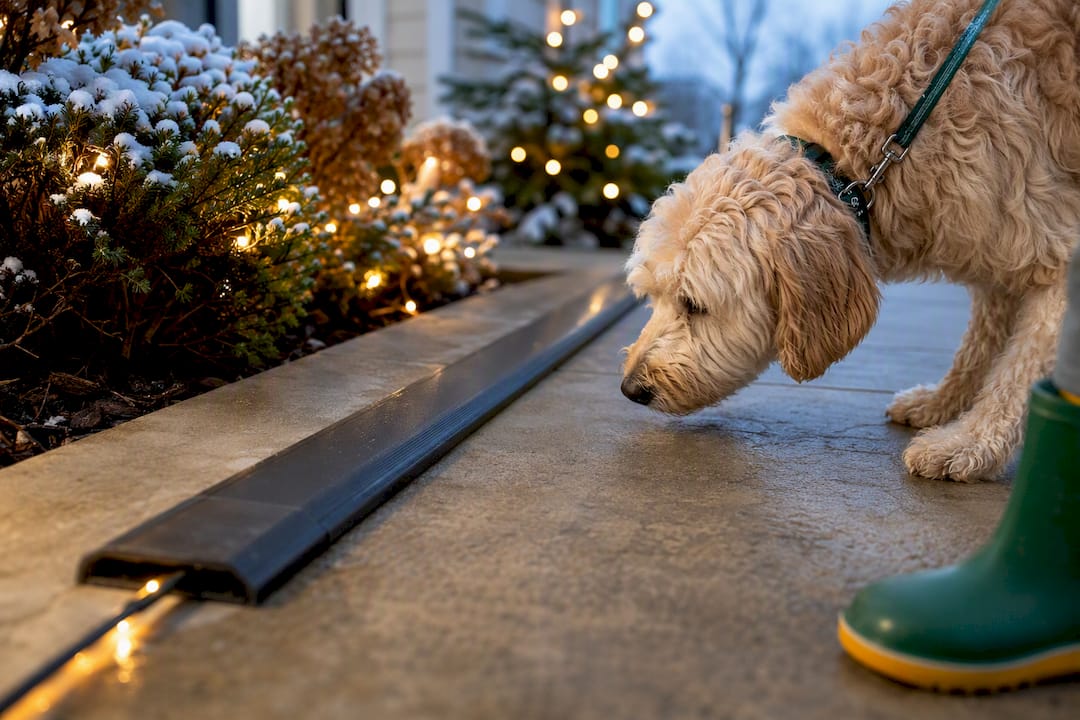
Route cords away from ground-level areas where kids play or pets nap, and use cord covers or channels anywhere a cord has to cross a path or patio. If your pet has a habit of chewing, keep cords elevated on hooks or clips rather than running along the ground where they’re accessible. A determined dog can bite through a cord’s insulation in seconds, and that’s a shock hazard for the animal and a fire risk for the house.
Bulbs themselves matter too. LED strings run cool enough to touch safely, while some incandescent bulbs get hot enough to cause a minor burn on contact or ignite dry leaves piled against them. If you have young children or pets that investigate low-hanging decorations, LED sets are the lower-risk choice on this front as well as the electrical one.
Keep breakable ornaments and any glass elements out of reach, and avoid extension cords stretched across doorways or gates where pets or kids might trip. A GFCI outlet protects against electrical faults, but it won’t stop a fall.
How Should You Handle and Dispose of Damaged Christmas Lights?
A damaged light string isn’t something to patch with electrical tape and hope for the best. Once you’ve found frayed wire, a cracked socket, or a pinched plug, unplug it immediately and don’t reconnect it to test “just to see.”
Handle a damaged string by the plug, not the cord itself, when removing it from a display, since flexing damaged insulation can widen an existing crack or expose more bare wire. Coil it separately from your good strings so you don’t accidentally grab it next season.
For disposal, don’t just toss light strings in curbside recycling. Most municipal recycling programs don’t accept string lights because the thin wire and mixed plastics jam sorting equipment. Check whether your city runs a holiday light recycling drive, common at hardware stores and some municipal facilities in December and January, or look for an e-waste collection event that accepts small electronics and wiring. If no recycling option is available, dispose of the string in household trash rather than leaving it somewhere it could get scavenged and reused.
An Editorial Take: Why “It Worked Last Year” Isn’t a Safety Standard
The riskiest phrase in holiday lighting is “these still work fine.” A cord that survived last winter can still have insulation microcracked by a full season of freeze and thaw. Trew Landscape LLC approaches every seasonal display the way we approach permanent landscape lighting: plan the load first, weatherproof every connection, and build for durability rather than a quick fix that looks fine from the sidewalk.
Most DIY displays fail quietly, a flickering strand or a warm plug, long before they fail dramatically. If your setup has outgrown a simple one-outlet, one-string job, that’s worth taking seriously.
— Trew Landscape LLC
Get a Safety-First Christmas Light Installation in Kansas City
Trew Landscape LLC is the alternative to a weekend of ladder work and guesswork wiring: our crews plan circuit loads before a single clip goes up, use insured, code-aware installation practices, and weatherproof every connection the way a licensed electrician would expect. That’s the difference between a display that looks great in photos and one that’s still safe in February.

We handle the roofline work, the GFCI checks, and the load math so you don’t have to guess whether your setup exceeds a manufacturer’s end-to-end limit or overloads a circuit. If your home has multiple stories, mature trees, or a display bigger than a single extension cord can handle, that’s exactly the scenario where professional installation earns its cost back in avoided risk. Request a quote through our Christmas Light Installation page and get your display planned, installed, and tested before the season’s first hard freeze.
Sources
- Usfa
- Outdoor Decoration Safety Tips - ESFI
- Seasonal and decorative lighting products - CPSC
- Holiday lighting display safety and the NEC - IAEI Magazine
- How many Christmas light strings can you connect? - The Christmas Light Emporium
FAQ
Can I leave my Christmas lights on 24/7?
No. Use a timer or photocell instead.
What time should you turn off outdoor Christmas lights?
There’s no single mandated time, but most homeowners set timers to shut off at a reasonable time and avoid running displays unattended while everyone is asleep.
What are the safety considerations for outdoor lights?
Outdoor-rated, UL-listed products, GFCI-protected outlets, undamaged cords, insulated mounting hardware, and staying clear of overhead power lines cover the core risks.
What are the safety considerations for Christmas light installation?
Beyond product choice, installation safety comes down to ladder practices, circuit load math, weatherproofed connections, and knowing when a job’s scope calls for a licensed installer like Trew Landscape LLC rather than a DIY setup.