
Trew Landscape Blog
$10–$130/ft: French Drain Costs 2026 for Homeowners, Permit Planning
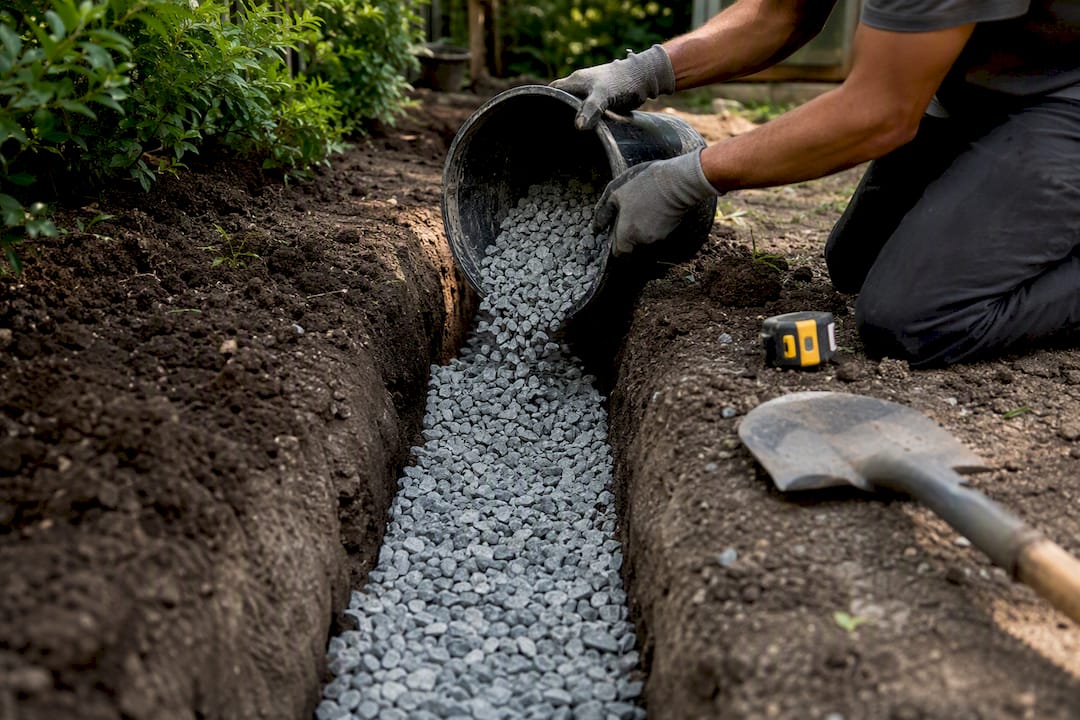
$10–$130/ft: French Drain Costs 2026 for Homeowners, Permit Planning ! Installing crushed stone in French drain trench Most homeowners pay between $1,500 and $6,000 to install a French drain, with exterior systems running $10 to $50 per linear foot and interior basement systems climbing to $50 to $130 per foot once slab work enters the picture.
$10–$130/ft: French Drain Costs 2026 for Homeowners, Permit Planning
Most homeowners pay between $1,500 and $6,000 to install a French drain, with exterior systems running $10 to $50 per linear foot and interior basement systems climbing to $50 to $130 per foot once slab work enters the picture. National averages land around $4,000 to $5,000 for a standard residential project. Soil type, trench depth, and where the water ultimately drains to swing that number in either direction fast.
TL;DR:
- Exterior French drains cost between $10 and $50 per foot, with a typical project averaging around $4,000 to $5,000, depending on soil and discharge point complexity.
- Interior basement drainage systems range from $50 to $130 per foot, with total costs for a 1,200-square-foot foundation reaching into five figures due to slab work and sump pump installation.
- Labor and equipment expenses account for the majority of costs, with materials like pipe and gravel only constituting about 20 to 30 percent of the total; contractors typically charge $1,500 to $3,500 for a 100-foot exterior drain.
- Proper trench size involves about 2.78 cubic yards of crushed stone and 52 feet of fabric and pipe for a 50-foot run, with bulk delivery and correct material choices ensuring efficiency.
- Homeowners should budget for permits, especially if connecting to public infrastructure, which can cost $75 to $400, and consider integrated planning to avoid rework and ensure the system addresses the entire yard.
Table of Contents
- French Drain Cost Per Foot: What You’ll Actually Pay
- Materials and Quantities: What Actually Goes in the Trench
- Professional Installation vs. DIY: Where the Money Goes
- What Drives the Price Up (and When You Need a Permit)
- Interior Basement Systems vs. Exterior Yard Drains
- How Long a French Drain Lasts and What Upkeep Costs
- Getting an Accurate Quote: What to Ask For
- Why Integrated Drainage Planning Saves Money Long-Term
- Get a Straight Answer From Trew Landscape LLC
- Sources
- FAQ
French Drain Cost Per Foot: What You’ll Actually Pay
The per-foot number is where quotes start making sense, and it splits sharply based on where the drain goes. An exterior yard drain, the kind that intercepts surface runoff or redirects a soggy low spot, typically runs $10 to $50 per linear foot installed. The low end covers a shallow trench in easy-to-dig soil with a simple daylight outlet. The high end reflects deeper trenches, rocky or clay soil, and a discharge point that requires extra pipe or a pump.
Interior perimeter drains, the ones installed along a basement’s inner footing to stop seepage, cost more because they involve breaking and repouring concrete; for detailed instructions, see our guide on how to install an interior French drain in your basement. Expect $50 to $130 per linear foot once you factor in slab cutting, disposal of broken concrete, and a sump pump connection. A basement system for a 1,200 square foot foundation can easily run into five figures.
Here’s how those per-foot ranges translate into real project totals:
| Project Length | Exterior Drain (Low) | Exterior Drain (High) | Interior/Basement (Low) | Interior/Basement (High) |
|---|---|---|---|---|
| 50 ft | $250 | $1,800 | $1,800 | $3,000 |
| 50 ft | $500 | $2,500 | $2,500 | $6,000 |
| 100 ft | $1,000 | $5,000 | $5,000 | $10,000 |
| 200 ft | $2,000 | $10,000 | $10,000 | $26,000 |
A contractor hired to excavate, install, and backfill 100 feet of exterior drain typically charges $1,500 to $3,500, with materials accounting for only 20 to 30 percent of that total. That split surprises a lot of homeowners who assume pipe and gravel drive the price. They don’t. Labor and equipment time do.
A few add-ons show up on almost every real-world quote:
- Sump pump installation for interior systems: $600 to $2,000 depending on pump type and battery backup
- Downspout tie-ins to route roof water away from the trench: $150 to $500 per connection
- Catch basins or drainage grates at low points: $200 to $600 each
- Landscape restoration (sod, mulch, or planting beds disturbed during digging): $300 to $1,500
Quick math for budgeting: multiply your linear footage by the midpoint of the applicable per-foot range, then add 15 to 20 percent for add-ons and restoration. A 60-foot exterior drain at a $30 per-foot midpoint runs about $1,800 before extras, landing closer to $2,100 to $2,200 once you tack on downspout work and reseeding.
Materials and Quantities: What Actually Goes in the Trench
A standard French drain trench measures about 12 inches wide by 18 inches deep, though depth varies with your grading and frost line. Inside that trench, three materials do the work: crushed stone, geotextile fabric, and perforated pipe.
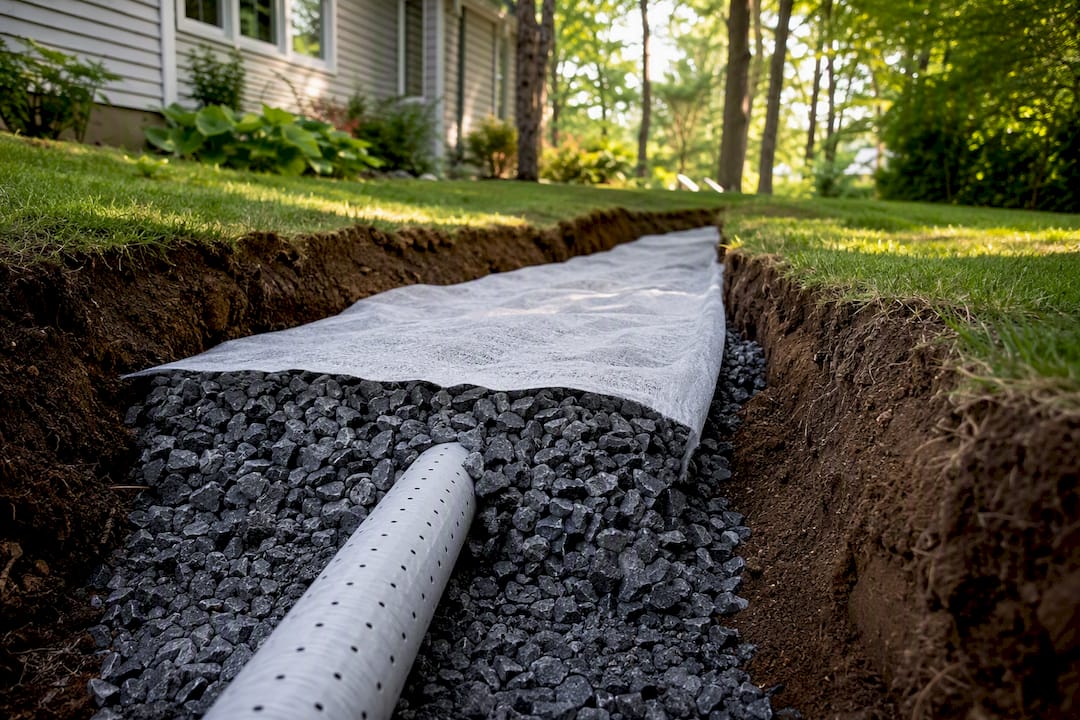
For a 50-foot trench at that standard cross-section, you’ll need roughly 2.78 cubic yards of #57 crushed stone, about 52 feet of non-woven landscape fabric, and around 53 feet of 4-inch perforated pipe. Material costs for that same 50-foot run total roughly $187 to $395, depending on regional stone pricing and whether you choose solid or slotted pipe.
Ordering tips that save a second trip to the supplier:
- Add 10 percent extra pipe length to account for connector fittings and cutting waste.
- Buy fabric in a continuous roll rather than pre-cut sections; overlap seams by at least 6 inches to keep silt out.
- Confirm you’re getting angular #57 stone, not rounded pea gravel. Angular stone locks together and drains faster.
- Ask your supplier about bulk delivery minimums. Most yards deliver stone by the cubic yard, and a 50-foot job often falls just under a full-load discount threshold.
Pro Tip: Call 811 at least two to three business days before you dig. Utility marking is free, and it’s the difference between a clean install and an expensive gas or fiber line repair. This is standard call-before-you-dig guidance that applies everywhere in the country, not just in high-density neighborhoods.
Professional Installation vs. DIY: Where the Money Goes
Doing it yourself changes the math dramatically, but not always in your favor once you account for time and risk.
- Materials-only DIY runs $5 to $10 per linear foot. That’s the range if you’re buying stone, pipe, and fabric and doing the excavation with a rented trencher or by hand.
- Professional installation runs $20 to $50 per foot for exterior systems, covering labor, equipment, correct slope calculation, and cleanup.
- Equipment rental adds its own cost curve. A walk-behind trencher rents for roughly $150 to $300 per day. A mini excavator, needed for deeper trenches or rocky soil, runs $250 to $450 per day plus delivery fees.
- Time investment for DIY is real. A 50-foot trench by hand can take a full weekend for two people; a rented trencher cuts that to a few hours but adds a learning curve for operating heavy equipment safely.
The risk scenarios matter more than the sticker price. Get the slope wrong by even half an inch over 20 feet, and water pools in the trench instead of flowing to the outlet. That mistake often isn’t visible until the next hard rain, and by then you’re digging the whole thing back up.
- Hand-digging in clay or rocky soil frequently doubles the time estimate versus loose loam.
- DIY interior basement work almost always requires a licensed plumber for the sump pump discharge line, even if you cut the slab yourself.
- A poorly wrapped pipe (wrong fabric, or none at all) leads to silt clogging within a few seasons, turning a one-time DIY savings into a full re-dig.
What Drives the Price Up (and When You Need a Permit)
Three factors move the needle more than anything else: soil, depth, and access.
Clay and rocky soil slow excavation dramatically compared to sandy loam, sometimes doubling labor hours for the same trench length. Deeper trenches, especially anything below 24 inches, require more careful shoring and often bigger equipment. And limited access, think fenced backyards, mature trees, or a narrow side yard, can force hand-digging where a machine would otherwise finish in a fraction of the time. Equipment that has to be walked in and out through a gate wears faster and costs more to operate per hour.
Where the water goes after it leaves your trench matters just as much as how it gets there:
- Daylight discharge (draining to a lower point on your property) is the cheapest option, usually adding no extra cost.
- Dry well installation for properties without a natural low point runs $500 to $2,500 depending on well size and soil percolation rate.
- Municipal storm-sewer tie-in requires connecting to public infrastructure, which is where permits and inspection fees enter the picture.
Permit rules vary significantly by municipality. Small residential systems that daylight on your own property are often exempt entirely. But systems that connect to a municipal storm sewer or alter drainage patterns affecting a neighboring property commonly require a storm-sewer connection or grading permit, typically costing $75 to $400.
Skipping that step isn’t just a legal risk. Calling your local building department and 811 before you get bids ensures your contractor’s quote already accounts for any required inspections, rather than surprising you with a change order mid-project.
Interior Basement Systems vs. Exterior Yard Drains
The symptoms on your property point you toward one system or the other, and mixing them up wastes money.
You need an interior perimeter drain if:
- Water seeps up along the base of basement walls after heavy rain
- The slab itself feels damp or shows efflorescence (white mineral staining)
- A sump pump already exists but can’t keep pace during storms
You need an exterior French drain if:
- Water pools in a specific yard low spot after rain
- Soil stays saturated near the foundation but the basement itself stays dry
- Downspouts dump water in a location that erodes soil or floods a patio
Interior systems cost substantially more because they require cutting and repouring the basement slab, tying into (or installing) a sump pump, and routing discharge either to daylight or a dry well outside. If your basement is dry but your yard turns into a pond every spring, an exterior system solves the problem for a fraction of the price. For a deeper look at whether surface grading might fix the issue without any trenching at all, Trew Landscape LLC’s guide to stormwater drainage solutions walks through that decision.
How Long a French Drain Lasts and What Upkeep Costs
A properly built French drain lasts 30 to 40 years with minimal attention, but “properly built” is doing a lot of work in that sentence.
Plan on a visual inspection once or twice a year, ideally after the heaviest rain of each season, checking that the outlet is flowing freely and no sediment has built up at the discharge point. Flushing the pipe with a garden hose or a mild jetting service every few years clears minor silt buildup before it becomes a clog.
The most common failure causes are avoidable:
- Routing roof downspouts directly into the gravel trench overloads the system with a volume of water it wasn’t sized for, a mistake flagged repeatedly by installation professionals.
- Using woven fabric instead of non-woven geotextile lets fine silt through, clogging the pipe from the inside over a few seasons.
- Insufficient slope (less than the 1 percent minimum, or roughly 1 inch per 10 feet) leaves standing water in the trench that eventually stagnates or backs up.
When something does go wrong, repair or relining costs typically run $500 to $2,500 depending on how much of the trench needs to be reopened.
Pro Tip: If your downspouts currently drain anywhere near your French drain’s trench line, redirect them separately before they ever reach the gravel. It’s a cheap fix now versus a full re-excavation later.
Getting an Accurate Quote: What to Ask For
Comparable bids require comparable information, and vague quotes are where homeowners get burned on change orders. Before you call a contractor, gather these details:
- Total linear feet needed, measured or estimated from your yard’s low points to the intended discharge location.
- Trench depth and width specs, since a deeper trench in tough soil costs more per foot than a shallow one.
- Material specifications, specifically pipe diameter and type (solid vs. perforated), stone grade (#57 is standard), and fabric type (non-woven geotextile).
- Discharge method, whether daylight, dry well, or storm-sewer connection, since each carries different equipment and permit implications.
- Who handles permits, and whether that cost is included in the quote or billed separately.
Once you have written quotes in hand, ask each contractor about slope guarantees (how they verify the 1 percent minimum), references from similar projects, proof of insurance, and warranty length on both materials and labor. A quote that’s dramatically lower than others often excludes something, commonly landscape restoration, permit fees, or downspout tie-ins. Read the fine print before you sign.
Why Integrated Drainage Planning Saves Money Long-Term
Most homeowners call about a French drain in isolation, but drainage rarely exists in isolation on a real property. A trench that solves one wet spot while ignoring the yard’s overall grading often just moves the water problem somewhere else, and that means a second project a year or two later.
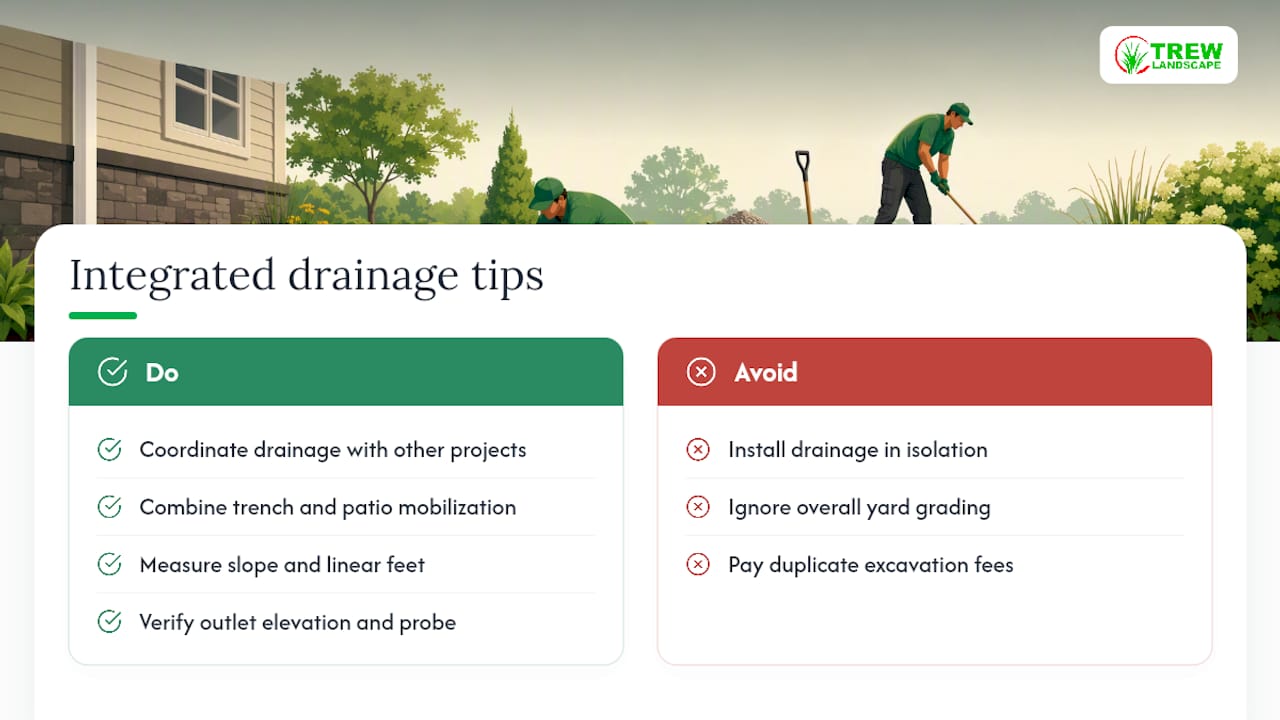
Coordinating drainage with grading, patio work, or planting bed design up front avoids that rework entirely. If a paver patio is already planned for the low corner of your yard, the drainage trench and the base preparation for that patio should happen in the same mobilization, not two separate visits with two separate excavation fees. Trew Landscape LLC’s landscape drainage installation work follows this on-site assessment approach: measuring linear feet and slope, verifying the outlet elevation actually supports gravity flow, and probing for rock or clay before a number ever reaches paper.
That kind of upfront diligence costs nothing extra and prevents the far more expensive scenario: a drain installed correctly on its own terms that still floods a neighboring low spot because nobody looked at the whole yard.
— Trew Landscape LLC
Get a Straight Answer From Trew Landscape LLC
Trew Landscape LLC gives Kansas City homeowners something most drainage quotes skip: a single visit that assesses your whole yard, not just the trench line. Instead of pricing a French drain in isolation, we look at grading, existing hardscape, and downspout routing together, so you’re not paying for a second mobilization when the next wet spot shows up.

During an on-site estimate, we measure linear footage and slope, check your outlet elevation, probe the soil for rock or clay, and note any utility markings, then walk you through exactly what’s included before you see a number. If your project extends beyond a simple trench, our landscape design and hardscape teams coordinate directly with drainage planning so grading and paver work happen in one pass. Ready to see what your yard actually needs? Request an on-site estimate from Trew Landscape LLC and get a written quote with every line item explained.
Sources
Run your own numbers before calling contractors. A material calculator gives sample quantities for pipe, stone, and fabric based on your trench length. Check permit requirements with your local building department before bidding, and always call 811 first. For gravel and pipe, local landscape supply yards typically beat big-box pricing on bulk stone orders.
- French Drain Calculator: Gravel, Pipe & Cost Guide (2026) | YardCalc
- Doineedapermit
- French drain installation mistakes (The Spruce)
- How much do French drains cost? (Angi)
FAQ
How Much Does a 200-Foot French Drain Cost?
A 200-foot exterior French drain typically costs $2,000 to $10,000 installed, while a 200-foot interior perimeter system runs $10,000 to $26,000 due to slab cutting and sump pump work.
Is It Expensive to Install a French Drain?
Costs range widely: DIY materials run $5 to $10 per foot, while professional installation runs $20 to $50 per foot for exterior systems and $50 to $130 per foot for interior basement systems.
What’s the Average Cost for a 100-Foot French Drain?
A 100-foot exterior French drain typically costs $1,000 to $5,000 installed, with contractor labor for excavation and backfill alone running $1,500 to $3,500 depending on soil and depth.
Are French Drains Worth the Money?
For chronic standing water or basement seepage, yes: a correctly sloped drain with proper fabric and stone prevents far costlier foundation repairs and yard erosion, and national averages of $4,000 to $5,000 are modest compared to water damage repair costs.
Do I Need a Permit to Install a French Drain?
Small residential systems that drain entirely on your own property are often exempt, but systems connecting to a municipal storm sewer typically require a permit costing $75 to $400.