
Trew Landscape Blog
Homeowners: Retrofit Smart Landscape Lighting Without Rewiring
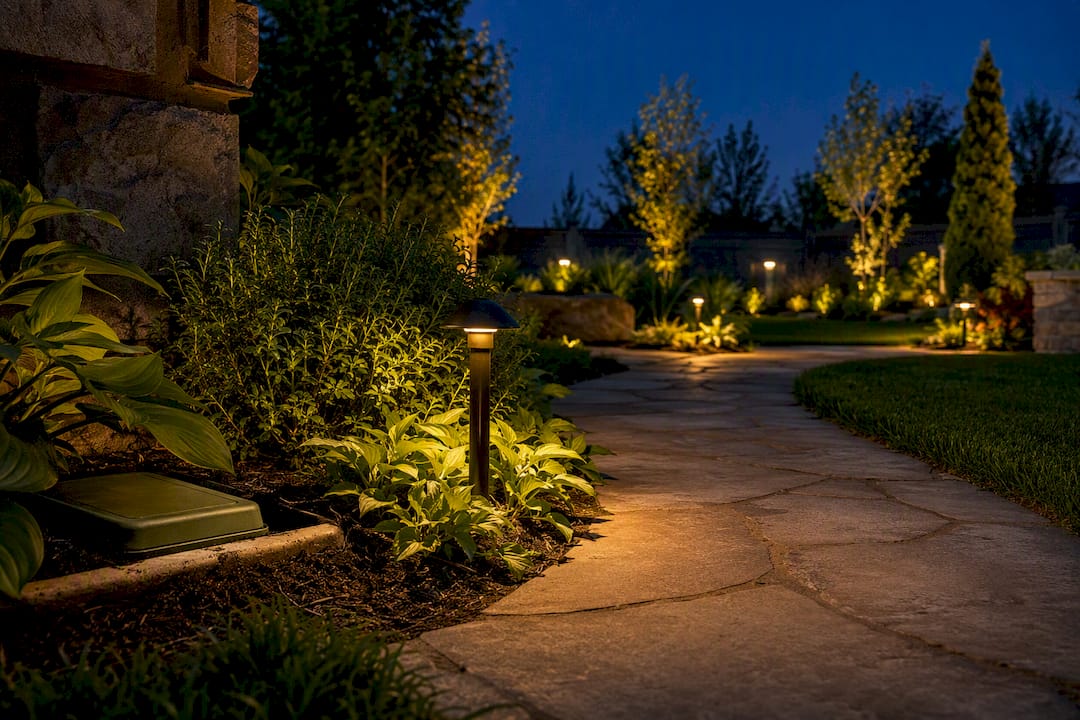
Homeowners: Retrofit Smart Landscape Lighting Without Rewiring ! Smart lighting illuminating a landscaped backyard The easiest high-value upgrade for most homeowners is to keep the existing low-voltage wiring in the ground and retrofit the fixtures with LEDs while adding a dedicated smart controller or a smart-transformer relay.
Homeowners: Retrofit Smart Landscape Lighting Without Rewiring
The easiest high-value upgrade for most homeowners is to keep the existing low-voltage wiring in the ground and retrofit the fixtures with LEDs while adding a dedicated smart controller or a smart-transformer relay. That single move unlocks zone-based scenes, real dimming, and app or voice control without a full system rebuild. The payoff shows up fast: lower energy use, better-looking evenings, and a system that adjusts itself instead of needing a timer reset every time the sunset shifts.
TL;DR:
- Upgrading with a smart controller between your transformer and zones allows for fine dimming, scene setting, and voice control, unlocking the most automation features.
- Converting existing low-voltage systems usually involves assessing fixture types and transformer capacity first, then upgrading to LED and adding smart devices in a phased approach.
- Proper weatherproofing and burying connections at the correct depth with waterproof connectors prevent failures from water ingress and ensure system longevity.
- Costs range from simple smart plug swaps for basic on/off control to full zone controllers with transformer upgrades for comprehensive automation, with staged work helping keep expenses manageable.
- While DIY is feasible for basic upgrades, complex replacements and wiring should be handled by licensed professionals to avoid issues like voltage drop, weather damage, or improper scene integration.
Table of Contents
- What Are the Smart Control Options for Landscape Lighting?
- How Does a Smart Landscape Lighting System Actually Work?
- How Should You Zone and Design a Smart Lighting Layout?
- How Do You Upgrade an Older Low-Voltage System to Smart Control?
- What Weatherproofing Do Smart Outdoor Lights Need?
- What Does a Smart Landscape Lighting Upgrade Cost?
- What Are the Security and Privacy Risks of Smart Landscape Lighting?
- How Do You Maintain a Smart Landscape Lighting System?
- How Do Popular Smart Landscape Lighting Brands Compare?
- Trew Landscape’s Perspective: When to Call in a Pro
- Ready to Upgrade? How Trew Landscape Can Help
- Sources
- FAQ
What Are the Smart Control Options for Landscape Lighting?
Homeowners upgrading an existing yard usually pick from four approaches, and the right one depends on how much control you actually want versus how much rewiring you’re willing to do.
A smart controller is the most capable option. It sits between your transformer and your zones, letting you dim, schedule, and group fixtures through an app or voice assistant like Alexa or Google Assistant. Most installers wire it in during a transformer swap.
A smart transformer or relay is the budget-friendly middle ground. It replaces your existing transformer and lets you schedule and switch whole circuits, though usually without per-fixture dimming. This is often enough for a straightforward path-and-accent setup.
Addressable RGBW fixtures add color, useful for holiday displays or accent walls, but they cost more per fixture and complicate wiring.
A smart plug retrofit is the cheapest entry point: plug your existing transformer into a smart outdoor plug for basic on/off scheduling. It won’t dim or zone, but it’s a fine starting point. Market surveys of smart landscape lighting products show these four categories cover nearly everything homeowners install today.
- Want scenes and app control: smart controller
- Want simple scheduling on a budget: smart transformer/relay
- Want color and effects: addressable RGBW fixtures
- Want the cheapest fix right now: smart plug retrofit
How Does a Smart Landscape Lighting System Actually Work?
Think of the controller as the brain. It receives your app or voice command and translates it into an electrical signal that tells a specific zone to dim, brighten, or shut off, based on how Legrand’s smart lighting architecture manages zoning and real-time color temperature adjustments between 2700K and 5000K.
The transformer still does the grunt work of stepping household voltage down to 12 volts for your fixtures. Sizing it correctly matters more than most homeowners realize: the 80% rule says your total fixture wattage should sit at or below 80% of the transformer’s rated capacity, leaving headroom and preventing voltage drop that dims far-end fixtures unevenly.
Sensors and astronomical schedules round out the system. Instead of a fixed 7 p.m. start time, the hub calculates actual sunset and adjusts automatically as seasons change, a detail HomeAutoCentral’s design guide flags as one of the highest-value automation moves you can make. Some setups go further, learning your arrival patterns to brighten before you pull in, an approach Portfolio Lighting describes as predictive rather than purely reactive.
- Controller: interprets commands, manages zones
- Transformer: converts and distributes voltage, sized with the 80% rule
- Sensors/astronomical clock: automate timing without manual resets
- Wiring/connectors: the most common point of failure in older systems
How Should You Zone and Design a Smart Lighting Layout?
Good zoning turns a pile of fixtures into a system that actually behaves the way you want at different times of night. Layered lighting design, as outlined in Portfolio Lighting’s placement guide, separates function from mood, and smart control lets you assign each layer its own behavior.
- Entry and walkway zone: path lights spaced 6 to 10 feet apart for even, walkable coverage without a runway effect.
- Patio and gathering zone: ambient wash lighting on a dimmer scene for evening use, brighter for entertaining.
- Accent zone: uplights on trees, walls, or architectural features, usually the first zone dimmed for a “moody” scene.
- Security zone: motion-triggered boost lighting near entry points and dark corners, layered on top of the baseline scene rather than replacing it.
For color, stick with roughly 2700K across the property. It reads as warm and inviting rather than clinical, and it matches most interior lighting so the transition from indoors to outdoors doesn’t feel jarring.
How Do You Upgrade an Older Low-Voltage System to Smart Control?
Most existing yards don’t need to be ripped out. They need a phased retrofit, and the order matters.
- Assess what you have. Check transformer output against actual fixture load, inspect cabling for cracked insulation, and note whether fixtures are halogen or already LED.
- Right-size or replace the transformer if it’s undersized or maxed out. This is the point to apply the 80% rule.
- Convert remaining halogen fixtures to LED. Lower wattage draw makes dimming smoother and gives your transformer more room to grow, a step Portfolio Lighting’s retrofit guidance treats as the highest-leverage single change in most upgrades.
- Add the smart controller or smart-transformer relay and assign zones.
- Layer in sensors and astronomical scheduling, then build out your scenes.
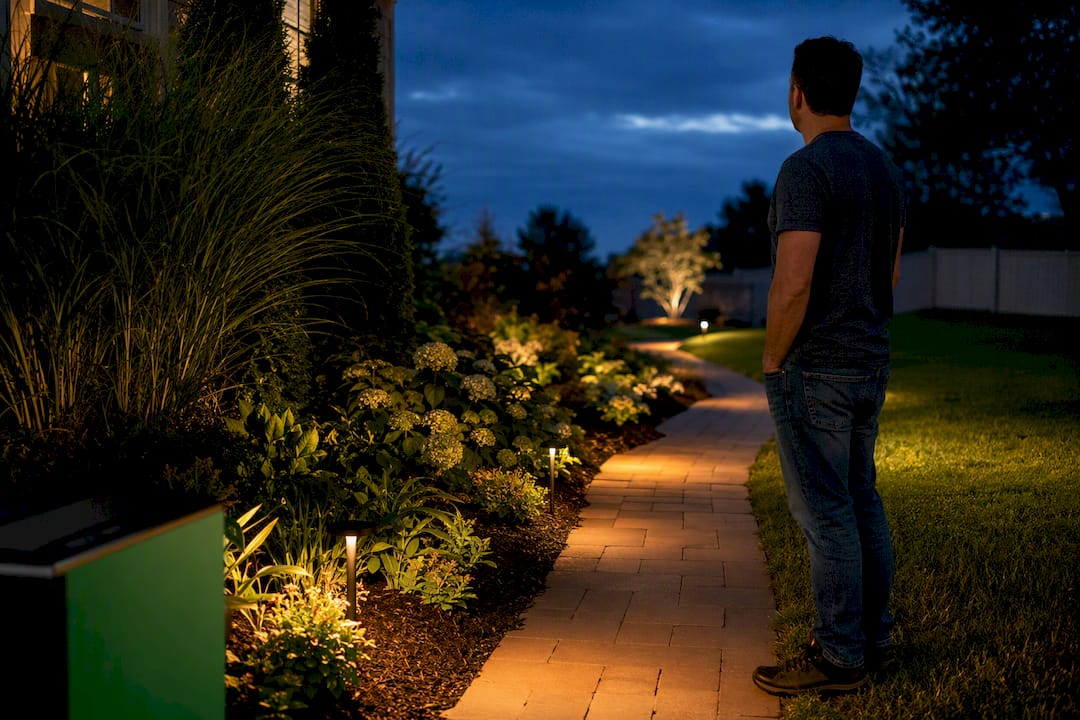
The most common technical pitfalls are voltage drop on long runs, an undersized transformer pushed past capacity, and splices that were never properly sealed. All three show up as flickering, uneven brightness, or a zone that just stops working after a rainy month.
Pro Tip: Before buying a single smart device, run your existing transformer at full load for 15 minutes and check the far-end fixtures. If they’re noticeably dimmer than the ones closest to the transformer, you have a voltage-drop problem no controller will fix. Address the wiring first.
What Weatherproofing Do Smart Outdoor Lights Need?
Outdoor electronics fail at the connection points long before the fixtures themselves quit. That single fact drives almost every weatherproofing rule worth following.
Fixtures and any near-ground components should carry an IP65 rating or better. Buried splices need gel-filled or heat-shrink waterproof connectors rather than basic wire nuts and electrical tape, which degrade within a season or two underground.
- Use gel-filled or heat-shrink connectors on every buried splice, not just the main runs.
- Build a drip loop into any wire entering a fixture or junction box so water travels away from, not into, the connection.
- Bury cable at the depth your local code requires and run conduit under hardscape or driveways.
- Mount transformers in a rated enclosure, off the ground, away from sprinkler spray.
Pro Tip: Walk your system once a year, ideally before the wet season, and open a few buried splices at random. Connector quality matters more for long-term reliability than fixture price, and catching one bad seal early beats replacing three fixtures later.
What Does a Smart Landscape Lighting Upgrade Cost?
Costs scale with how much of the system you’re replacing versus retrofitting, and staging the work is usually what keeps a budget under control.
- Smart plug + LED lamp swap: the cheapest entry point, essentially a weekend project with off-the-shelf parts.
- Per-zone smart controller install: mid-range cost, typically involving a transformer swap, new low-voltage wiring to a few zones, and controller setup.
- Full redesign with addressable fixtures and sensors: the highest-cost option, usually paired with a broader landscape design project rather than lighting alone.
Time follows the same pattern. A plug-and-lamp swap takes an afternoon. A phased transformer-and-controller upgrade often spans a weekend or two, especially if you’re waiting on a licensed electrician for the transformer connection. A full redesign can take several days once trenching, fixture placement, and low-voltage runs are factored in.
Fixture quality, transformer capacity, and labor are the three levers that move price the most. A cheap fixture that fails in two seasons costs more over time than a slightly pricier one with a real warranty.
What Are the Security and Privacy Risks of Smart Landscape Lighting?
Any device that connects to your home network is a potential entry point, and outdoor lighting controllers are no exception. Most run on the same Wi-Fi as your router, which means a weak password or outdated firmware on the controller can expose more than just your porch lights.
The biggest practical risk isn’t a hacker dimming your patio lights for fun. It’s a poorly secured hub becoming a foothold into your broader home network, especially if it shares credentials with other smart devices. Keep your landscape controller on a separate guest or IoT network segment if your router supports it, and update its firmware the same way you’d update a phone.
Data privacy matters too, particularly with systems that use motion sensing or predictive scheduling to learn your arrival patterns. That data usually lives with the manufacturer’s cloud service, not just on the device in your yard. Before buying, check whether the brand publishes a clear privacy policy and whether you can run scenes locally without a constant cloud connection. Systems that support local control through a hub like Apple HomeKit tend to keep more data on your own network rather than a third-party server.
A few habits go a long way: use a unique, strong password for the controller’s app account, enable two-factor authentication if it’s offered, and avoid sharing remote access credentials with anyone who doesn’t need them. Motion-triggered security lighting is genuinely useful, but only if the system controlling it is locked down as carefully as the front door it’s illuminating.
How Do You Maintain a Smart Landscape Lighting System?
Smart components add a layer of maintenance beyond the usual bulb swap, but most of it is quick if you build it into a seasonal routine.
Check firmware and app updates a few times a year. Manufacturers push updates that fix bugs and occasionally patch security issues, and a controller running old firmware is more likely to drop connection or misbehave with scene scheduling.
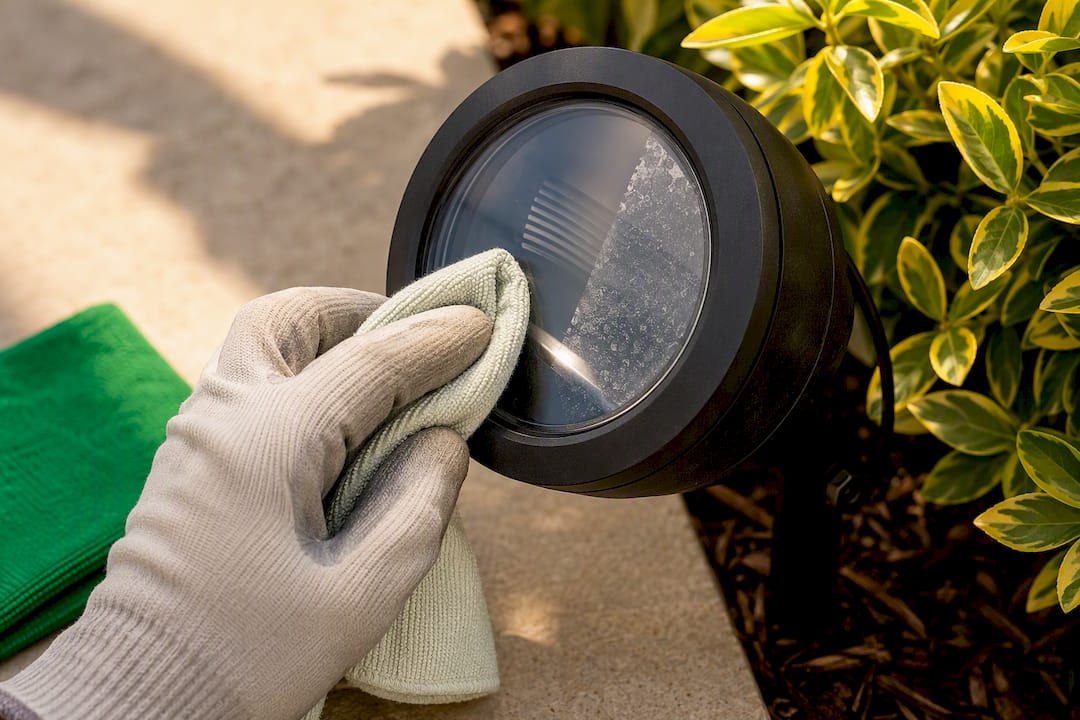
Clean fixture lenses at least twice a year. Dirt and mineral buildup from sprinklers cut light output more than most homeowners expect, and it’s easy to mistake a dim fixture for a wiring problem when the real issue is grime on the lens.
Test battery-backed sensors and smart plugs seasonally, since outdoor temperature swings shorten battery life faster than indoor use. Re-check your astronomical schedule settings once a year too. Most systems recalculate sunset and sunrise automatically, but it’s worth confirming after any firmware update or app migration.
Inspect wiring and connectors annually, ideally in early spring after the ground has thawed and settled. This is when buried splices are most likely to reveal water intrusion from winter freeze-thaw cycles. Walk the full run of each zone, not just the fixtures you can see from the patio, since underground connectors are where failures start.
Finally, keep a simple log of which zones and fixtures you’ve serviced. A one-line note with the date saves real time later if a zone starts acting up and you need to remember whether the problem is new or a repeat.
How Do Popular Smart Landscape Lighting Brands Compare?
Rather than ranking specific products, it helps to understand the categories these systems fall into, since most homeowner decisions come down to which category fits their yard and effort level.
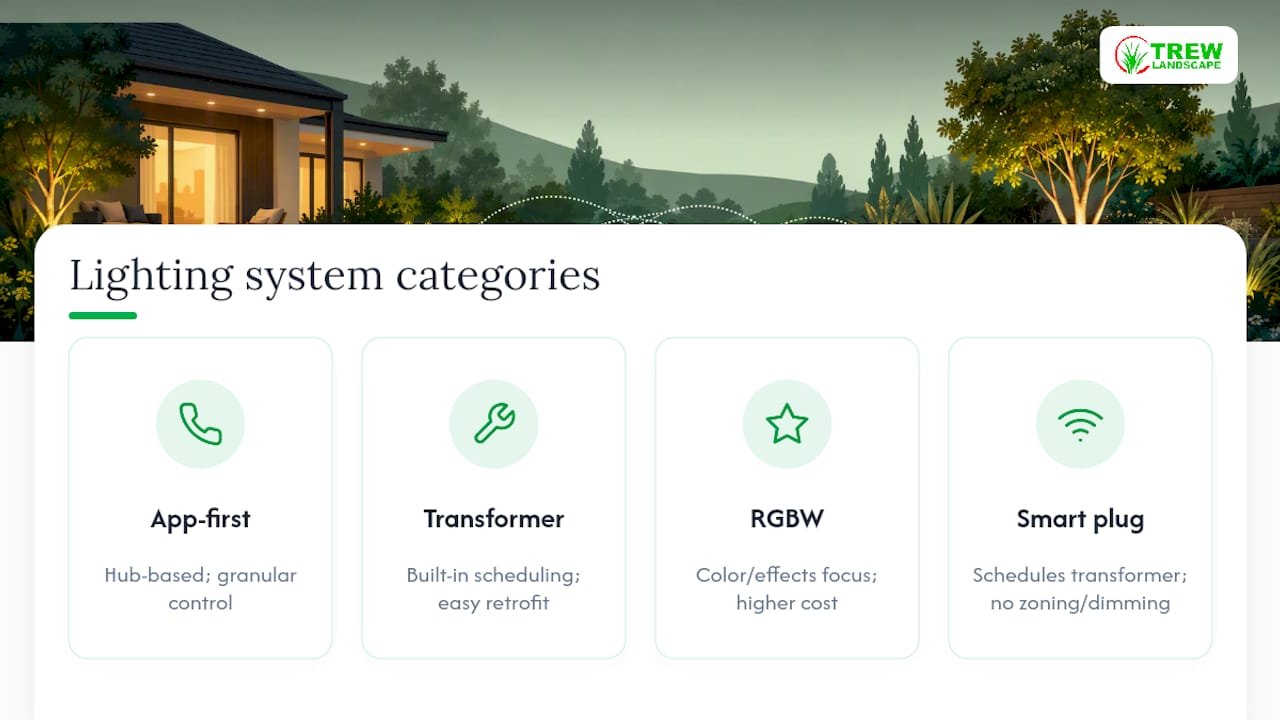
App-first controller systems are built around a dedicated hub that manages zones, dimming, and scenes through a manufacturer’s app, often with Alexa or Google Assistant integration layered on top. These tend to offer the most granular control but usually require professional installation for the transformer connection.
Smart transformer/relay systems skip the dedicated hub and build scheduling directly into the transformer or a relay module. They’re generally simpler to retrofit onto an existing low-voltage run and cost less, but they trade away fine-grained dimming for basic on/off or timed switching.
Addressable RGBW fixture systems are built for color and effects first, function second. They shine for holiday displays or accent walls where color-changing capability matters, but they’re overkill and more expensive for a standard path-and-patio setup.
Smart plug systems are the simplest category: a Wi-Fi-enabled outdoor plug that schedules whatever transformer is already plugged into it. No zoning, no dimming, just scheduled on/off, which makes it the right call for renters or anyone testing the waters before a bigger investment.
Compatibility with your existing home automation ecosystem, whether that’s Alexa, Google Home, or Apple HomeKit, should weigh as heavily as price when comparing options, since switching ecosystems later usually means replacing hardware, not just reconfiguring an app.
Trew Landscape’s Perspective: When to Call in a Pro
A smart plug and a few LED lamps are a fine weekend project. Whole-property redesigns, transformer or wiring replacement, and any long-run troubleshooting where voltage drop keeps reappearing are a different story, and that’s where a licensed pro earns their fee.
Professional design and installation deliver things a DIY retrofit often misses: correct transformer sizing under the 80% rule, weatherproofing that survives a Kansas City winter, and scenes actually integrated across zones instead of stitched together fixture by fixture.;;;
— Trew Landscape LLC
Ready to Upgrade? How Trew Landscape Can Help
Trew Landscape LLC handles the part of a smart lighting upgrade most homeowners would rather not tackle alone: sizing the transformer correctly, running wiring that survives freeze-thaw cycles, and integrating zones into scenes that actually work together instead of fighting each other through three different apps.

Our landscape lighting team designs and installs systems around your property’s actual layout, whether that means retrofitting an aging low-voltage setup or building a new one alongside a broader landscape design project. If you’re planning zones yourself first, our placement guide walks through spacing and layout before you call anyone. When you’re ready for a system built to last, request an on-site consultation and we’ll walk your property with you.
Sources
- AI Outdoor Lighting Systems (2026 Guide): Smart Automation, Design & Upgrades | Portfolio Lighting
- Smart lighting control system | Legrand
- How to choose the best landscape lighting for your home & yard | VOLT Lighting
FAQ
Do I Need to Replace All My Fixtures for Smart Control?
No. A smart transformer or controller can manage existing LED fixtures, and even halogen fixtures can run on smart schedules, though converting to LED first gives smoother dimming and lower energy use.
What Color Temperature Should I Use for Landscape Lighting?
Around 2700K is the standard recommendation for warm, inviting landscape lighting that matches typical interior lighting.
How Much Does a Smart Landscape Lighting Upgrade Cost?
Costs vary widely by scope, from an afternoon smart plug swap to a full per-zone controller install with a transformer replacement, so the real number depends on how many zones and fixtures are involved.
Can I Install Smart Landscape Lighting Myself?
Basic swaps like smart plugs and LED lamp upgrades are DIY-friendly, but transformer replacement, new wiring, and whole-property zoning are best left to a licensed professional like Trew Landscape LLC to avoid voltage drop and weatherproofing mistakes.
How Do I Prevent Voltage Drop in a Smart System?
Size the transformer using the 80% rule, keep wire runs within recommended gauge and length limits, and inspect connectors annually since poor splices cause more dimming issues than the wiring itself.