
Trew Landscape Blog
Trex vs TimberTech: Which Deck Is Right for You?
Trex vs TimberTech: Which Deck Is Right for You? !

Trex vs TimberTech: Which Deck Is Right for You?
TL;DR:
- Trex offers cost-effective, widely available capped composite decking with excellent scratch resistance, ideal for high-traffic use. TimberTech AZEK, made from 100% PVC, provides superior moisture resistance and longer warranties, suited for damp or low-clearance sites. Proper site assessment and quality installation are crucial to ensure long-term deck performance regardless of brand choice.
For most homeowners, Trex is the smarter starting point: it’s widely available, costs less per board, and the Trex Transcend line delivers superior scratch resistance that holds up well under heavy foot traffic and pets. Choose TimberTech AZEK when your site demands it — poolside surrounds, low-clearance decks with poor airflow, or any spot that stays damp. The 100% PVC construction resists moisture at a level capped wood-plastic composites simply cannot match, and the structural warranty terms on premium AZEK lines run longer than Trex’s standard coverage.
Best for value and wide retail access: Trex (Trex Select, Trex Enhance, Trex Transcend) Best for moisture-heavy or demanding sites: TimberTech AZEK (cellular PVC, no wood fiber) Best for mid-tier performance with flexibility: TimberTech composite lines (Pro Legacy, Pro Terrain)
One caution before you order: heat underfoot is real on any composite deck in direct sun, and darker colors hold more heat regardless of brand. Pick the lightest color you can live with aesthetically, especially for south- or west-facing decks. And no matter which brand you choose, warranty coverage only activates when you register — Trew Landscape LLC handles that handoff for every deck we install.
Table of Contents
- How do Trex and TimberTech actually compare side by side?
- What do Trex and TimberTech cost, and how do the warranties differ?
- Which brand should you choose for your specific situation?
- How do color options and aesthetics differ between the two brands?
- What does deck maintenance actually look like year to year?
- What should you tell your installer before work begins?
- Your decision checklist and questions to ask every installer
- Key Takeaways
- What installers see that the spec sheets don’t tell you
- Ready to plan your deck? Here’s what to expect with Trew Landscape LLC
- Useful sources
- FAQ
How do Trex and TimberTech actually compare side by side?
Both brands make capped composite decking, but the materials, capping methods, and product lines diverge in ways that matter once you’re living on the deck.
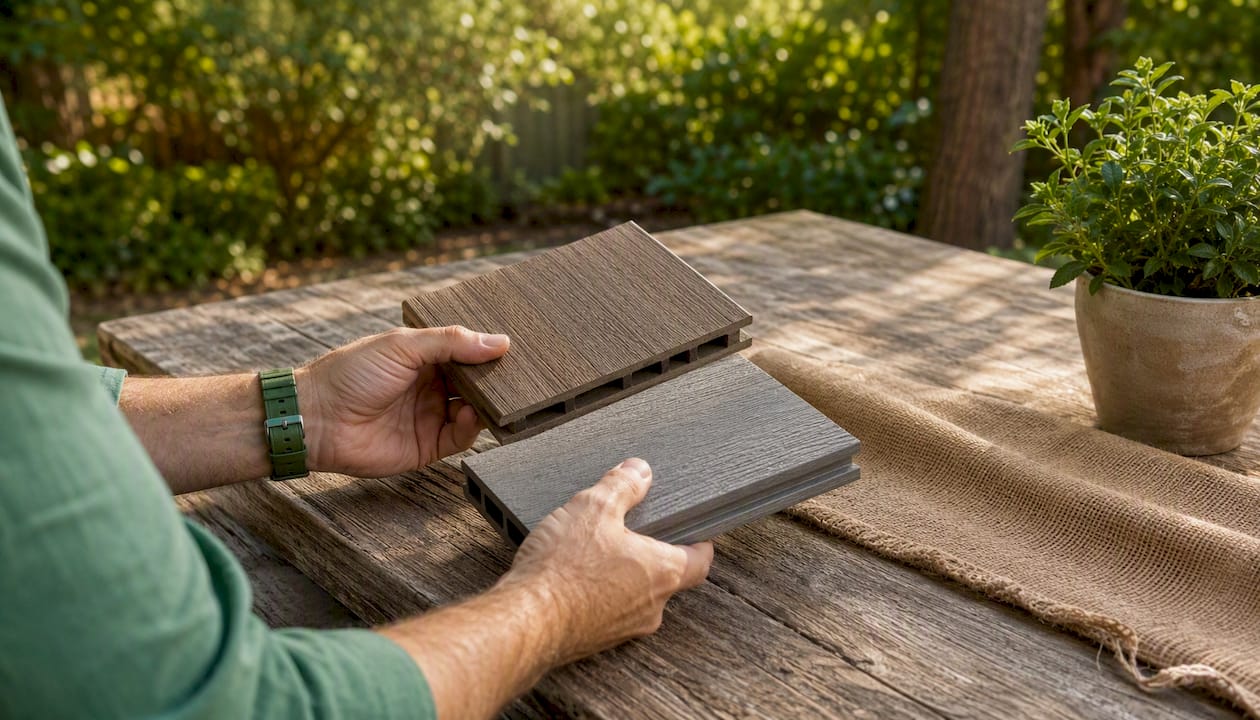
Trex builds its boards from wood fiber and recycled plastic, with recycled content reaching up to roughly 95% across its lines. Most Trex boards use a 3-sided cap — the top and two long edges are protected, but the bottom face is uncapped. The flagship Trex Transcend line adds a harder cap compound that resists scuffs and surface scratches better than most competitors in real-world use.
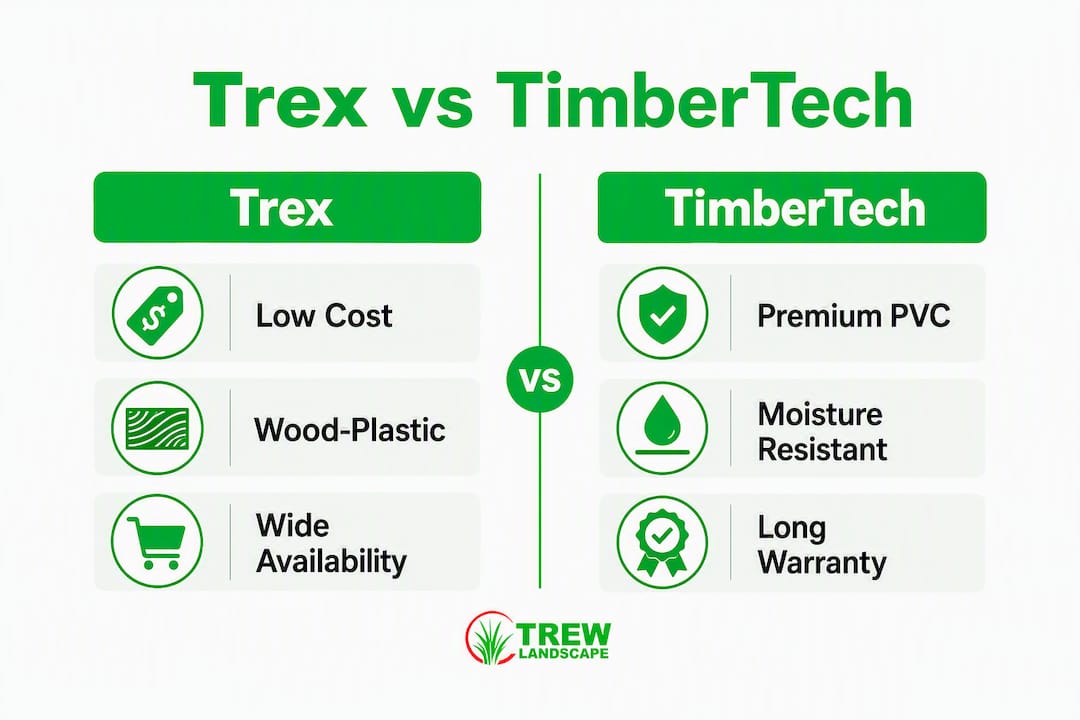
TimberTech runs two distinct product families. Its composite lines (Pro Legacy, Pro Terrain, Harvest Collection) use wood-plastic composite construction similar to Trex, with 4-sided capping on premium boards. Its AZEK line is a different animal entirely: 100% cellular PVC, no wood fiber at all, fully impervious to water absorption. That distinction drives nearly every performance difference between the two brands.
| Dimension | Trex (Transcend / mid-tier) | TimberTech AZEK (PVC) | TimberTech Composite |
|---|---|---|---|
| Material type | Wood-plastic composite (WPC) | 100% cellular PVC | Wood-plastic composite |
| Capping | 3-sided (most lines) | 4-sided | 4-sided |
| Scratch resistance | Excellent (Transcend) | Good | Good |
| Heat retention | Moderate to high in dark colors | Lower than WPC in dark colors | Moderate |
| Moisture resistance | Good (capped) | Excellent (no wood fiber) | Good |
| Fade/stain warranty | 25 years (most lines) | Up to 50 years or lifetime | 25–30 years |
| Typical board price | Lower | Premium | Mid-range |
| Retail availability | Wide (big-box + pro dealers) | Pro dealer network | Pro dealer network |
| Best for | Value, high-traffic, pets | Pools, damp/low-clearance sites | Mid-tier moisture performance |
Trex strengths and tradeoffs
Strengths:
- Trex Transcend ranks among the hardest-capped composite surfaces available, making it a strong pick for homes with large dogs or heavy outdoor furniture
- Broad retail availability means you can source replacement boards years later without hunting for a specialty dealer
- Lower entry price across all tiers compared to AZEK
Tradeoffs:
- 3-sided capping leaves the bottom face exposed, which matters in low-clearance or high-moisture installs
- 25-year warranty is solid but shorter than AZEK’s premium terms
- Darker Trex colors can get uncomfortably hot underfoot in Kansas City summers
TimberTech AZEK strengths and tradeoffs
Strengths:
- Zero wood fiber means zero food source for mold and no moisture absorption, even in standing water
- Longer warranty terms on premium lines
- Runs noticeably cooler than capped composites in dark colors, though the gap narrows with lighter shades
Tradeoffs:
- Higher board cost across every tier
- PVC expands and contracts more than WPC with temperature swings — gapping requirements are stricter
- Primarily available through pro dealer networks, which can complicate sourcing replacement boards for DIY repairs
What do Trex and TimberTech cost, and how do the warranties differ?
Trex generally runs lower per linear foot than TimberTech AZEK across every tier. Entry-level Trex Enhance boards typically start around $3–$5 per linear foot at retail, while Trex Transcend runs roughly $6–$10 per linear foot depending on color and profile. TimberTech AZEK boards start closer to $8–$12 per linear foot for standard profiles, with premium collections pushing higher. For a full installed deck in the Kansas City area, expect total costs (materials plus labor) to land roughly in the $30–$50 per square foot range for mid-tier composite and $45–$65+ per square foot for premium AZEK, depending on substructure condition, deck size, and complexity. The Kansas City deck cost guide from Trew Landscape LLC breaks down those installed ranges in more detail.
| Warranty dimension | Trex (most lines) | TimberTech AZEK (premium PVC) | TimberTech composite (mid-tier) |
|---|---|---|---|
| Structural warranty | 25 years | 50 years or lifetime (line-dependent) | 25–30 years |
| Fade/stain warranty | 25 years | 50 years or lifetime | 25–30 years |
| Labor coverage | Not typically included | Not typically included | Not typically included |
| Transferable? | Yes (with registration) | Yes (with registration) | Yes (with registration) |
| What voids it | Improper install, wrong fasteners, sanding/refinishing | Same, plus improper gapping for thermal movement | Same |
A few practical notes on warranty coverage:
- Registration is required. Both brands require you to register your warranty within a set window after installation. Miss it and you may lose coverage entirely.
- Labor is almost never covered. If a board fails and needs replacement, the manufacturer typically covers the board cost only. Labor to remove and reinstall is your expense.
- Transfers require paperwork. If you sell your home, warranty transfer is possible but requires formal documentation. Keep your serial numbers and purchase receipts.
- Sanding voids everything. Composite and PVC decking caps cannot be sanded or refinished. Attempting to do so permanently voids the warranty and damages the surface.
Pro Tip: Read the specific warranty document for the exact line you’re buying — not just the brand-level summary. “25-year fade warranty” language varies: some cover only significant color change (measured in delta-E units), while others have exclusions for certain colors or finishes. Ask your installer for the line-specific warranty PDF before you sign a contract.
Which brand should you choose for your specific situation?
Site conditions and how you use the deck matter more than brand loyalty when it comes to long-term satisfaction. Here’s how the decision plays out across the most common homeowner scenarios:
- Poolside or spa surrounds: TimberTech AZEK. No wood fiber means no organic material for mold to feed on, and the board won’t swell or degrade from constant splash and humidity. Trex’s capped WPC holds up reasonably well, but the uncapped bottom face on 3-sided boards is a vulnerability in standing-water conditions.
- Low-clearance decks (under 12 inches of ground clearance): TimberTech AZEK again. Poor airflow traps moisture underneath, and PVC’s complete impermeability to water absorption makes it the safer long-term choice. Trex Transcend with a 3-sided cap is a workable alternative if AZEK’s cost is prohibitive, but ventilation gaps become critical.
- South- or west-facing decks in full sun: Go lighter on color regardless of brand. Material composition does affect heat — PVC boards generally run cooler than capped composites in dark shades — but a light-gray Trex Transcend will stay more comfortable underfoot than a dark-brown AZEK board. Color choice matters as much as material here.
- Homes with large dogs or heavy furniture: Trex Transcend. Its surface hardness and scratch resistance are well-regarded in real-world use, and it’s the stronger pick when you expect regular scuffing from claws or dragged chairs. If you’re also weighing pet-friendly outdoor surfaces for adjacent yard areas, that’s worth factoring into the overall project plan.
- Budget-conscious builds: Trex across any tier. The value gap versus AZEK is real at every price point, and for a covered deck or a shaded backyard space where moisture isn’t a constant factor, Trex delivers excellent long-term performance at a lower upfront cost.
- High-traffic family decks: Either brand performs well with proper installation. Trex Transcend’s scratch resistance gives it a slight edge for families with kids and pets; TimberTech’s 4-sided capping on composite lines offers better edge protection in high-wear spots.
Heat underfoot safety note: On a hot Kansas City afternoon, dark composite decking in direct sun can reach surface temperatures that are uncomfortable or unsafe for bare feet and pets. This isn’t a defect — it’s a physics reality for any dark surface. Choose lighter colors, plan for shade structures, or consider deck and step lighting that doubles as a visual cue for edge safety at night.
How do color options and aesthetics differ between the two brands?
Both brands have closed the gap on realistic wood appearance significantly, but they take different approaches to grain and palette depth.
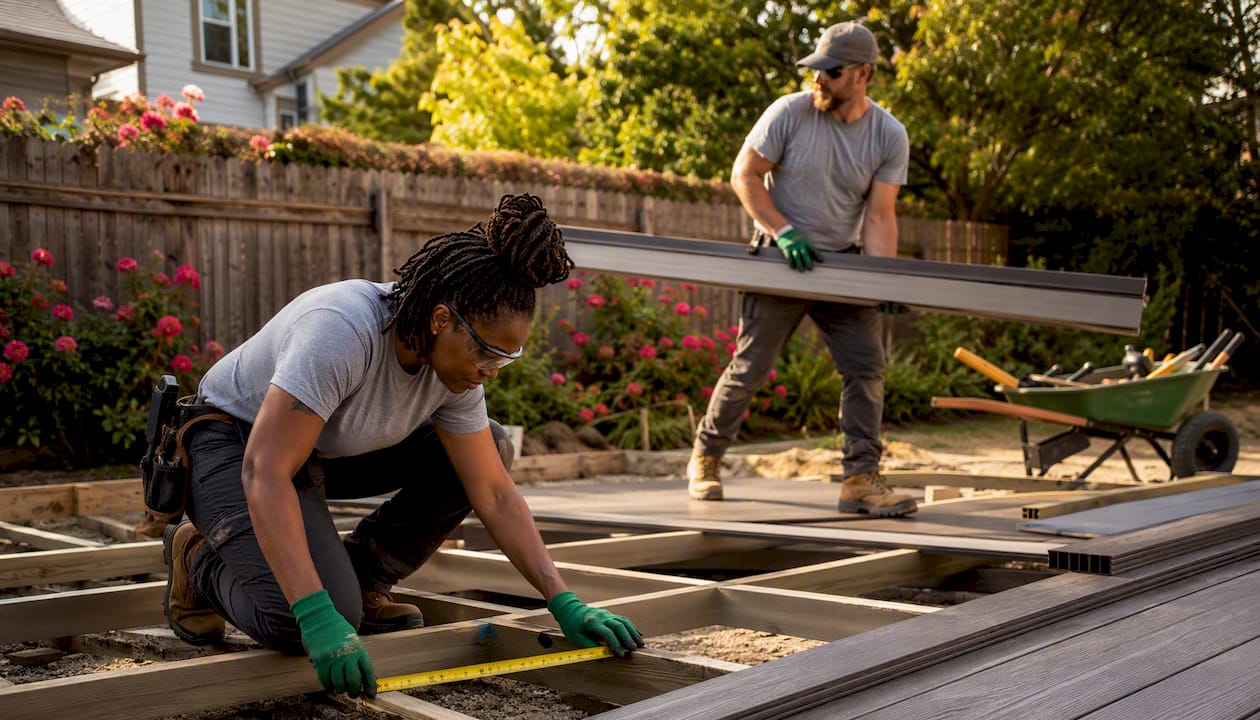
- TimberTech AZEK — leans into hyper-realistic hardwood simulation, with curated collections (like the Vintage and Landmark series) that use multi-tonal streaking and wire-brushed textures to replicate specific wood species more convincingly up close. The palette is more curated and intentional, with fewer total options but stronger individual realism.
Pro Tip: Always order sample boards before committing to a color. Manufacturer color chips and website photos rarely capture how a board looks at full scale in your specific light conditions. Lay samples flat on your actual deck frame or substructure in both morning and afternoon light before placing your order.
What does deck maintenance actually look like year to year?
Composite and PVC decking are genuinely low-maintenance compared to wood, but “low maintenance” doesn’t mean zero maintenance. Here’s what annual upkeep looks like in practice.
Annual cleaning checklist
- Spring wash: Mix a mild dish soap with warm water and scrub the deck surface with a soft-bristle brush. Work with the grain direction of the board texture to avoid surface marring.
- Rinse thoroughly: Use a garden hose or low-pressure setting on a pressure washer (under 1,500 PSI, fan tip, held at least 8 inches from the surface). High-pressure direct spray can damage the cap layer.
- Spot-treat stains: For grease or food stains, apply a composite-deck-approved cleaner and let it dwell for a few minutes before scrubbing. Avoid bleach-based products, which can discolor the cap.
- Clear debris from gaps: Use a plastic putty knife or a deck gap brush to remove leaves, seeds, and organic material from between boards. This is where mold actually starts.
- Fall inspection: Check for any boards that have shifted, fasteners that have backed out, or gaps that have closed due to thermal movement. Address these before winter.
- Snow removal: Use a plastic shovel only. Metal blades scratch the cap surface and can void warranties. Salt-based ice melts can damage board surfaces and substructure hardware — use calcium chloride sparingly if at all.
What to know about surface mold
Surface mold on capped composite decking feeds on pollen, dirt, and organic debris that accumulates on top of the cap, not on the board material itself. This means regular cleaning prevents the vast majority of mold and algae issues. A deck that’s swept and washed twice a year rarely develops visible mold problems. If mold does appear, a composite-approved cleaner with a soft brush removes it without damaging the surface.
Lifespan expectations with proper maintenance: mid-tier capped composite (Trex Enhance, TimberTech composite lines) typically performs well for 25+ years. Trex Transcend and TimberTech AZEK, with their harder caps and superior material composition respectively, can reasonably exceed that with consistent care. PVC boards like AZEK have no wood fiber to degrade, which gives them a theoretical longevity advantage in wet climates.
What should you tell your installer before work begins?
Installation quality determines long-term deck performance more than brand selection does. Most composite decking failures — warping, buckling, board movement — trace back to installation errors, not material defects. Here’s what to confirm before your installer drives the first fastener.
Installation checklist for homeowners
- Hidden fastener systems: — Both Trex and TimberTech have proprietary hidden fastener systems (Trex Hideaway, TimberTech’s clip systems) that create a clean surface and allow for thermal movement. Confirm your installer is using the manufacturer-specified system for your line.
DIY vs. pro installation
Trex boards are available at big-box retailers and are DIY-friendly for straightforward rectangular decks. TimberTech AZEK is primarily sold through pro dealer networks, and the stricter gapping requirements for PVC make installation errors more consequential. For either brand, a complex layout (diagonal, picture frame, multi-level) warrants a trained installer. Warranty coverage on both brands can be voided by installation errors, so if you’re hiring someone, ask specifically whether they’ve installed that exact product line before.
Your decision checklist and questions to ask every installer
10-question decision checklist
- Is my deck site exposed to constant moisture, poolside splash, or low ground clearance? (Yes = lean toward AZEK)
- Is my budget the primary constraint? (Yes = Trex is the value choice)
- Will the deck face south or west with full afternoon sun? (Yes = choose lighter colors regardless of brand)
- Do I have large dogs or expect heavy furniture drag? (Yes = Trex Transcend for scratch resistance)
- Is this a covered or shaded deck? (Yes = either brand performs well; Trex value advantage applies)
- Do I need wide retail availability for future board replacement? (Yes = Trex)
- Am I prioritizing the longest possible warranty terms? (Yes = TimberTech AZEK premium lines)
- Is the deck part of a larger outdoor project with integrated hardscaping? (Yes = coordinate with your hardscape designer early)
- Do I want the most realistic wood-grain appearance up close? (Yes = TimberTech AZEK collections)
- Am I comfortable with a pro dealer sourcing process vs. big-box retail? (No = Trex)
10 questions to ask every installer
- What joist spacing are you planning, and does it account for my layout direction?
- Which fastener system are you using, and is it the manufacturer-specified system for this line?
- What are your end-gap and side-gap dimensions, and how do they account for seasonal temperature range?
- Who handles warranty registration, and will you provide me with board serial numbers and purchase documentation?
- Can I see a sample board in my color choice before you order the full pallet?
- What’s your lead time for a full pallet of this color, and what happens if boards arrive damaged?
- How do you handle defective boards discovered after installation?
- What substructure work is included in this estimate, and what’s the condition of my existing framing?
- Is labor documented separately from materials in your written quote?
- Have you installed this specific product line before, and can you provide a reference?
Red flags to watch for
- No written quote with separate material and labor line items
- Vague warranty handling (“the manufacturer takes care of it”) with no serial number handoff process
- Installed price that seems significantly below market without a clear explanation
- Installer who can’t name the specific fastener system they plan to use
- No mention of expansion gaps or thermal movement in the installation discussion
Key Takeaways
TimberTech AZEK is the right choice for moisture-heavy and demanding sites; Trex delivers better value and scratch resistance for most standard residential decks, and installation quality determines long-term performance more than brand selection does.
| Point | Details |
|---|---|
| Trex vs TimberTech value | Trex runs lower per linear foot across all tiers; TimberTech AZEK carries a premium for PVC performance. |
| Material drives moisture performance | AZEK’s 100% PVC construction outperforms capped WPC in poolside, low-clearance, and high-humidity installs. |
| Heat and color selection | Darker colors hold more heat on any composite; PVC boards run cooler than WPC in dark shades. |
| Installation is the critical variable | Improper joist spacing, missing expansion gaps, and wrong fasteners cause most composite deck failures. |
| Trew Landscape LLC | Handles material selection, warranty registration, and full deck installation for Kansas City homeowners. |
What installers see that the spec sheets don’t tell you
The spec comparison between Trex and TimberTech AZEK is straightforward on paper. What’s less obvious is how often the “wrong” material gets ordered for a site because the homeowner was focused on color and price, not on what’s actually happening at ground level.
The poolside retrofit scenario comes up regularly. A homeowner has an aging pressure-treated deck around a pool, wants to upgrade to composite, and gravitates toward Trex because it’s familiar and available at the local home improvement store. That’s a reasonable instinct for most decks. But a pool surround with constant splash, no shade, and less than 8 inches of clearance to the ground is exactly the site where AZEK’s zero-wood-fiber construction earns its price premium. The difference isn’t visible in year one. It shows up in year five or six when a capped WPC board in a perpetually damp spot starts showing edge degradation that a PVC board simply wouldn’t.
The shaded deck replacement is the opposite story. A homeowner has a covered back porch, good airflow, no moisture issues, and a dog that treats the deck like a racetrack. Trex Transcend is the right call there, and the cost savings versus AZEK are real money that can go toward better lighting or a more complex railing system.
What both scenarios have in common: the material decision should follow a site assessment, not a showroom visit. Walk the site with your installer before any product is specified. Look at drainage, clearance, sun exposure, and how the deck connects to adjacent hardscaping or patio areas. Those conditions tell you more than any brand comparison chart.
On warranty registration: at Trew Landscape LLC, we document board serial numbers, purchase receipts, and installation dates and hand that package directly to the homeowner at project completion. Warranty claims years down the road depend on that paperwork existing. Don’t assume your installer is handling it unless you’ve confirmed it in writing.
Ready to plan your deck? Here’s what to expect with Trew Landscape LLC
Choosing between Trex and TimberTech AZEK is easier when someone who has installed both walks your site with you. Trew Landscape LLC provides professional deck installation for Kansas City homeowners, from initial site assessment through material sourcing, installation, and warranty registration handoff.
When you book a site visit, here’s what happens: we assess your site conditions (clearance, drainage, sun exposure, substructure condition), review sample boards in your color choices on-site, and deliver a written quote with material and labor itemized separately. No vague estimates, no warranty paperwork left to chance. If your deck project connects to a broader yard update, our team also handles landscape and hardscape design so the whole project comes together as one coordinated plan.
Contact Trew Landscape LLC for a no-obligation estimate on your deck installation.
Useful sources
- TimberTech Advanced PVC Decking Overview — manufacturer product page for TimberTech AZEK PVC lines, including specs and warranty summaries
- Composite Lumber — Wikipedia — background on wood-plastic composite material composition and manufacturing
- Trex vs TimberTech Brand Comparison — DeckMath — detailed line-level pricing and warranty comparison
- Trex Deck Problems — Deck Bros — installation failure causes and contractor observations
FAQ
What is the main downside of Trex decking?
Heat retention in dark colors and the 3-sided cap on most lines are the two most cited limitations. In direct sun, dark Trex boards can get uncomfortably hot underfoot, and the uncapped bottom face is a vulnerability in low-clearance or high-moisture installs.
Does TimberTech AZEK get as hot as Trex in the sun?
PVC boards like TimberTech AZEK generally run cooler than capped wood-plastic composites in dark colors, though the gap narrows significantly with lighter shades. Color choice affects surface temperature more than brand on either material.
Which composite decking brand has the longest warranty?
TimberTech AZEK’s premium PVC lines offer up to 50 years or lifetime warranty coverage on fade, stain, and structural performance, depending on the specific line. Trex’s standard warranty across most lines is 25 years for both structural and fade/stain coverage.
Is TimberTech AZEK worth the higher price?
For poolside surrounds, low-clearance decks, or any site with constant moisture exposure, yes. The 100% PVC construction eliminates the moisture absorption risk that capped WPC boards carry, and the longer warranty terms reflect that material advantage. For a standard covered or shaded residential deck, Trex delivers comparable performance at a lower cost.
Can I install Trex or TimberTech myself?
Trex is available at big-box retailers and is DIY-friendly for straightforward rectangular layouts. TimberTech AZEK is primarily sold through pro dealer networks and has stricter gapping requirements that make installation errors more consequential. For either brand, complex layouts or warranty-sensitive installs are better handled by a trained professional.