
Trew Landscape Blog
Turf for Shade: What Actually Grows and What Doesn't
Turf for Shade: What Actually Grows and What Doesn't ! Landscaper installing shade-tolerant sod under trees If your shaded area gets at least a few hours of direct sun, fine fescue or turf-type tall fescue can produce a workable lawn.
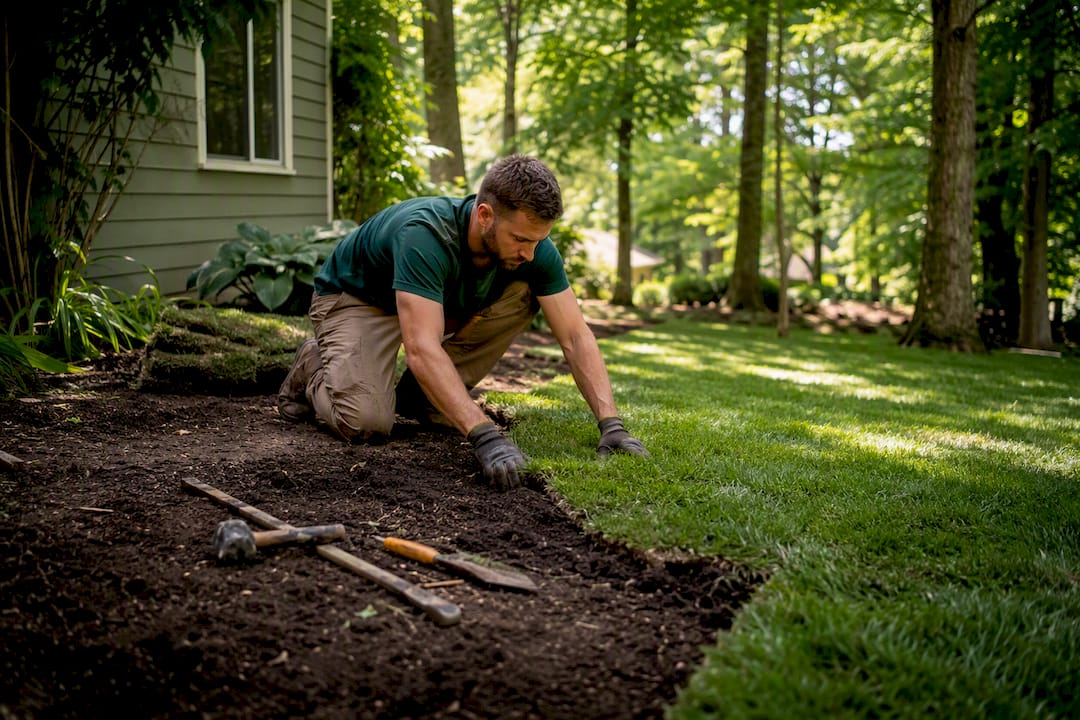
Turf for Shade: What Actually Grows and What Doesn’t
If your shaded area gets at least a few hours of direct sun, fine fescue or turf-type tall fescue can produce a workable lawn. Under that threshold, stop fighting the light and switch to groundcovers, mulch beds, or hardscaping instead. Rough bluegrass (Poa trivialis) is an option too, but only where the soil stays consistently moist and cool.
The short version, before you invest a weekend of labor:
- A few hours of direct sun daily: fine fescue blends or turf-type tall fescue, seeded or sodded.
- Consistently moist, cool, shaded soil: Poa trivialis, planted as its own patch rather than mixed in.
- Very limited sun or heavily shaded (about half or less open sunlight): skip turf entirely; groundcovers, mulch, or a hardscaped path will outperform and outlast any grass you plant there.
- Any shade situation: raise your mowing height, water less often but more deeply, and cut nitrogen roughly in half compared to your sunny lawn areas.
Key Takeaways
Shaded turf succeeds only when species choice, sunlight thresholds, and cultural practices align, and it fails whenever any one of those three is ignored.
| Point | Details |
|---|---|
| Check your light first | Measure direct sun hours; below 2 to 4 hours, plan for alternatives instead of turf. |
| Pick the right species | Fine fescue and turf-type tall fescue lead for shade; reserve Poa trivialis for consistently moist patches. |
| Adjust mowing and watering | Mow at 3.0 to 3.5 inches and water deeply but infrequently in the morning only. |
| Cut nitrogen | Fertilize shaded turf at roughly half the rate used on sunny lawn areas. |
| Know when to stop | Persistent root competition, moss, or thinning after repeated overseeding means it’s time for groundcovers, hardscape, or a professional sod installation from Trew Landscape LLC. |
Table of Contents
- Best Turf for Shade: Species and Seed Mixes That Actually Perform
- How to Test Your Yard for Shade Before You Plant
- How Maintenance Changes for Turf in Shaded Areas
- Seeding, Overseeding, and Sod for Shaded Lawns
- Ground Cover and Hardscape Alternatives When Shade Wins
- When to Call In a Landscaping Professional
- Common Pests and Diseases That Target Shaded Turf
- Long-Term Maintenance Challenges Unique to Shaded Turf
- How Seasonal Changes Affect Shaded Turf Performance
- Why “Right Plant, Right Place” Beats Wishful Reseeding
- Get Shade Turf Done Right the First Time
- Sources
- FAQ
Best Turf for Shade: Species and Seed Mixes That Actually Perform
Not all shade-tolerant turf is created equal, and picking the wrong species is the single most common reason homeowners give up on shaded lawns before they’ve given the grass a fair shot.
- Fine fescues (creeping red, Chewings, hard, and sheep fescue) top the list for shade tolerance among cool-season grasses. They handle low light and low fertility better than anything else you’ll plant, which is why they dominate most shade seed mixes sold at garden centers.
- Turf-type tall fescue trades a bit of shade tolerance for deeper roots and much better wear resistance. If your shaded spot doubles as a dog run or a shortcut to the garage, tall fescue holds up where fine fescue would thin out.
- Rough bluegrass (Poa trivialis) tolerates heavy shade about as well as fine fescue, but it demands consistently moist, cool soil and struggles in heat or drought. It also spreads aggressively by stolons, which is why extension agronomists recommend planting it as its own dedicated patch rather than blending it into a general mix.
- Shade-adapted Kentucky bluegrass cultivars can round out a mix for texture and self-repair, but they’re a minor player in true shade. Use them in small percentages, not as the backbone of a shaded lawn.
For deep but not total shade with reliable moisture, straight Poa trivialis in its own bed can outperform a blend. Warm-season grasses like Bermudagrass and Zoysiagrass are poor choices here no matter how the mix is marketed. Fine fescues rate highest for shade tolerance among cool-season species, while warm-season turf simply isn’t built for low light.
Sod gets you an established look overnight, but seed lets you tailor the exact species blend to your site. If you’re re-doing a shaded area from scratch, a sod installation with a shade-formulated blend skips months of thin, patchy establishment.
Pro Tip: *Don’t buy a generic “shade mix” without checking the label.
How to Test Your Yard for Shade Before You Plant
Before you buy a single bag of seed, spend fifteen minutes actually measuring what you’re working with.
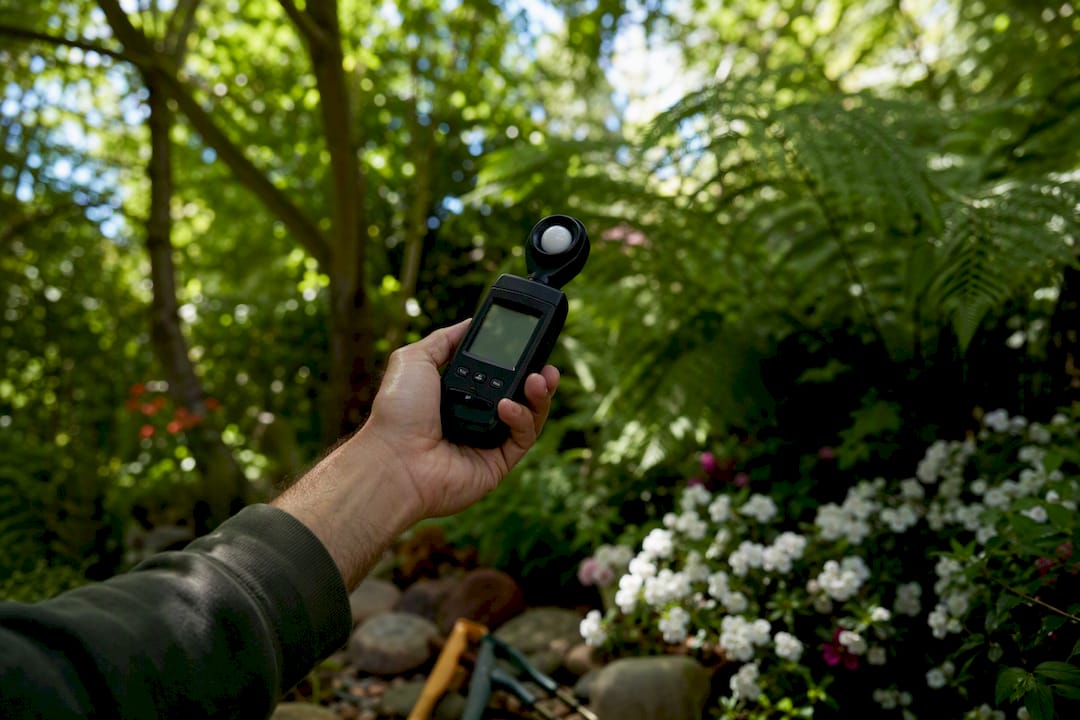
Track direct sunlight hours across a typical day in late spring, when tree canopies are full. Most shade-tolerant turf needs roughly 2 to 4 hours of direct sun to hold a decent stand, and dense canopies can block nearly 95% of summer sunlight, so an area that looks bright in March can turn nearly dark by July.
Distinguish deciduous shade (bright in winter, dark in summer) from evergreen shade (dark year-round). Deciduous shade under maples or oaks often supports a decent stand if you overseed in spring before leaf-out. Evergreen shade under pines or spruces rarely does.
Dig down 4 to 6 inches near the dripline of nearby trees. If you hit a mat of fine roots, you’re competing with the tree for water and nutrients, not just fighting for light. Check for standing water, moss, or compacted soil too.
- Proceed with shade turf if: you get 2+ hours of direct sun, root density is moderate, and drainage is decent.
- Choose alternatives if: sun is under 2 hours, roots are dense within the top 6 inches, or moss and standing water are already present.
How Maintenance Changes for Turf in Shaded Areas
Shaded turf isn’t sunny-lawn turf with less water. The whole cultural program shifts.
Mowing. Raise your deck to around 3.0 to 3.5 inches for shaded cool-season grass. Taller blades capture more of the limited light available for photosynthesis and push roots deeper, which helps turf compete with tree roots for moisture. Stick to the one-third rule: never remove more than a third of the blade height in a single cut, even if that means mowing more often during a growth spurt.
Watering. Water deeply and infrequently, early in the morning. Shaded soil holds moisture longer than sunny soil because evaporation is slower, so shaded turf on a full-sun irrigation schedule becomes a disease incubator thanks to reduced air circulation. Water only when the grass shows real stress, not on a fixed sunny-lawn timer.
Fertilizing. Cut nitrogen roughly in half compared to your sunny lawn. Heavy nitrogen pushes soft, leafy top growth at the expense of root development, and that soft growth is exactly what fungal disease loves. Use a slow-release formula and split it into smaller, more frequent applications.
- Prune lower tree limbs and thin the canopy to improve both light and airflow.
- Rake up fallen leaves promptly; a wet leaf mat smothers grass and feeds disease.
- Avoid evening watering entirely.
- Route foot traffic onto a stepping-stone path instead of across the thin turf.
Pro Tip: If you only make one change this season, raise your mower deck. It’s the cheapest fix and the one most homeowners skip.
Seeding, Overseeding, and Sod for Shaded Lawns
Timing determines whether shaded turf establishes or fails.
- Choose your window. Seed cool-season shade mixes in early spring before deciduous trees leaf out, or in early fall once summer heat breaks. Both windows give seedlings a head start before full canopy shade returns.
- Prep the site. Core-aerate compacted soil, test pH, and rake out thatch and old leaf litter so seed reaches bare soil.
- Seed at the right rate. A fine fescue and tall fescue blend typically goes down at 5 to 8 lb per 1,000 sq ft for overseeding, higher for bare-soil renovation.
- Decide sod versus seed. Sod establishes visible cover almost immediately and resists erosion better on slopes, but seed lets roots adapt directly to your soil. For larger shaded areas or tight timelines, professional sod installation removes most of the establishment risk. Spring overseeding while trees are still bare is generally the safer bet for thin, marginal shade.
Ground Cover and Hardscape Alternatives When Shade Wins
Some spots will never grow a decent lawn, and that’s not a maintenance failure. It’s physics.
- Pachysandra spreads into a dense, glossy carpet in deep shade and needs almost no upkeep once established.
- Liriope tolerates root competition better than turf and adds texture with strappy foliage and late-summer blooms.
- Ajuga and periwinkle (vinca) fill in fast and choke out most weeds on their own.
- Mulch beds under trees protect roots, suppress weeds, and cost far less over time than repeatedly reseeding failed turf.
- Stepping-stone paths or a small patio solve the traffic problem directly instead of asking grass to survive foot traffic it was never suited for.
When feeder-root competition is the real problem, replacing turf with a mulch or planting bed under the dripline is often the fix that actually sticks, rather than another round of reseeding.
When to Call In a Landscaping Professional
Some shaded lawns just need the right seed and a little patience. Others need equipment and expertise most homeowners don’t have on hand.
Call in help when the shaded area is large, when tree roots have taken over the top few inches of soil, when drainage problems keep resurfacing, or when you want a solution that lasts without another reseeding cycle next spring.
- Sod installation with shade-formulated blends for fast, reliable establishment
- Artificial turf installation for areas too dark for any living grass
- Landscape design that replaces struggling turf with groundcovers or hardscape
- Drainage correction and tree-root mitigation around problem areas
See our sod for shade guide or explore full sod installation services.
Common Pests and Diseases That Target Shaded Turf
Shade doesn’t just slow grass growth. It creates conditions that specific pests and diseases exploit.
Powdery mildew is the classic shaded-lawn disease, coating blades in a white or gray dust that blocks what little light the grass is already getting. It thrives on Kentucky bluegrass in low-light, poor-airflow spots and rarely shows up in full sun.
Brown patch and other fungal diseases spread fastest where moisture lingers on the leaf surface overnight, which is exactly what happens in shaded areas with restricted airflow. Evening watering is the single biggest trigger you control directly.
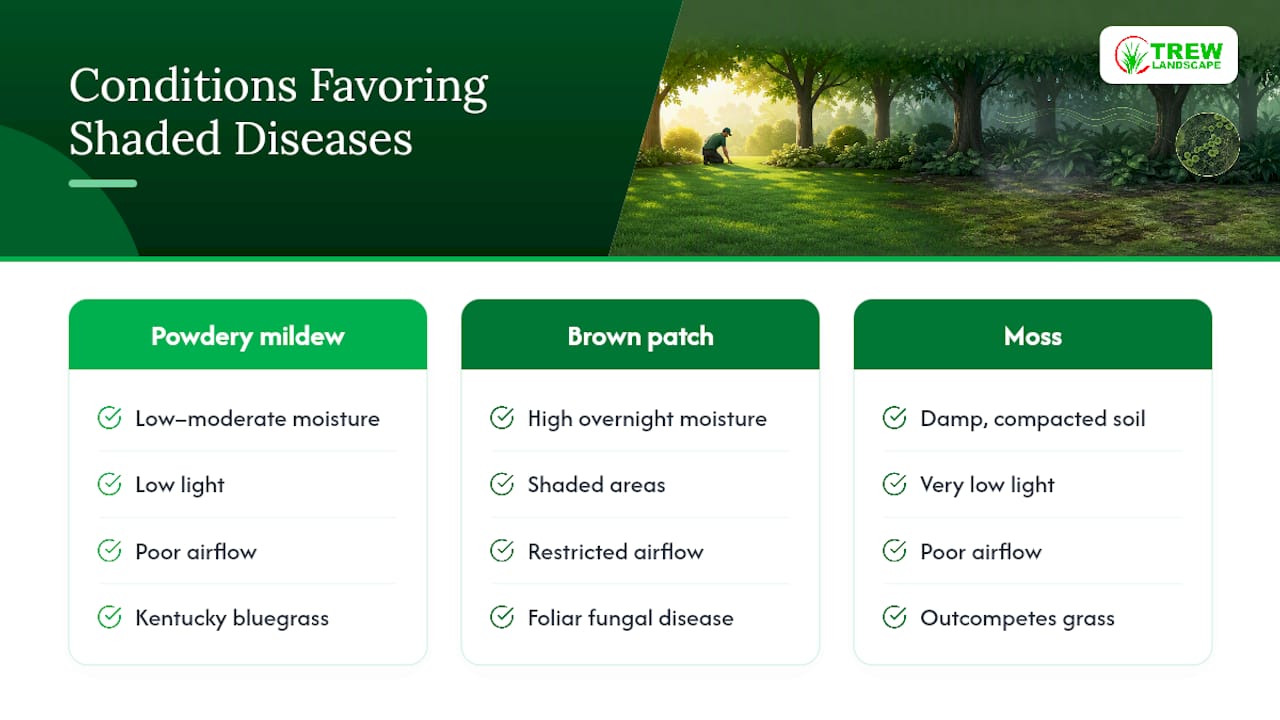
Moss isn’t technically a turf disease, but its spread signals the same underlying conditions: compacted, damp, acidic soil with too little light for grass to outcompete it. Once moss dominates a patch, adding more seed rarely fixes it. The soil chemistry and light level need to change first.
Slugs and grubs tend to concentrate in shaded, moist turf more than sunny lawn because the environment favors them year round. Thin, stressed grass gives them less resistance too, compounding the damage.
Managing all of this comes back to the same cultural playbook: prune for airflow, water in the morning only, keep nitrogen low, and rake leaves off the surface before they mat down and trap moisture. Treating the symptom with a fungicide without fixing the light and airflow problem underneath just buys you a few more weeks before the same issue returns.
Long-Term Maintenance Challenges Unique to Shaded Turf
Shaded turf doesn’t fail once. It erodes gradually, which is what makes it so frustrating to manage.
Trees grow. A canopy that let through 4 hours of sun five years ago might let through 2 hours today, and the turf underneath thins in step with that change even if your maintenance routine hasn’t slipped at all. This is the single most overlooked long-term issue: homeowners blame their fertilizer or watering schedule when the real culprit is a maple that’s simply gotten bigger.
Root competition compounds over time too. As tree roots mature, they claim more of the same soil volume the turf needs for water and nutrients, which is why a shaded lawn that looked fine at year three can be bare by year seven even with identical care.
The realistic long-term strategy is annual or biennial overseeding to replace grass that thins from age, disease, or increasing shade, paired with periodic reassessment of the site itself. If overseeding stops producing results after two or three seasons, that’s your signal the light has dropped below what any turf species can use, not a sign you need a different seed blend.
How Seasonal Changes Affect Shaded Turf Performance
Shaded lawns behave differently through the year than sunny ones, and the swings are often more extreme.
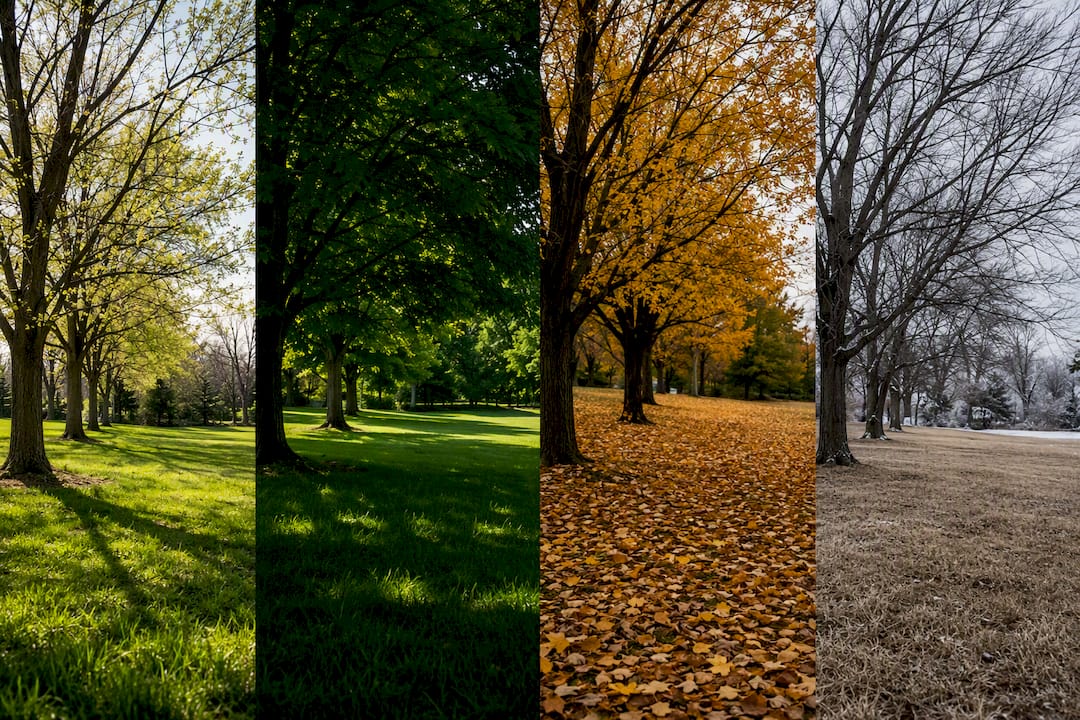
Spring is the best window for shaded turf, especially under deciduous trees still bare from winter. Cool temperatures and full light before leaf-out give grass its best growth spurt of the year, and it’s the ideal time to overseed thin spots.
Summer is when shaded lawns face their toughest test. Full canopy cover cuts light dramatically just as heat and humidity spike disease pressure, so growth slows even as fungal risk rises.
Fall brings a second growth window as temperatures cool and, for deciduous shade, light gradually increases again as leaves drop. This is prime overseeding season in most cool-season regions.
Winter shade patterns reset, and evergreen shade becomes the dominant constraint since deciduous trees no longer block light at all.
Why “Right Plant, Right Place” Beats Wishful Reseeding
Most shaded-lawn advice online treats every bare patch as a fertilizer or seed problem. It usually isn’t. The research consistently points to light and root competition as the real drivers, and no amount of premium seed fixes a spot that gets 90 minutes of dappled sun under a mature oak.
What gets underestimated is how much a single pruning session changes the equation. Raising a canopy and thinning crowded limbs often does more for a struggling lawn than any product you could buy, because it attacks the actual constraint instead of masking it. Homeowners skip this step constantly because it feels less direct than buying a bag of seed.
The advice that actually holds up is boring but effective: measure your light honestly, match the species to the reality of your site, adjust mowing and watering specifically for shade, and set a real deadline for switching to groundcovers or hardscape if two seasons of proper care don’t produce results. Chasing a lawn that the site will never support wastes money and delays a better solution.
— Trew Landscape LLC
Get Shade Turf Done Right the First Time
Trying three seed blends over three summers costs more in time and frustration than getting the site evaluated once. Trew Landscape LLC handles the part homeowners usually get wrong: matching the actual sunlight and root conditions on your property to the right solution, whether that’s a shade-formulated sod blend, artificial turf for the darkest corners, or a redesigned bed that replaces turf altogether.

Our crews install sod, manage root and drainage issues that undercut DIY seeding attempts, and build out landscape design solutions when the honest answer is that turf was never going to work in a given spot. If you’ve already tried reseeding a shaded patch twice with no luck, that’s usually the clearest sign it’s time for a site visit rather than a third bag of seed. Request a quote for sod installation and get a straight answer on whether your shaded area is a turf project or a design project.
Sources
- Selecting and managing lawn grasses for shade — NC State Extension
- Improving lawns in the shade — Purdue Extension
- Lawns in shady areas — UNL Lancaster County
- Growing turf under shaded conditions — Penn State Extension
FAQ
What Is the Best Grass Alternative for Shady Areas?
Groundcovers like pachysandra, liriope, and ajuga, along with mulch beds and hardscaping, outperform turf once an area gets less than 2 hours of direct sun or has heavy tree root competition.
Can You Grow Grass in 100% Shade?
No species reliably grows in total, dense shade; even the most shade-tolerant fine fescues need roughly 2 hours of direct sun to form a fair stand.
What Type of Grass Is Best for a Shaded Lawn?
Fine fescue blends are the top choice for most shaded lawns, with turf-type tall fescue as a durable option where the area gets moderate shade and foot traffic.
What Grass Requires the Least Amount of Sunlight?
Fine fescues, including creeping red and Chewings fescue, tolerate the lowest light levels of any common turf species, though they still need some direct sun to survive long term.