
Trew Landscape Blog
Installers: Commercial Christmas Light Ideas That Meet Code and Last
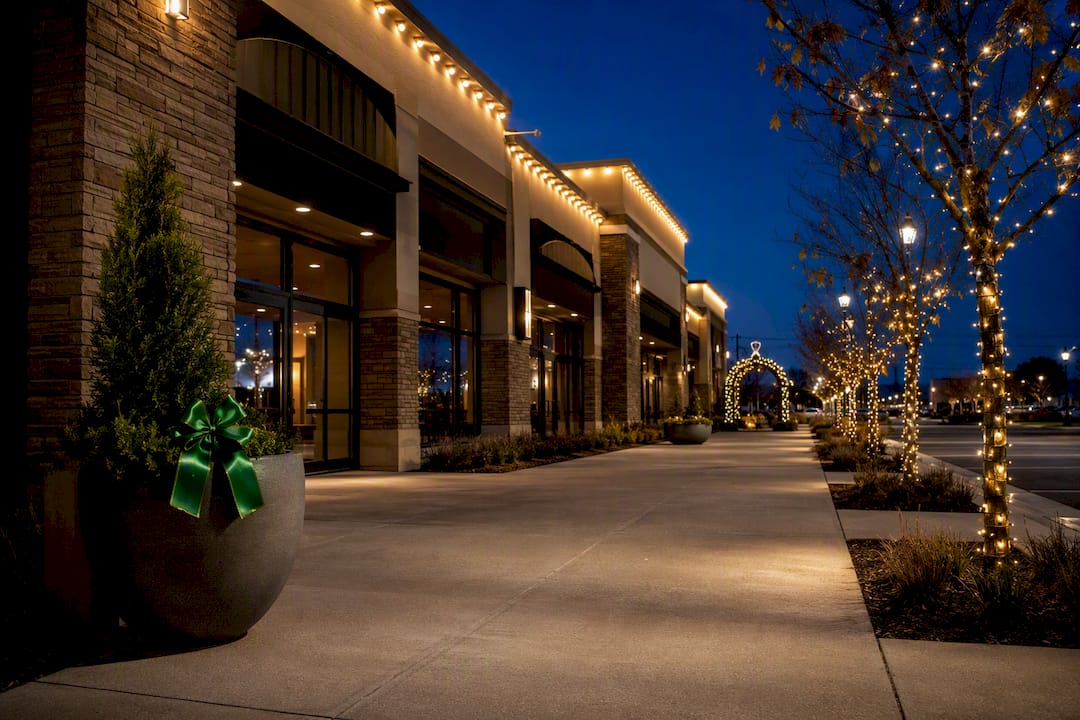
Installers: Commercial Christmas Light Ideas That Meet Code and Last ! Commercial plaza with illuminated roofline and arch The best approach to commercial Christmas lighting pairs weatherproof, commercial-grade LEDs and sculptures with electrical planning that satisfies code from day one.
Installers: Commercial Christmas Light Ideas That Meet Code and Last
The best approach to commercial Christmas lighting pairs weatherproof, commercial-grade LEDs and sculptures with electrical planning that satisfies code from day one. That means IP65+ fixtures, sealed connectors, and a written load calculation before anyone touches a breaker. Skip the retail aisle entirely. The display ideas below only work long term when the mounting, wiring, and permitting behind them are done right.
TL;DR:
- Only IP65-rated fixtures and sealed connectors ensure long-term durability in harsh weather conditions.
- Load calculations must be documented and kept in compliance with electrical codes to avoid safety issues and fines.
- Retrofit light lines with socket infrastructure are more cost-effective and easier to maintain over multiple seasons than replacing entire strings.
- Proper mounting with manufacturer-approved clips and ballast weights prevents damage from wind and reduces liability risks.
- Professional installation offers comprehensive design, electrical planning, and certification that DIY may not safely or legally provide.
Table of Contents
- Commercial Christmas Light Ideas Worth Your Budget
- Commercial-Grade Products and the Specs That Actually Matter
- Mounting and Structural Practices That Protect the Building
- Electrical Planning, Load Calculations, and Code Compliance
- Maintenance, Testing, and the Takedown Plan
- Budgeting, Procurement, and Scheduling for Commercial Displays
- What a Professional Lighting Scope Should Include
- Permitting and Local Ordinance Compliance
- Professional Installation vs. DIY: How to Evaluate the Choice
- How Holiday Lighting Shapes Branding and Customer Engagement
- Energy Efficiency and Sustainability in Commercial Lighting
- Design Themes That Work for Commercial Properties
- What Most Commercial Lighting Advice Gets Wrong
- Get a Quote for Commercial Holiday Lighting
- Sources
- FAQ
Commercial Christmas Light Ideas Worth Your Budget
Not every display concept earns its cost on a commercial property. These are the ones that consistently deliver visibility, durability, and repeat-season value across facades, plazas, and parking areas.
- Facade and roofline outlines with retrofit C9 or LED rope. Retrofit runs let installers custom-fit the exact roofline geometry instead of forcing a standard string to fit, which matters on buildings with irregular fascia or multiple rooflines.
- Large LED sculptures as plaza anchors. A single oversized reindeer, tree, or ornament near an entrance becomes the photo-op that drives foot traffic and social shares, especially at retail centers and hotel entrances.
- Pole-mounted silhouettes and banners along streetscapes. These read clearly at driving speed, which makes them the right call for road-facing frontage and parking-lot perimeters where pedestrians rarely linger.
- Canopy and tunnel installations over walkways. Overhead light tunnels turn a plain path into an experience, and they work especially well at building entries, courtyard walkways, and event plazas.
- Tree wraps and perimeter pole wraps for consistency. Wrapping every tree and light pole along a property line creates visual rhythm and doubles as wayfinding for visitors moving between lots or buildings.
- Light curtains on storefronts and window lines. These add density and sparkle to flat facades without the structural load of sculptures, ideal for strip retail and office storefronts.
Match the concept to the zone. Facades and window lines suit retail storefronts. Pole wraps and silhouettes suit parking lots and road frontage. Sculptures and tunnels suit plazas and entrances where people walk slowly enough to notice detail.
Commercial-Grade Products and the Specs That Actually Matter
C9 bulbs give you the boldest, most traditional roofline look and typically run higher wattage per bulb than C7 or mini lights, which trade brightness for a subtler, denser glow. Wide-angle LED lenses spread light further per fixture, useful for covering large facade runs without doubling your bulb count.
The rating that separates a display that survives January ice storms from one that fails in week two is the IP rating. Installers’ guides on outdoor Christmas lighting note that IP44 is common on retail-grade product but frequently inadequate for exposed commercial fixtures, while IP65 and above holds up under direct rain, sleet, and standing water.
Specs to check before you buy or specify anything:
- IP65 or higher on any fixture with direct weather exposure
- Sealed, threaded O-ring connectors rather than snap-fit retail plugs
- SPT2-rated cord on key runs, not the thinner SPT1 wire found in big-box sets
- Manufacturer-marked maximum wattage per run, especially on series-connected strings
Pro Tip: Commercial LED fixtures often last 25,000 to 75,000 hours and use roughly 80% less energy than incandescent sets, according to CPSC guidance on seasonal and decorative lighting products. A retail incandescent string lasting one to three seasons is not a bargain once you count the labor to replace it.
Retrofit light line with empty sockets is often the smarter roofline choice for exactly this reason. You buy the socket infrastructure once and swap bulbs as needed instead of discarding entire strings.
Mounting and Structural Practices That Protect the Building
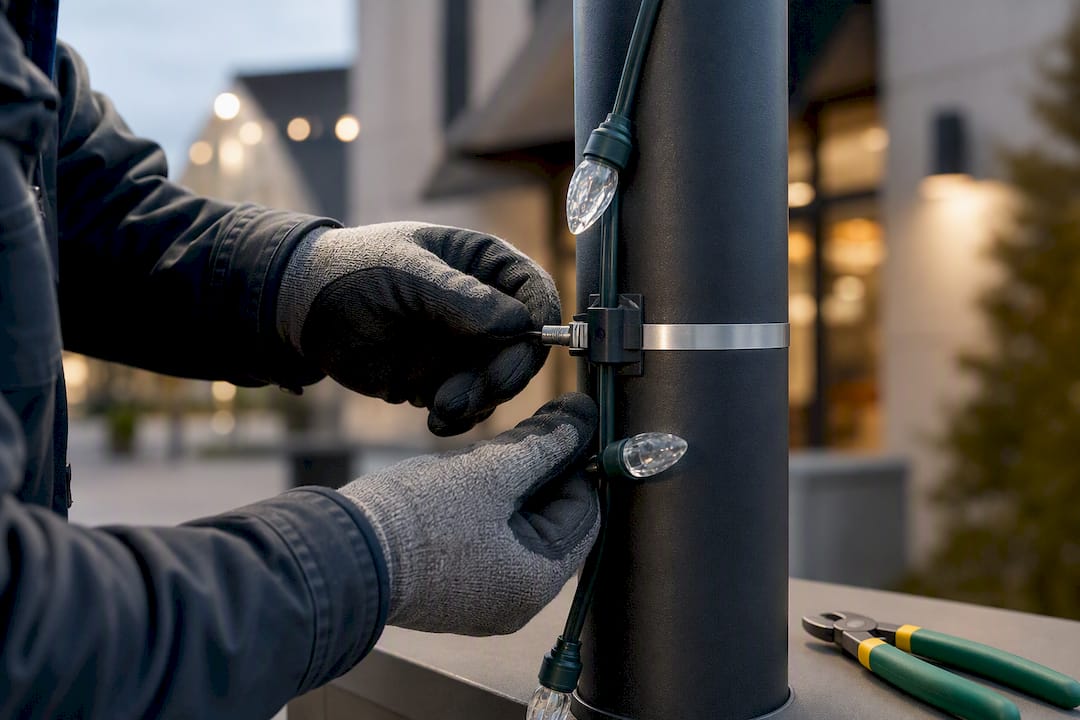
Every mounting decision on a commercial job doubles as a liability decision. Use manufacturer-approved clips rated for the specific gutter, fascia, or pole profile on your building, and secure pole-mounted pieces with stainless-steel banding rather than nails, staples, or zip ties directly through wire insulation.
Wind load is the factor most installers underestimate on large freestanding sculptures. A flat-surface piece like a lit archway or oversized ornament catches wind like a sail, and it commonly needs real ballast weight or engineered ground anchors to stay upright through a winter storm. When a location gets consistent wind exposure, reducing the sculpture’s footprint or adding non-penetrating roof anchors beats fighting the wind with weight alone.
Keep every mounting point clear of:
- Sprinkler heads and irrigation lines
- Emergency exits, fire lanes, and exit signage
- Illuminated signs where cords could obscure visibility
Pro Tip: Photograph and log every attachment point, clip type, and hardware spec as you install. That documentation is what an insurance adjuster or building inspector asks for first, and it saves hours if a piece needs adjustment mid-season.
Electrical Planning, Load Calculations, and Code Compliance
Run the math before you plug anything in. Total watts divided by 120 volts gives you amps, and the load on any circuit should stay under 80% of breaker capacity. Here’s the checklist:
- Add up total wattage across every fixture, sculpture, and string on a planned circuit.
- Divide by 120 to get amp draw, then confirm that figure stays under 80% of the breaker’s rated capacity.
- Route all outdoor runs through GFCI-protected circuits or breakers. CPSC’s guidance on seasonal and decorative lighting flags GFCI protection as essential for outdoor electrical connections.
- Never series-connect retail strings beyond the manufacturer’s marked maximum, and observe overcurrent protection requirements on every run.
- File a written load calculation in the job folder before inspection.
Standards updates to UL 588 have revised conductor sizing and maximum wattage limits for seasonal products, so check current product markings rather than relying on last year’s spec sheet, according to Intertek’s UL 588 standards update summary. Local fire marshals frequently review larger commercial displays, and fire-code compliance guidance for property managers recommends keeping every fixture clear of emergency equipment and documenting your load calculation and mounting method in case of inspection. Our own electrical safety checklist for outdoor Christmas lighting walks through the same load math in more detail.
Maintenance, Testing, and the Takedown Plan
A display that looks perfect on install day still needs eyes on it through January. Walk the property regularly checking for loose fasteners, cracked sockets, and any sign of water intrusion in connectors. After every major storm, test timers, photocells, and any centralized controllers before assuming the display still works.
Takedown deserves the same discipline as installation:
- Let everything dry completely before boxing it, since damp storage is the leading cause of connector corrosion by next season
- Label every run by zone so reinstallation next year doesn’t start from scratch
- Inventory bulbs, connectors, and hardware against your original count
- Store sculptures and light line in climate-aware racks or bins, not a damp basement corner
A short post-install report with a maintenance schedule gives the property manager a record of what’s installed, where, and when it needs attention. See our Christmas light installation safety checklist for a fuller maintenance rundown.
Budgeting, Procurement, and Scheduling for Commercial Displays
Custom sculptures and bulk commercial orders need to lead time measured in weeks, not days. Plan procurement in late summer if you want anything custom-fabricated for the season.
- Order early. Custom pieces and large bulk C9 or rope-light runs routinely have multi-week production and shipping windows.
- Buy from direct manufacturers or established B2B commercial suppliers rather than retail channels, and keep spare connectors and controller modules on hand for field repairs.
- Weigh reuse ROI. Commercial-grade fixtures and sculptures built for multi-season redeployment cost more upfront but spread that cost across several years instead of one.
- Schedule installation crews before the residential rush hits, since equipment and labor both get harder to secure once the season’s underway. Our per-foot cost guide breaks down typical budget ranges by scope.
What a Professional Lighting Scope Should Include
A professional commercial holiday lighting service approaches the project as a full scope, not a one-time install: design, installation, seasonal maintenance, takedown, and code-backed electrical guidance from the first walkthrough. A proposal worth signing spells out the zone plan, who’s responsible for what, the maintenance window through the season, and a post-install report documenting mounting points and load calculations for your records.
Permitting and Local Ordinance Compliance
Electrical code is only part of what governs a commercial display. Many municipalities regulate signage brightness, hours of illumination, and even the footprint of temporary structures like sculptures or arches placed on public-facing property. A display that meets every electrical code requirement can still draw a citation if it violates a local sign ordinance or a homeowner association’s exterior lighting rule.
Larger installations, particularly anything spanning multiple buildings or a shared plaza, commonly trigger fire marshal review. Fire-code compliance guidance notes that contractors should expect inspection on bigger jobs and should document load calculations and mounting methods in advance rather than scrambling after a request. Some jurisdictions also require a temporary structure permit for freestanding sculptures or arches over a certain height or footprint, separate from any electrical permit.
Before locking a design, property managers should check three things with their local building or fire department: whether the display size or wattage triggers a permit requirement, whether there’s a curfew on illumination hours (common near residential zones), and whether temporary structures need separate sign-off. None of this is difficult to clear, but it has to happen before installation, not after a neighbor complains or an inspector walks the lot. Building that lead time into your project calendar avoids a last-minute teardown.
Professional Installation vs. DIY: How to Evaluate the Choice
DIY makes sense for a small storefront with a single roofline run and a facilities team comfortable on a ladder. It stops making sense once you’re dealing with multiple buildings, sculptures with real wind exposure, or any circuit calculation more complex than plugging one string into one outlet.
Evaluate the decision on four criteria: scale, structural complexity, code exposure, and labor cost of your own team’s time. A property with one facade and a low sightline can often be handled internally with commercial-grade product and a basic load check. A property with pole-mounted pieces, freestanding sculptures, or multiple electrical circuits needs someone who calculates loads for a living and carries the liability if a fastener fails in a windstorm.
The math usually favors professional installation once a facilities team’s hourly cost, ladder and lift access, and the risk of a failed anchor or overloaded circuit get factored in. A professional crew also brings fall-protection equipment and OSHA-aware ladder practices that most internal maintenance teams aren’t equipped to bring to a rooftop job in December. If your property falls anywhere near the complexity threshold above, get a proposal before committing internal labor. Trew Landscape LLC’s Christmas Light Installation service handles that evaluation as part of the initial site walk.
How Holiday Lighting Shapes Branding and Customer Engagement
A well-executed display becomes free marketing every single night it’s lit. Retail centers, hotels, and office campuses that invest in a strong entrance anchor, whether that’s a sculpture, a lit archway, or a dense tunnel walkway, give visitors a reason to stop, photograph, and share the space. That kind of organic visibility costs nothing beyond the install.
Consistency matters as much as spectacle. A property with a coherent lighting theme across every building and pole reads as maintained and intentional, while mismatched colors and inconsistent brightness read as neglected, even when the underlying business is thriving. Commercial property groups increasingly treat seasonal exterior lighting as part of their overall tenant and visitor experience strategy, not an afterthought bolted on in November.
The branding effect compounds at multi-tenant properties. A retail center that lights its shared plaza well benefits every storefront in it, while a property that skips lighting altogether puts every tenant at a visible disadvantage against neighboring centers that do it right. For hospitality and office properties, a strong entrance display signals attention to detail before a visitor ever walks through the door, which shapes first impressions long before anyone speaks to staff.
Energy Efficiency and Sustainability in Commercial Lighting
Switching a commercial property from incandescent to LED holiday lighting is one of the simplest sustainability wins available in facilities management. Pro-grade LED fixtures use roughly 80% less energy than traditional incandescent bulbs, according to CPSC’s lighting product guidance, which matters directly on a property running dozens or hundreds of fixtures across multiple buildings for six to eight weeks straight.
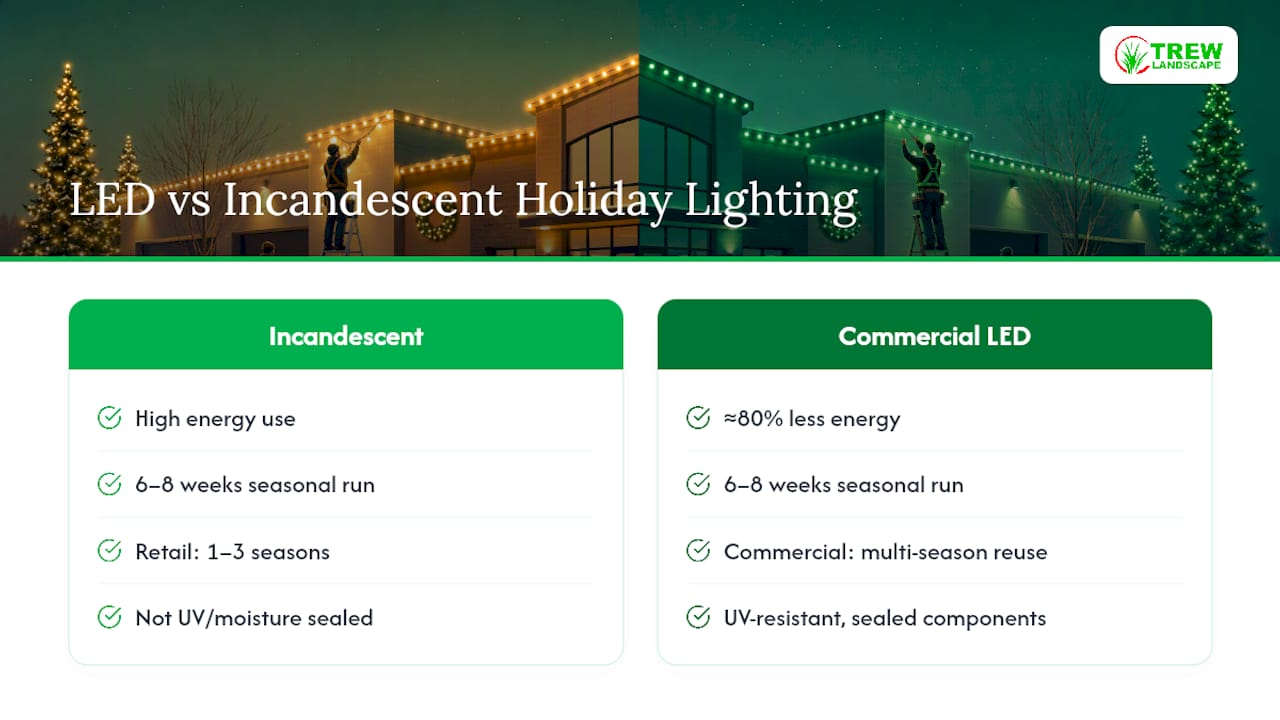
The sustainability case goes beyond the electric bill. Commercial-grade fixtures built for multi-season reuse mean less seasonal waste going into landfills every January, unlike retail strings that typically die after one to three seasons and get discarded outright. Specifying UV-resistant, sealed components at purchase extends that reuse window further, since sun and moisture damage are what typically end a fixture’s life before the LEDs themselves fail.
Timers and photocells add a second layer of efficiency by limiting illumination to actual dark hours instead of running fixtures around the clock. Pairing that with a documented maintenance plan, so failed components get replaced rather than the whole run getting swapped out, keeps both energy use and waste down over the life of a commercial lighting investment.
Design Themes That Work for Commercial Properties
Commercial displays succeed when the theme matches the property’s traffic pattern and brand tone rather than chasing every trend at once. A “winter wonderland” theme built around white and cool-blue LEDs, tree wraps, and light curtains reads as upscale and works well for hotels, medical offices, and professional campuses aiming for understated elegance. A traditional red-and-green C9 theme with bold rooflines and a large sculpture anchor reads as festive and family-friendly, better suited to retail centers and restaurants where energy and warmth drive foot traffic.
Mixed-use and multi-tenant properties often do best with a modular theme: consistent pole wraps and facade outlines as the baseline, with a single standout sculpture or tunnel at the primary entrance as the anchor piece. That approach, described in planning guidance for mixed-use holiday lighting, keeps costs predictable across a large footprint while still giving the property one memorable focal point worth photographing.
Whatever theme gets chosen, consistency across every building and pole on the property matters more than any single flashy element. A single stunning sculpture next to three mismatched, half-lit facades undercuts the whole investment. Our landscape lighting placement guide covers the same spacing and visibility principles that apply to permanent fixtures, and they translate directly to seasonal display planning.
What Most Commercial Lighting Advice Gets Wrong
Most guides to commercial Christmas lighting spend all their energy on the visual concepts and treat code compliance as a footnote. That ordering is backwards. The sculptures and facade outlines are the easy part. What actually determines whether a display survives the season without an incident, a fine, or a failed inspection is the load calculation nobody wants to sit down and do.
The conventional advice to “buy commercial-grade and you’re covered” is also incomplete. Commercial-grade product reduces risk, but a sealed IP65 connector on an overloaded circuit is still a fire hazard. Product quality and electrical planning are two separate problems, and a property manager needs both solved, not just the one that’s easier to shop for.
If there’s one place to spend the most attention, it’s documentation. A written zone plan, a filed load calculation, and a maintenance schedule turn a seasonal decoration project into something closer to a professional building system, which is exactly how fire marshals and insurance adjusters will judge it if anything goes wrong. Skip that step and even the best-looking display is a liability wearing string lights.
— Trew Landscape LLC
Get a Quote for Commercial Holiday Lighting
Professional commercial Christmas lighting services typically include full scope offerings: design, professional installation, seasonal maintenance, and takedown, backed by load-calculation and code-compliance standards similar to those covered above.

Rather than guessing at wattage limits or hunting for IP65 connectors on your own, a property manager gets a site walk, a zone plan, and a documented electrical plan before a single fixture goes up. That’s the gap between a display that looks good in a photo and one that survives an actual Kansas City winter without a callback. Request a quote or schedule a site consultation through Trew Landscape LLC’s Christmas Light Installation page, and get your property on the install calendar before the residential rush claims the crews.
Sources
- CPSC guidance on seasonal and decorative lighting products
- Holiday Light Installation and Fire Code Compliance
- UL 588 seasonal and holiday decorative products — standards update summary
FAQ
What Are the Latest Trends in Commercial Christmas Lights?
Warm and cool-white LED sculptures paired with immersive tunnel walkways are leading commercial displays right now, alongside a shift toward IP65-rated retrofit systems that let properties reuse the same infrastructure for years instead of replacing strings annually.
Where Can I Get Commercial-Grade Christmas Lights?
Source them from direct manufacturers or established B2B commercial lighting suppliers rather than retail stores, since commercial fixtures need SPT2 cord, sealed connectors, and IP65+ ratings that retail sets rarely carry. Trew Landscape LLC sources and installs commercial-grade product as part of its Christmas Light Installation service.
How Do You Make Christmas Lights Look Professional?
Consistency across every facade and pole matters more than any single dramatic piece. Use retrofit C9 or LED rope for clean roofline runs, anchor entrances with one strong sculpture, and keep color temperature and brightness matched across the whole property.
What Are the Latest Trends in Commercial Lighting Overall?
Beyond the holiday season, commercial exterior lighting is trending toward LED retrofits and smart timer or photocell controls that cut energy use while extending fixture life, a shift documented in CPSC’s guidance on seasonal and decorative lighting.
How Much Does Commercial Christmas Light Installation Cost?
Pricing depends on square footage, roofline length, and design complexity, so current rates are listed directly on Trew Landscape LLC’s Christmas Light Installation page rather than as a flat figure here.